
Every packaging project starts with a conversation, and every conversation starts with vocabulary. When a supplier says "your MOQ is 1,000 at FOB," or "this box needs a 300 GSM SBS board with a spot UV logo," the words carry real cost and schedule implications. Misreading one term can mean comparing the wrong quotes, ordering the wrong material, or approving a dieline that does not fit your product.
This guide explains the 15 packaging terms that come up in almost every custom box project — what each one means, why it matters to you, and where to go for the full detail. Use it as your reference when you read quotes, review samples, or brief your packaging team.

The 15 Terms at a Glance
| Term | Quick Meaning | Why It Matters |
|---|---|---|
| MOQ | Minimum order quantity | Sets the entry cost of a project |
| FOB | Free On Board | Defines who pays freight and when risk transfers |
| DDP | Delivered Duty Paid | One all-in delivered price, duty included |
| GSM | Grams per square meter | Paper weight and rigidity |
| Greyboard | Thick recycled board core | The structure inside rigid boxes |
| SBS | Solid Bleached Sulfate | Bright-white premium paperboard |
| ECT | Edge Crush Test | Corrugated box strength rating |
| CMYK | Four-color print process | How full-color packaging is printed |
| Pantone | Spot color matching system | Exact brand color reproduction |
| Spot UV | Highlighted glossy coating | Draws attention to specific graphics |
| Foil stamping | Metallic film applied with heat | Premium logo and detail effect |
| Soft-touch lamination | Velvety matte coating | Luxury hand-feel finish |
| Dieline | Box cutting and folding template | The production blueprint |
| Box insert | Internal product-holding structure | Protection and premium layout |
| EVA foam | Firm closed-cell insert foam | Precision product cavities |
Ordering and Shipping Terms
These three terms decide the price you actually pay and the schedule you actually get.
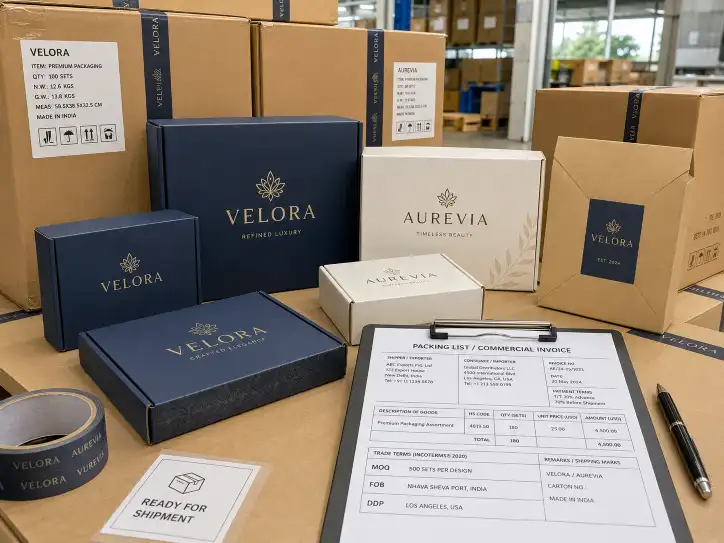
1. MOQ (Minimum Order Quantity)
MOQ is the smallest number of identical boxes a factory will produce in one order. It exists because every run has fixed setup costs — dies, print plates, and machine setup — that need a minimum quantity to absorb. Know the MOQ before you fall in love with a design, because it sets the floor for your budget. For how MOQs vary by box type and how to lower yours, see our minimum order quantity guide.
2. FOB (Free On Board)
Under FOB, the supplier's responsibility ends when the goods are loaded on the vessel at the origin port. From that point, you pay and arrange the ocean freight, insurance, and import clearance. FOB gives you control and usually the lowest freight rate, but it puts the logistics work on you. It is the default term for sea shipments from China.
3. DDP (Delivered Duty Paid)
Under DDP, the supplier arranges freight, insurance, import clearance, and duty, and delivers to your door at one all-in price. It is the simplest term for first-time importers and small courier orders. The trade-off is less control over the freight. For the full FOB vs DDP comparison, see our shipping incoterms guide.
Material Terms
Material vocabulary decides how the box feels, how strong it is, and how it prints.
4. GSM (Grams per Square Meter)
GSM measures paper weight: the weight of one square meter of the sheet. Higher GSM means heavier, thicker, and more rigid paper. Folding cartons typically run 250–400 GSM, rigid box wrapping paper 120–180 GSM, and tissue as light as 17–30 GSM. The right GSM balances rigidity, print quality, and cost. Our custom packaging materials guide has the full GSM comparison tables.
5. Greyboard
Greyboard is the thick, dense, recycled board that forms the core of a rigid box — typically 1.5 to 2.5 mm. It is not used alone; it is wrapped with printed paper, leatherette, or fabric to become the finished premium box. Greyboard quality determines edge sharpness and structural feel. For how it combines with wraps and finishes, see our luxury rigid gift box materials guide.
6. SBS (Solid Bleached Sulfate)
SBS is a premium paperboard grade made from virgin bleached pulp, giving a bright white surface that prints cleanly and vividly. It is the go-to for luxury cosmetics, food, and any packaging where print color matters most. It sits at the higher end of the paperboard cost scale.
7. ECT (Edge Crush Test)
ECT is the standard measure of corrugated board strength — how much force the board edge resists before crushing. A higher ECT means a stronger, more stackable box. It matters for shipping and ecommerce packaging, where the box carries weight and survives handling. For strength ratings and when to use them, see our custom corrugated boxes guide.

Printing and Finishing Terms
These terms describe how artwork becomes a finished surface.
8. CMYK
CMYK is the four-color printing process — cyan, magenta, yellow, and black — that reproduces full-color artwork on packaging. Files for offset printing should be supplied in CMYK rather than RGB, so the printed colors match the design. For how CMYK, Pantone, and digital printing compare, see our box printing methods guide.
9. Pantone
Pantone is the spot color matching system used to reproduce brand colors exactly. A Pantone reference (for example, Pantone 286C) lets the printer match your logo color to a defined standard instead of relying on a four-color approximation. It is the standard way to brief a logo color on packaging.
10. Spot UV
Spot UV is a glossy, high-gloss coating applied to selected areas of a printed surface — a logo, a product image, or a text line — while the rest of the box stays matte. The contrast draws the eye. It is a cost-effective way to add a premium touch without full lamination.
11. Foil Stamping
Foil stamping presses a metallic film onto the surface using heat and pressure, adding a reflective logo or detail in gold, silver, rose gold, or holographic finishes. It is one of the strongest premium signals in gift packaging. For the full process and design rules, see our foil stamping guide.
12. Soft-Touch Lamination
Soft-touch lamination applies a matte, velvety coating that feels smooth and premium in the hand. It is the finish most associated with luxury rigid boxes, and it pairs well with foil and spot UV for contrast. For when to use it and how it compares to gloss, see our soft touch coating guide.

Structure and Component Terms
These terms describe how the box is engineered and what holds the product inside.
13. Dieline
A dieline is the technical template that defines every cut, fold, and crease of a box — the production blueprint for its shape. Artwork is built onto the dieline, and accuracy here determines whether the box assembles correctly. For how to prepare one, see our dielines for print guide.
14. Box Insert
A box insert is the internal structure that holds products in place — made from paperboard, corrugated board, foam, or molded pulp. It protects the product and creates the organized, premium layout inside a gift set. For the full range of insert types, see our custom box inserts guide.
15. EVA Foam
EVA foam is a firm, closed-cell foam used for precision insert cavities — it holds jewelry, cosmetics, and electronics exactly in place and resists moisture. Its softer counterpart, PU foam, cushions fragile items instead. For the material-by-material decision, see our EVA foam vs PU foam comparison.
How to Use This Glossary
The fastest way to put this vocabulary to work is to read a quote with these terms in hand. When a number looks surprising, check which term it is attached to: a low FOB price may become a normal DDP price once freight and duty are added, and a low unit price may depend on a MOQ you cannot meet.
For the full buying workflow that uses all of these terms — specification, RFQ, samples, and production — our step-by-step sourcing guide walks through each stage, and our custom packaging cost guide translates the terms into a budget.
FAQ
What does MOQ mean in packaging?
MOQ stands for minimum order quantity — the smallest number of boxes a factory will produce in one order. It exists because every run has fixed setup costs, and it determines the entry cost of a custom packaging project.
What is GSM in paper and packaging?
GSM means grams per square meter and measures paper weight. Higher GSM means heavier, thicker, more rigid paper. Folding cartons typically use 250–400 GSM, while wrapping paper for rigid boxes runs 120–180 GSM.
What is the difference between FOB and DDP?
Under FOB, the buyer pays and arranges freight and import after goods are loaded at the origin port. Under DDP, the seller pays freight, insurance, duty, and delivery to the buyer's door. FOB offers more control; DDP offers a fixed all-in price.
What is greyboard used for?
Greyboard is the thick recycled board core of rigid boxes, typically 1.5–2.5 mm, wrapped with printed paper or fabric to form a premium box. Its density determines the box's structural feel and edge sharpness.
What is a dieline in packaging?
A dieline is the technical template showing every cut, fold, and crease of a box. It is the blueprint for production, and artwork is built onto it, so its accuracy determines whether the box assembles correctly.
Conclusion
Packaging terminology is not jargon for its own sake — every term on this list maps to a cost, a material decision, or a shipping obligation in your next order. Learn the five that affect your project most, and you will compare quotes fairly, brief suppliers clearly, and avoid the surprises that come from misreading a term. Keep this glossary as your reference and follow the linked guides when you need the full depth.
For authoritative reference, the color printing standards used across the packaging industry are published by the International Organization for Standardization (ISO 12647), and the PMMI publishes practical packaging industry data. When you are ready to put this vocabulary into practice, send your product details to our packaging team — we will respond with a clear spec, a sample plan, and a quote you can read term by term.

