
MOQ — minimum order quantity — is the smallest number of units a packaging factory will produce in one order. It is the first number that stops a project: your brand needs 300 boxes for a test launch, the supplier quotes 1,000, and the conversation stalls before it starts.
The reason MOQ exists is not greed. Packaging production has fixed setup costs — dies, print plates, machine setup, material minimums — and a factory only breaks even on those costs if the order is large enough. Once you understand what drives the number, you can see which parts are negotiable, which are not, and how to structure an order that meets both your budget and the factory's economics.
What Does MOQ Mean in Packaging?
In packaging, the MOQ is the minimum number of identical boxes a factory will manufacture in a single run. It is stated per box style, per finish, and sometimes per print design — two box styles in one order each have their own MOQ, and adding foil stamping may raise the minimum because the foil tooling has to be set up separately.
The MOQ covers bulk production only. It does not include samples — you can almost always order one or a few samples before committing to the MOQ, and sample cost is often refunded against the bulk order. For the full picture of how MOQ fits into the rest of a box project — sampling, lead time, inserts — our custom gift box MOQ, sample and lead time guide walks through the six questions every buyer asks first.
Why Do Packaging Factories Set MOQs?
Every packaging order carries fixed costs that are the same whether you order 100 boxes or 10,000:
- Dies and tooling — a cutting die for a folding carton, or wrapping jigs for a rigid box, costs money to make and is specific to your box dimensions
- Print plates — offset printing plates are made once per design and per color
- Machine setup — a printing press or folder-gluer takes time to change over between jobs
- Material minimums — paper mills and board suppliers deliver in set lots, and the factory has to order enough board to fill the run
- Labor setup — rigid box assembly is partly manual, and the line has to be trained on your structure
These costs are spread across the order quantity. Order 500 boxes and the die cost adds a lot to each unit; order 5,000 and it becomes a rounding error. This is the same economics explained in our custom packaging cost guide, which breaks down every line item that goes into a box price.
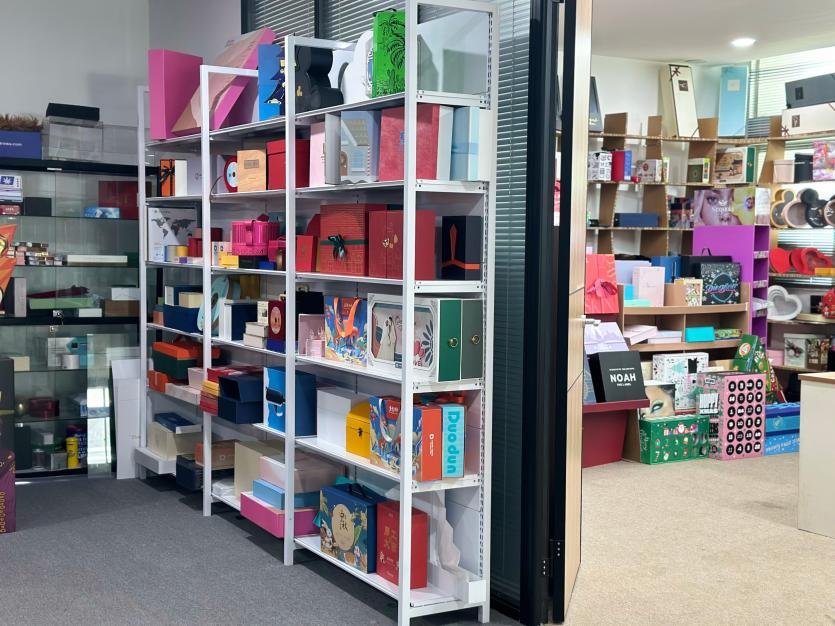
Typical MOQ by Packaging Type
MOQs vary widely by structure because different boxes use different production methods. The table below shows the typical range you can expect — and the reason behind each number.
| Packaging type | Typical MOQ | Why |
|---|---|---|
| Stock / ready-made boxes | No MOQ — buy 1+ | Already manufactured, no setup |
| Mailer boxes | 200–500 | Simple single-wall, automated line |
| Corrugated boxes | 500–1,000 | Die-cut and print on a high-speed line |
| Paper bags | 500–1,000 | Print and handle setup |
| Rigid boxes | 500–1,000 | Manual assembly and wrapping |
| Folding cartons | 1,000–5,000 | Runs on high-speed presses, needs longer runs |
| Custom box inserts | 500–2,000 | Depends on material — paperboard, EVA, or foam |
For rigid boxes specifically, our rigid box MOQ guide explains the exact factors that push the number up or down. If you need boxes without any minimum, the fastest route is a stock box like our ready magnetic box, which is already manufactured and ships in any quantity.
MOQ vs Unit Price: How Quantity Drives Cost
MOQ and unit price are two sides of the same equation. The unit price falls as quantity rises, because the fixed setup costs are spread over more boxes.
The curve looks like this in practice:
- 300 units — the die, plates, and setup dominate; unit price is at its highest
- 1,000 units — fixed costs are absorbed; the unit price drops noticeably
- 5,000 units — material and labor now dominate; further quantity discounts shrink
- 10,000+ units — the price flattens, and freight and storage become the bigger lever
This is why comparing two quotes at different quantities is misleading. A $3.00 price at 500 units and a $2.20 price at 5,000 units are not two prices for the same box — they are two points on the same curve. To compare suppliers fairly, ask both for the same quantity, and understand what each quote includes. Our step-by-step guide to sourcing packaging from China covers how to run that comparison cleanly.

How to Lower Your MOQ
If the factory minimum is higher than your first order, you have more options than you think. In order of easiest to most involved:
- Buy stock boxes — ready-made boxes have no MOQ, so a small launch or test run can use stock packaging with a custom sticker, ribbon, or insert. The stock box collection covers this.
- Simplify the structure — a single-wall mailer or a plain folding carton runs on automated lines with lower minimums than a hand-assembled rigid box.
- Combine products in one order — if you need a box and an insert, ordering them together from one factory can justify a smaller per-item minimum.
- Negotiate at the right moment — MOQ is most flexible when the factory has spare capacity or when you commit to a repeat program. This conversation happens in the RFQ stage, not after the quote is issued.
- Accept a slightly higher unit price — many factories will run below their ideal minimum if you cover the setup cost, which often works out cheaper than over-ordering boxes you do not need.
The trade-off is always the same: a lower MOQ costs more per unit, so size your first order against your real demand rather than chasing the lowest price per box.
MOQ vs Samples vs Lead Time: How They Connect
MOQ, samples, and lead time are the three numbers that define a packaging project, and they interact:
- Samples come first — order a sample before the bulk order to confirm structure, insert fit, and print finish. Sampling is independent of the MOQ. Our custom packaging samples guide tells you what to check on arrival.
- MOQ sets the entry cost — it determines the smallest bulk order the factory will accept, and it scales with the complexity of your box.
- Lead time sets the calendar — production time grows with quantity and complexity, so the order quantity you choose affects not just price but the launch date. For rigid boxes, our rigid box MOQ guide includes the production timeline.
One more connection matters: MOQ and shipping economics. A smaller order may meet the factory MOQ but still ship uneconomically, because freight is charged by volume and weight. This is where the shipping term — FOB or DDP — changes the picture, explained in our FOB vs DDP shipping incoterms guide.

FAQ
What does MOQ mean in packaging?
MOQ stands for minimum order quantity — the smallest number of identical boxes a factory will produce in one bulk order. It exists because every packaging run has fixed setup costs for dies, print plates, and machine setup that need a minimum order to absorb.
What is a typical MOQ for custom boxes?
Rigid boxes typically start at 500–1,000 units, folding cartons at 1,000–5,000 units, and corrugated or mailer boxes at 200–1,000 units. Stock boxes have no MOQ and can be ordered in any quantity.
Can I get a lower MOQ from a packaging manufacturer?
Often yes. Options include buying stock boxes, simplifying the structure, combining products in one order, negotiating at the RFQ stage, or accepting a higher unit price to cover setup costs.
Is the sample included in the MOQ?
No. Samples are ordered separately before bulk production and usually fall outside the MOQ. Many factories refund the sample cost against your bulk order.
Why does the unit price drop at higher quantities?
Because fixed setup costs — dies, plates, machine setup, and material minimums — are spread across more units. The price falls quickly at first, then flattens once material and labor dominate the cost.
Conclusion
MOQ is not a barrier — it is the visible part of packaging's fixed-cost economics. The number tells you how a factory pays for its dies, plates, and setup, and once you read it that way, you can work with it: buy stock for a test run, simplify the structure, combine items in one order, or negotiate at the right moment. The key is matching the order quantity to your real demand, not to the lowest unit price.
For authoritative reference on manufacturing and packaging industry practices, the PMMI — Association for Packaging and Processing Technologies publishes industry data, and the U.S. Commercial Service provides guidance for importing and working with overseas suppliers. When you are ready to size your first order, send your product details and target quantity to our packaging team — we will tell you the realistic MOQ for your structure, or point you to a stock option that needs no minimum at all.

