
When a box needs to hold a product securely and feel premium at the same time, foam inserts are usually the answer. And when packaging teams talk about foam inserts, two materials dominate the conversation: EVA foam and PU foam. They look similar in a finished box, but they behave very differently — one is firm and water-resistant, the other is soft and plush — and the difference decides how your product feels in the hand, how well it survives shipping, and how much the insert costs.
This guide compares EVA and PU foam across the factors that actually matter for packaging: feel, protection, precision, cost, and sustainability. By the end you will know which one fits your product, your budget, and your unboxing goal.
For the full range of insert options beyond foam — paperboard, corrugated, molded pulp, and combined structures — start with our custom box inserts guide.
What Are EVA Foam and PU Foam?
EVA foam — ethylene-vinyl acetate — is a closed-cell foam. Its cells are sealed, which makes it firm, water-resistant, and stable in shape. EVA cuts cleanly into precise cavities, holds products rigidly in place, and does not absorb moisture or dust. It is the workhorse of packaging inserts: jewelry, cosmetics, electronics, and perfume all rely on EVA for exact-fit product cavities.
PU foam — polyurethane — is more varied. In packaging inserts, the common form is flexible PU foam, which has an open-cell structure. That structure makes it soft and compressible — the "squishy" foam that gives a high-end unboxing feel. PU foam absorbs impact well and conforms around products, but it is softer, more expensive, and absorbs moisture unless it is coated or laminated.
Both materials are commonly paired with rigid boxes and magnetic gift boxes for the premium structure-and-insert combination. The rest of this guide compares them head to head.

EVA Foam vs PU Foam: The Quick Comparison
If you only read one section, read this table.
| Property | EVA Foam | PU Foam |
|---|---|---|
| Cell structure | Closed-cell | Open-cell (flexible PU) |
| Feel | Firm, solid, rigid | Soft, plush, compressible |
| Protection | Rigid hold — stops product from shifting | Cushioning — absorbs impact |
| Moisture resistance | Water-resistant | Absorbs moisture unless coated |
| Cut precision | Crisp edges, precise cavities | Can be die-cut, softer edges |
| Durability | High, keeps shape for years | Medium, compresses over time |
| Cost per insert | Lower | Higher |
| Recyclability | Limited but reclaimable in some programs | Harder to recycle |
The pattern is clear: EVA is the precision-and-durability choice, PU is the luxury-feel choice. That single distinction drives every other decision.
Where Each Foam Excels
Choose based on what the product needs, not on which material is "more premium."
EVA foam works best when the product must stay exactly in place:
- Jewelry — rings, necklaces, earrings in precise cavities
- Watches, pens, and small accessories
- Electronics and audio accessories
- Perfume and cosmetic bottles with an exact-fit base
- Multi-item gift sets where each item needs its own slot
Because EVA is firm and cuts cleanly, it creates the crisp, organized layout that makes a gift set look considered. For that reason it is the standard in custom box inserts for gift sets and skincare kits.
PU foam works best when the feel and the cushioning matter most:
- Fragile glass items that need impact absorption
- High-end unboxing reveals where the soft "squish" signals luxury
- Products with irregular shapes that benefit from a foam that conforms
- Gift boxes where the reveal experience is part of the brand
PU foam gives a plush first touch that EVA cannot match. If the unboxing moment is the product, PU is worth the premium. For an in-depth look at how inserts protect fragile products during transit, see our mailer box inserts guide, which covers cushioning for shipping scenarios.

Cost and MOQ: How Foam Choice Affects Price
EVA is generally the lower-cost choice. Its material cost is lower, it die-cuts and CNC-routes efficiently, and it works with the same tooling across large runs, which keeps the minimum order quantity practical for small and mid-size brands.
PU foam costs more for two reasons: the material itself is more expensive, and soft foam is harder to cut into precise cavities without specialized tooling. The price gap narrows at higher volumes, but for typical gift-box quantities, EVA remains the value option.
A note on the budget picture: the insert is only one line in the box price. For a full breakdown of how structure, materials, and finishing drive total cost, see our custom packaging cost guide.
How to Choose: A Decision Framework
Use the table below to move from product facts to a material decision.
| If your product... | Choose | Why |
|---|---|---|
| Is light and needs a fixed, organized position | EVA | Firm cavities stop shifting |
| Is fragile glass and needs impact absorption | PU | Soft foam cushions the hit |
| Faces humidity or condensation risk | EVA | Closed cells resist moisture |
| Is a premium reveal where feel sells the brand | PU | Plush touch signals luxury |
| Needs tight budget control | EVA | Lower material and tooling cost |
| Has an irregular shape | PU | Conforms around the product |
If the answer points to "no foam at all" — for example, sustainability is the priority and the product is light enough for a structural tray — paperboard or molded pulp inserts may serve better. The box inserts product range covers all the non-foam options.
Fit, Sampling, and Testing
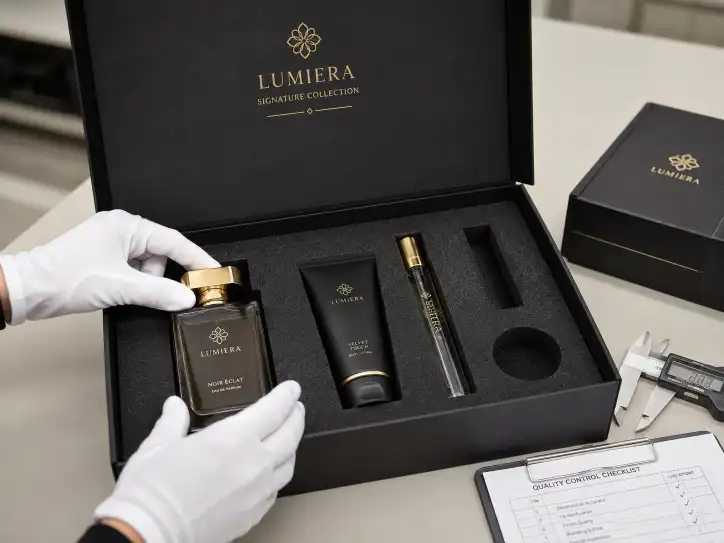
Whichever foam you choose, the fit must be confirmed with the real product, not with a reference drawing. Two things commonly go wrong: the cavity is slightly too tight (the product rubs or the box bulges), or slightly too loose (the product shifts during transit).
When you order packaging samples, test the insert the way the box will actually be handled:
- Place and remove the product several times — it should sit and lift smoothly
- Shake the closed box — nothing should shift or rattle
- Check the product against the foam for scuffing or friction marks
- Confirm the insert holds after repeated use, since customers open the box more than once
Foam fit issues almost never show in a photo. They show in the hand. That is exactly why a physical sample review with the real product is non-negotiable.
FAQ
What is the difference between EVA foam and PU foam?
EVA foam is a firm, water-resistant closed-cell foam that cuts into precise cavities and holds products rigidly. PU foam is a softer, compressible open-cell foam that cushions impact and gives a plush luxury feel but costs more and absorbs moisture unless coated.
Which foam is better for protecting fragile items?
PU foam absorbs impact better because it is soft and compressible, which makes it the better choice for fragile glass or delicate products. EVA protects by holding items firmly in place, which prevents shifting but offers less impact cushioning.
Is EVA foam or PU foam more expensive?
PU foam is more expensive than EVA, both in material cost and in tooling for precise cavities. The gap narrows at high volumes, but for typical gift-box quantities EVA remains the more budget-friendly insert material.
Can foam packaging inserts be recycled?
Foam inserts are harder to recycle than paper-based options. EVA is reclaimable in some programs, but PU foam recycling is limited. If recyclability is a priority, paperboard, corrugated, or molded pulp inserts are the more sustainable choice.
How do I choose between EVA and PU foam for my box?
Match the material to the need: choose EVA for firm, precise, moisture-resistant product holding at a lower cost, and choose PU for soft, impact-absorbing cushioning with a premium reveal feel. Confirm the choice with a physical sample using your real product.
Conclusion
EVA foam and PU foam both earn their place in premium packaging, but they serve different jobs. EVA delivers precision, durability, moisture resistance, and value — ideal for exact-fit product cavities in jewelry, cosmetics, and gift sets. PU delivers softness, impact absorption, and a plush reveal — ideal for fragile premium items where the unboxing feel is part of the brand. Choose with the product, not the trend, and confirm the fit with a real sample before committing to bulk.
For authoritative reference on sustainable packaging design and material decisions, the Sustainable Packaging Coalition publishes practical guidance on material selection and recyclability. When you are ready to spec the insert, send your product dimensions and fragility notes to our packaging team — we will recommend the structure and material, then send a sample to prove the fit.

