
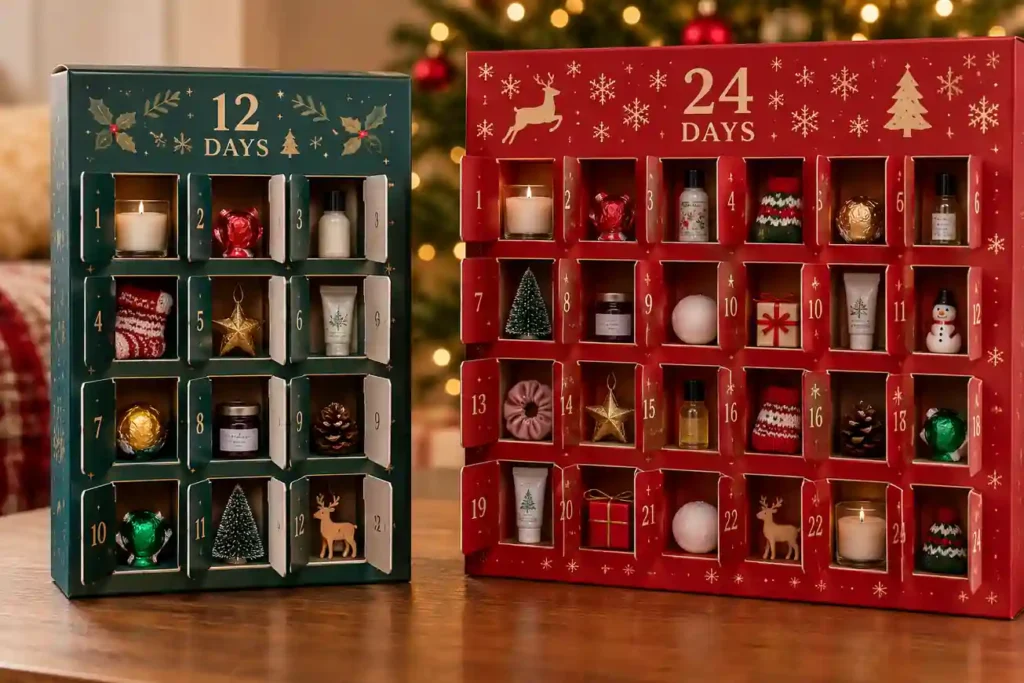
Choosing between a 12-day and 24-day calendar is a product and packaging decision, not simply a question of how many doors appear on the front.
The right structure must fit the product assortment, protect each item, control the finished box size, and create an opening sequence that feels natural for the customer. For a seasonal product launch, the choice also affects inserts, artwork, manufacturing complexity, retail presentation, shipping volume, and the perceived value of the complete gift set.
This guide compares 12 day vs 24 day advent calendar packaging for beauty, chocolate, jewelry, gift sets, and other seasonal assortments. It is designed for brand teams, importers, and retail buyers who need to decide on the structure before requesting a custom packaging quotation.
12-Day vs 24-Day Advent Calendar Packaging: Quick Comparison
A 12-day calendar gives each compartment more room and gives the brand more flexibility to include full-size products, larger samples, or a smaller number of carefully selected gifts.
A 24-day calendar creates a longer countdown and more frequent daily interaction, but the products generally need to be smaller or the finished package becomes significantly larger.
Before choosing a format, compare the basic differences:
| Decision Factor | 12-Day Advent Calendar | 24-Day Advent Calendar |
|---|---|---|
| Best product type | Full-size, mixed-size or higher-value products | Minis, samples and compact products |
| Compartment space | More room per product | Smaller individual compartments |
| Product mix | Fewer, more substantial gifts | More frequent smaller reveals |
| Typical structures | Drawer, book-style, mixed cavities | Door-opening, grids, modular trays |
| Insert design | Easier to combine different cavity sizes | Requires more detailed compartment planning |
| Customer experience | Curated and premium | Longer countdown and more daily engagement |
| Shipping impact | Can become deeper with larger products | Can remain compact if products are small |
| Common uses | Beauty, jewelry, candles, premium gifts | Chocolate, cosmetics minis, tea, accessories |
The decision should always start with the actual product assortment.
List every SKU together with its finished dimensions, weight, fragility, and secondary packaging. Then group the products into small, medium, and large formats.
If the assortment contains full-size skincare products, candles, jewelry pieces, or boxed gift items, a 12-day format may provide a better experience.
If the assortment is mainly minis, sachets, truffles, tea bags, small accessories, or trial-size cosmetics, a 24-day format can create a generous countdown without making the outer box unnecessarily large.
How Product Mix Should Drive the 12-Day or 24-Day Choice
Different industries use advent calendars in different ways, so the structure should follow the product mix rather than forcing every product into a standard grid.
Beauty and Skincare
Beauty brands often need to combine bottles, tubes, jars, masks, samples, and tools.
A 12-day calendar gives more room for different product depths and makes it easier to include full-size or hero products.
A 24-day beauty calendar works best when the assortment has been intentionally developed around travel sizes, minis, sachets, and compact accessories.
One of the most common structural problems occurs when the exterior calendar design is finalized before the actual product map has been confirmed.
A more practical approach is to confirm the largest and deepest products first, then build the smaller compartments around them.
Chocolate and Confectionery
Chocolate brands generally have more flexibility with a 24-day layout because each individual piece can be relatively compact.
However, the insert still needs to:
- Prevent products from moving
- Protect delicate surfaces
- Keep pieces separated
- Maintain the shape of each compartment
- Allow the customer to remove the product easily
A 12-day chocolate calendar is more suitable for larger bars, premium pralines, gift-sized products, or a mixture of different formats.
Jewelry
Jewelry products are usually small, but protection and presentation are extremely important.
Rings, earrings, charms, bracelets, or small necklaces can work in a 24-day format, but each cavity should hold the product securely and prevent tangling or movement.
A 12-day structure can be more appropriate when the collection includes:
- Larger jewelry pieces
- Presentation cards
- Pouches
- Small gift boxes
- Accessories with different dimensions
Mixed Gift Sets
Corporate gifting and mixed seasonal sets often contain products with completely different shapes.
In this situation, a 12-day structure may reduce design compromises because the packaging can combine several cavity sizes.
A 24-day format is still possible, but the internal structure should be designed from a detailed product map rather than using 24 repeated cavities.
How 12-Day vs 24-Day Formats Affect Box Size and Depth
The number of compartments affects much more than the front-panel width.
It can change:
- Overall box depth
- Tray dimensions
- Spacing between compartments
- Board thickness
- Drawer travel
- Door size
- Internal dividers
- Hinge structure
- Material consumption
A 24-day calendar can be arranged in many ways, including:
- Four rows of six
- Six rows of four
- Two opening panels
- A book-style structure
- Multiple drawers
- Mixed door and drawer layouts
Each arrangement changes the finished footprint and how the customer interacts with the box.
Before structural development begins, provide the packaging supplier with the actual finished product dimensions, not only the product names.
Dimensions should include:
- Caps
- Pumps
- Sleeves
- Protective packaging
- Secondary cartons
- Irregular shapes
A compartment may technically be large enough for the product but still provide a poor experience if the customer cannot grip the item or if the opening catches on the packaging.
For mixed assortments, it is normally better to place the largest and heaviest products first, then arrange smaller products around them.
This prevents a 24-day grid from forcing every product into the same narrow compartment size.
Insert Design for 12-Day and 24-Day Calendars
The insert is one of the most important structural parts of an advent calendar.
It controls product position, protects the products, supports the front panel, and affects how quickly the packing team can assemble the finished calendar.
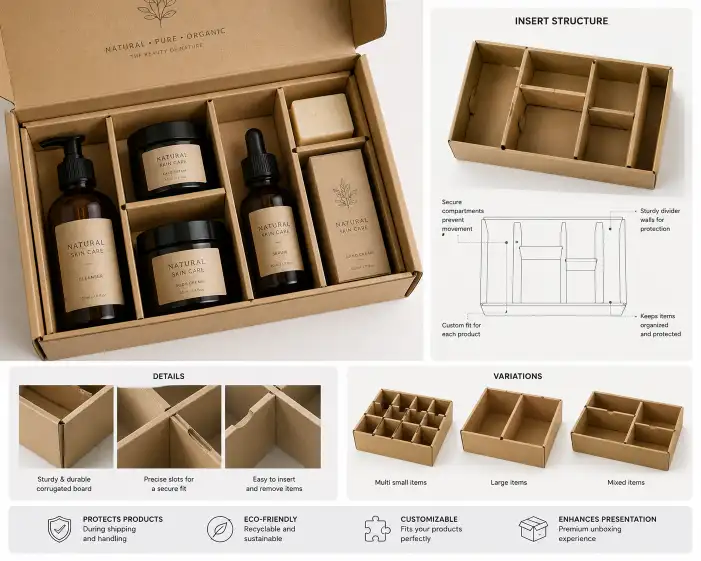
Common insert materials include:
Paperboard Inserts
Paperboard dividers work well for lightweight products and can be printed or wrapped to match the exterior packaging.
They are suitable for:
- Cosmetics
- Chocolate
- Small gift items
- Promotional products
Corrugated Inserts
Corrugated partitions provide additional strength for heavier or larger products.
They can also help divide the interior into different-size compartments.
EVA and Foam
EVA and foam are useful when the product requires:
- Precise positioning
- Additional cushioning
- A premium presentation
- Protection around fragile edges
These materials are commonly used for jewelry, fragrance, premium cosmetics, electronics, and higher-value gift sets.
Molded Pulp
Molded pulp can provide formed product positioning while maintaining a paper-based packaging appearance.
A 12-day calendar can usually accommodate deeper or more individualized cavities.
A 24-day calendar often benefits from a modular or repeated divider system, but the structural repetition should never override the actual product dimensions.
For cosmetics, bottle necks and pumps may need additional support.
For chocolate, compartments should prevent pieces from rubbing against one another.
For jewelry, wrapped surfaces, small slots, envelopes, or soft materials can help keep products secure.


You can review additional solutions on our custom box inserts page.
Which Structure Works Better for 12-Day and 24-Day Calendars?
The number of compartments is only one part of the decision. The opening style also changes the customer experience, packing process, and finished size.
Drawer Advent Calendar
Drawer structures create a strong daily unboxing experience.
Each drawer can:
- Hold a different product
- Use a different internal size
- Display individual numbering
- Support a premium presentation
This makes drawer calendars especially suitable for beauty, jewelry, fragrance, and luxury gift sets.
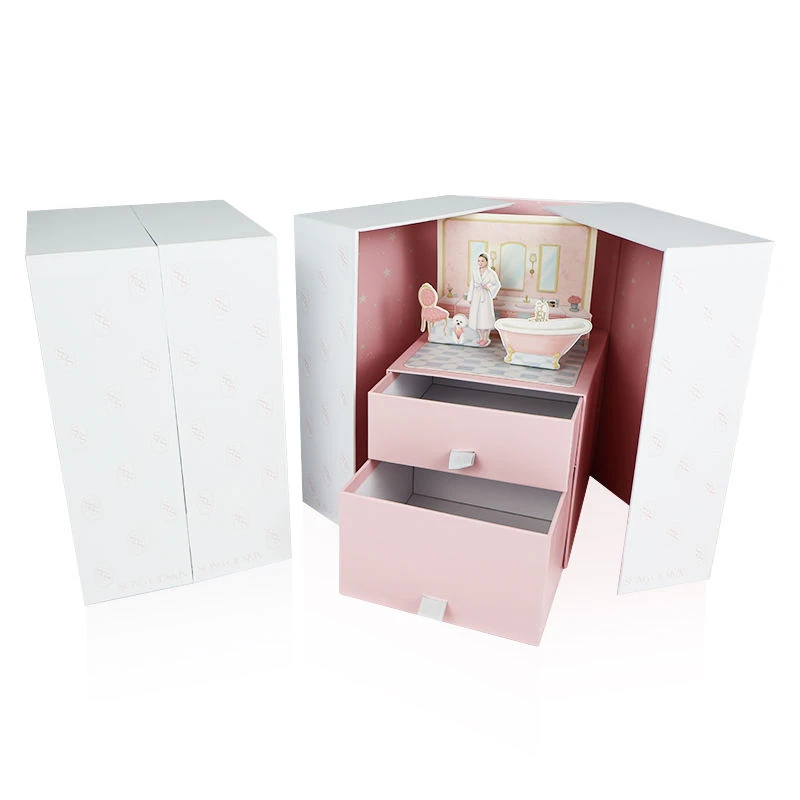
A 12-day drawer structure can provide more room for larger products.
A 24-day drawer calendar is possible, but the finished box can become large and heavy if every drawer uses rigid board.
Book-Style Advent Calendar
A book-style calendar opens like a hardcover book.
The internal structure can combine:
- Drawers
- Small boxes
- Doors
- Inserts
- Mixed-size compartments
The inside cover also creates additional space for artwork, storytelling, product instructions, or campaign messaging.
For 24-day formats, book-style construction can help divide the calendar into two balanced sections rather than forcing all compartments onto one panel.
The spine, hinge, magnet, and closing mechanism should be tested carefully so the box remains stable when filled.
Door-Opening Advent Calendar
Door-opening structures are familiar to consumers and work especially well for:
- Chocolate
- Small cosmetic samples
- Tea
- Small accessories
- Promotional items
This format is particularly suitable for 24-day calendars because the openings can be arranged efficiently across a flat panel.
The perforation and opening force are important. If the doors tear unevenly or the insert sits too close to the front panel, the unboxing experience can feel lower quality.
Fold-Out Advent Calendar
Fold-out calendars create a stronger display effect when opened.
Several panels can reveal:
- A product collection
- A holiday scene
- A brand story
- Different groups of products
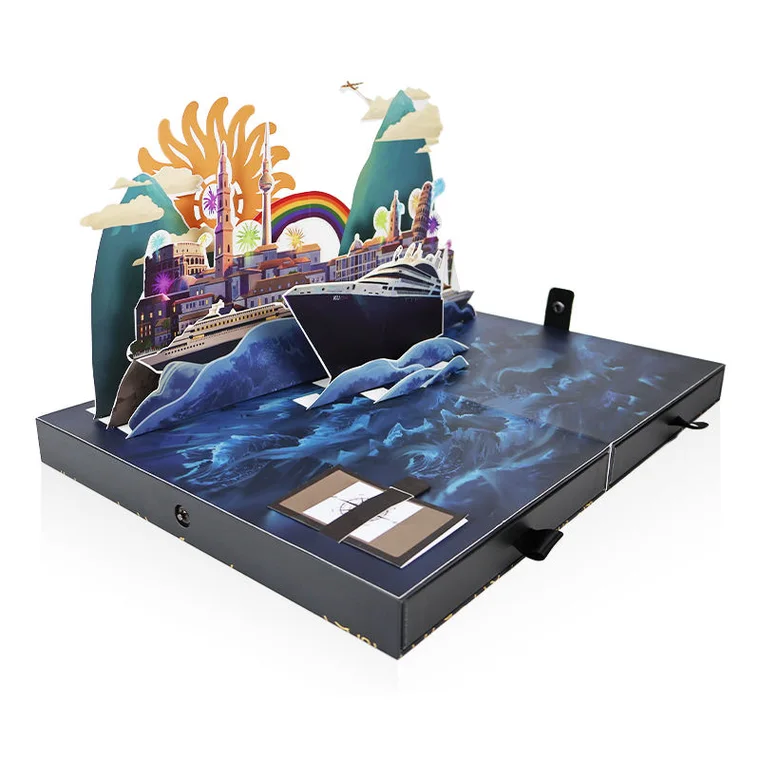
This style is useful for campaigns that want a more shareable unboxing experience.
A 12-day fold-out calendar can use larger decorative panels, while a 24-day version needs more careful planning to avoid making the opened structure too wide.
For a broader overview of structural options, see our custom advent calendar boxes page.
How 12-Day vs 24-Day Structures Affect Cost
A 24-day calendar does not automatically cost twice as much as a 12-day calendar.
Likewise, a 12-day calendar is not automatically the cheaper option.
The final cost depends on the complete structure.
Main cost drivers include:
- Outer box construction
- Board thickness
- Insert material
- Number of components
- Printing
- Specialty paper
- Foil stamping
- Embossing
- Magnets
- Ribbon
- Assembly
- Quality control
- Export packing
A premium 12-day calendar using thick wrapped rigid board, magnets, ribbons, custom drawers, and EVA inserts can cost more than a compact 24-day folding structure.
A 24-day design can also become expensive if it contains 24 individual drawers or small boxes requiring separate assembly.
When comparing structures, it is useful to request two or three concepts using the same product assortment.
For example:
- 12-day rigid drawer structure
- 12-day book-style structure
- 24-day door-opening structure
This makes it easier to compare the actual structural cost rather than comparing projects with different products and different specifications.
How 12-Day vs 24-Day Structures Affect Shipping Volume
Shipping volume can have a major effect on the total landed cost.
A calendar that looks attractive during product development may become expensive to ship if the finished structure is too deep or bulky.
Compare:
- Closed box dimensions
- Units per export carton
- Carton dimensions
- Gross weight
- Net weight
- Pallet footprint
- Assembly condition
A fully assembled 12-day drawer calendar may occupy more space because the individual compartments are deeper.
A compact 24-day door-opening structure may pack more efficiently if the products are small and the internal tray is shallow.
However, a 24-day rigid drawer calendar can also become larger than expected because of the number of individual components.
Retail buyers should additionally consider:
- Shelf depth
- Display orientation
- Case-pack efficiency
- Warehouse space
- Store handling
E-commerce brands should consider:
- Corner protection
- Surface scuffing
- Parcel impact
- Secondary shipping cartons
The cheapest packaging structure is not always the structure with the lowest total landed cost.
Why 24-Day Calendars Usually Need More Compartment Testing
The more compartments a calendar contains, the more individual fit points need to be checked.
A structural sample should confirm:
- Product fit
- Drawer movement
- Door opening
- Panel alignment
- Insert depth
- Product removal
- Structural strength

For a 24-day calendar, a small dimensional issue repeated across many compartments can create a larger production problem.
Examples include:
- Drawers that are too tight
- Doors that catch on the product
- Inserts that sit too high
- Products rotating inside cavities
- Uneven spacing between openings
For mixed assortments, test the largest, heaviest, and most fragile items first.
Once those compartments work correctly, smaller products can normally be arranged more easily around them.
A printed sample should then confirm:
- Color
- Numbering
- Logo position
- Finishing
- Hinge lines
- Door position
- Customer opening sequence

More information about structural development is available on our samples and prototyping page.
How Printing and Finishing Differ Between 12-Day and 24-Day Calendars
The artwork needs to follow the final structural dieline.
This is especially important for 24-day designs because numbering, doors, seams, hinges, and compartment positions must remain correctly aligned.
For a 12-day luxury beauty or jewelry calendar, the brand may choose:
- Foil stamping
- Embossing
- Textured paper
- Soft-touch lamination
- Wrapped rigid board
Because there are fewer openings, each reveal can feel more substantial.
For a 24-day chocolate or beauty calendar, clear numbering and visual rhythm are often more important.
The artwork should make it easy for the customer to identify each day without creating visual clutter.
Inside panels can also include:
- Short messages
- Product instructions
- Ingredient information
- Brand stories
- Seasonal graphics
Our packaging artwork design service explains how artwork can be prepared for the final dieline.
A Practical Way to Choose Between 12-Day and 24-Day Packaging
Before confirming the structure, ask these questions:
Are the products mostly full-size or mini-size?
If several products are large or irregular, start with a 12-day structure.
If most products are minis or samples, a 24-day format may be more practical.
Are all products similar in size?
Repeated-size products are easier to arrange in a 24-day grid.
Mixed product dimensions often work better with 12-day layouts or customized mixed cavities.
Is daily countdown engagement important?
If the campaign relies heavily on a traditional December countdown, 24 days may provide a stronger consumer experience.
If the goal is a premium edited gift collection, 12 days may create more perceived value per reveal.
Does the brand need a compact shipping size?
A shallow 24-day door-opening structure can be efficient.
A deep 24-drawer rigid calendar may not be.
Always compare the actual packed dimensions.
Is the packaging positioned as premium?
Premium positioning does not depend only on the number of compartments.
Structure, materials, insert quality, finishing, product assortment, and unboxing experience all contribute to the final result.
12-Day or 24-Day: Which Is Better?
There is no universal best format.
A 12-day advent calendar is usually a stronger starting point when:
- Products are larger
- Products have different dimensions
- Each gift has higher value
- The brand wants a curated premium collection
- Deeper compartments are required
- The overall product count does not need to reach 24
A 24-day advent calendar is usually more suitable when:
- Products are compact
- The assortment contains samples or minis
- Daily engagement is central to the campaign
- A traditional countdown experience is important
- Products can fit into repeated or modular compartments
- The outer box can remain reasonably compact
The final decision should come from the product map, insert tests, finished dimensions, handling requirements, and the customer experience the brand wants to create.
The packaging structure should support the assortment rather than force the assortment into an unsuitable layout.
Need Help Choosing a 12-Day or 24-Day Advent Calendar Structure?
If you are planning a custom advent calendar project, send us:
- Product photos
- Product dimensions
- Product weight
- Number of products
- Preferred calendar format
- Order quantity
- Target market
- Required delivery date
Our team can help evaluate whether a 12-day or 24-day structure is more suitable and develop the internal compartments around your actual product assortment.
Explore our custom advent calendar boxes or contact us to discuss your project.

