
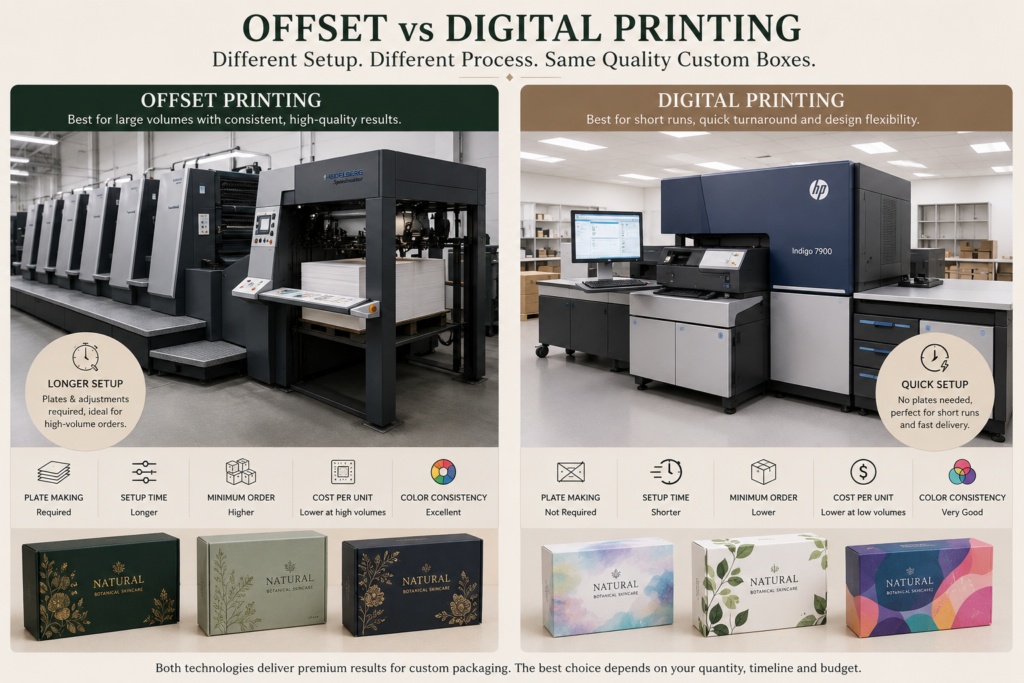
The box design is perfect. The materials are chosen. Then comes the question that stops every packaging project: which printing method should you use? Offset, digital, and flexo each produce very different results at very different costs — and choosing wrong means either overpaying or getting disappointing quality.

Custom box printing methods determine the quality, cost, and turnaround time of your packaging. The three main methods are offset printing (best quality at volume), digital printing (fast and flexible for small runs), and flexo printing (economical for simple designs at high volume). Choosing the right method depends on your quantity, design complexity, and budget.
This guide compares offset, digital, and flexo printing for custom boxes — how each method works, what quality to expect, cost per unit at different quantities, and which method suits your project. Whether you are ordering rigid gift boxes, folding cartons, or corrugated boxes, understanding printing methods helps you make the right decision.
Offset Printing for Custom Boxes
Offset printing, also called offset lithography, is the gold standard for custom box printing. It transfers ink from a metal plate to a rubber blanket, then onto the printing surface. For rigid gift boxes, offset printing is applied to the paper wrap before it is laminated onto the greyboard — a process called litho lamination.
How Offset Printing Works for Boxes
- The design is separated into CMYK color plates (plus optional Pantone spot colors)
- Each plate is mounted on the press
- Ink transfers from the plate to a rubber blanket
- The blanket presses the image onto the paper surface
- The printed paper is then laminated onto greyboard and wrapped around the box
When to Choose Offset Printing
| Factor | Offset Printing |
|---|---|
| Best quantity | 1,000+ units |
| Color accuracy | Excellent — Pantone matching available |
| Image detail | Highest — sharp text, smooth gradients, photographic quality |
| Per-unit cost at volume | Lowest among all methods |
| Setup cost | Moderate to high ($200–$800 for plates) |
| Turnaround time | 15–20 business days |
| Best for | Premium rigid boxes, folding cartons, any box needing high-quality branding |
Offset printing is the right choice when your box design includes fine text, full-color product images, gradient backgrounds, or brand colors that must match exactly. It is the most popular method for custom rigid gift boxes because the print quality justifies the premium packaging.
Digital Printing for Custom Boxes
Digital printing applies ink directly onto the paper or board without plates. It works like a large-format printer — the digital file goes straight to the press. For custom boxes, digital printing is ideal for short runs, prototypes, and variable data.
How Digital Printing Works for Boxes
- The digital file is sent directly to the press
- Ink (toner or liquid) is applied directly to the substrate
- No plates, no setup, no minimum quantity
- Each print can be different (variable data printing)
When to Choose Digital Printing
| Factor | Digital Printing |
|---|---|
| Best quantity | 1–500 units |
| Color accuracy | Very good — CMYK only, limited Pantone matching |
| Image detail | Very good — suitable for most designs |
| Per-unit cost at small runs | Lowest for small quantities |
| Setup cost | None |
| Turnaround time | 5–12 business days |
| Best for | Small batches, prototypes, test launches, personalized packaging |
Digital printing has no minimum order quantity — you can print as few as one box. This makes it perfect for startups testing a product, limited-edition packaging, or personalized boxes. The per-unit cost is higher than offset at volume, but when you factor in the zero setup cost, digital is the most economical choice for runs under 500 units.
Digital printing is also the best option when you need packaging fast. The shortened turnaround time (5–12 business days compared to 15–20 for offset) can make the difference between hitting a launch date and missing it.
Flexo Printing for Custom Boxes
Flexo printing uses flexible rubber or photopolymer plates wrapped around rotating cylinders. It transfers fast-drying inks onto a wide range of materials. Flexo is the dominant method for corrugated boxes and paperboard packaging with simple designs.
How Flexo Printing Works for Boxes
- Flexible plates are created with the raised image area
- Plates are mounted on cylinders
- Ink is applied to the plates from an anilox roller
- The plates press the image onto the material
- Fast-drying inks allow for quick production speeds
When to Choose Flexo Printing
| Factor | Flexo Printing |
|---|---|
| Best quantity | 5,000+ units |
| Color accuracy | Good for spot colors, limited for CMYK process |
| Image detail | Good for solid colors, text, and simple graphics |
| Per-unit cost at volume | Lowest for very large runs |
| Setup cost | Moderate to high ($300–$1,200 for plates) |
| Turnaround time | 12–18 business days |
| Best for | Corrugated boxes, shipping boxes, simple retail packaging |
Flexo printing excels on corrugated board and other uneven surfaces where offset printing cannot work. It is the standard for custom corrugated boxes and ecommerce packaging. Flexo handles solid colors well — if your design uses 1–4 spot colors with bold text and simple graphics, flexo delivers good quality at a low per-unit cost.

Offset vs Digital vs Flexo: Side-by-Side Comparison
This table summarizes the key differences between the three printing methods for custom boxes.
| Factor | Offset | Digital | Flexo |
|---|---|---|---|
| Print quality | Excellent — highest detail and color accuracy | Very good — suitable for most designs | Good — best for solid colors and simple graphics |
| Color capability | CMYK + Pantone spot colors | CMYK only (limited Pantone matching) | Spot colors (1–6), limited CMYK |
| Minimum quantity | 1,000 units | 1 unit | 500–1,000 units |
| Setup cost | $200–$800 | None | $300–$1,200 |
| Per-unit cost at 500 units | High (due to setup) | Low | Moderate |
| Per-unit cost at 5,000 units | Low | High | Low |
| Per-unit cost at 50,000 units | Very low | Not economical | Very low |
| Turnaround time | 15–20 business days | 5–12 business days | 12–18 business days |
| Substrate compatibility | Smooth paper and board | Most paper and board | Wide range — including corrugated |
| Best box types | Rigid boxes, folding cartons | Short-run boxes, prototypes | Corrugated boxes, shipping boxes |
Color Quality Explained
Offset printing produces the most accurate brand colors because it can use Pantone spot colors. If your brand has a specific blue that must match exactly, offset is the only reliable choice. Digital printing uses CMYK process colors, which cannot match all Pantone colors. Flexo printing can use spot colors but produces less consistent results than offset for detailed images.
Detail and Image Quality
Offset printing achieves the highest resolution (up to 300 LPI or more). Text remains sharp at small sizes, and photographic images reproduce with smooth gradients. Digital printing resolution has improved significantly — modern digital presses produce results that are very close to offset for most designs. Flexo printing has lower resolution and is best for bold graphics rather than fine detail.
Printing Method Cost Comparison
Understanding the cost structure of each printing method helps you choose the most economical option for your quantity.
Cost Comparison by Quantity
| Quantity | Offset (per unit) | Digital (per unit) | Flexo (per unit) |
|---|---|---|---|
| 100 units | $2.50–$5.00 | $0.80–$1.80 | Not recommended |
| 500 units | $1.20–$2.50 | $0.40–$0.90 | $1.00–$2.50 |
| 1,000 units | $0.50–$1.00 | $0.30–$0.70 | $0.40–$0.90 |
| 5,000 units | $0.20–$0.40 | $0.25–$0.60 | $0.15–$0.35 |
| 10,000 units | $0.12–$0.25 | Not economical | $0.08–$0.20 |
| 50,000 units | $0.06–$0.15 | Not economical | $0.04–$0.12 |
Cost Breakdown Components
| Cost Component | Offset | Digital | Flexo |
|---|---|---|---|
| Plate / setup (one-time) | $200–$800 | $0 | $300–$1,200 |
| Per-unit printing cost | Low | Moderate | Low |
| Per-unit material cost | Same | Same | Same |
| Lamination / coating (add-on) | +$0.10–$0.30 | +$0.10–$0.30 | +$0.10–$0.30 |
| Die-cutting (if applicable) | +$0.05–$0.15 | +$0.05–$0.15 | +$0.05–$0.15 |
Break-Even Points
- Digital to offset crossover: Around 500–1,000 units. Below this, digital is cheaper. Above this, offset becomes more cost-effective.
- Flexo to offset crossover: Around 10,000 units for simple designs. Offset remains cheaper for complex full-color designs at most quantities.
- Digital to flexo crossover: Digital is almost always cheaper than flexo for runs under 5,000 units due to flexo's setup costs.
For most custom box projects, offset printing offers the best value at 1,000–10,000 units. Digital is best below 500 units. Flexo only becomes economical above 5,000–10,000 units, especially for corrugated boxes.
How Printing Methods Apply to Different Box Types
Different box types are better suited to specific printing methods.
| Box Type | Recommended Method | Why |
|---|---|---|
| Rigid gift boxes (magnetic, ribbon, drawer) | Offset (litho lamination) | The paper wrap is printed separately before wrapping — offset produces the best quality for premium boxes |
| Folding cartons / paperboard boxes | Offset or digital | Flat sheets accept offset well; digital works for short runs |
| Corrugated boxes | Flexo or digital | Flexo handles corrugated surfaces; digital for short runs |
| Small rigid boxes (jewelry, cosmetics) | Offset | Small boxes need fine detail and accurate color |
| Prototype or test run boxes | Digital | No setup cost, fast turnaround |
| Ecommerce shipping boxes | Flexo | Simple designs (logo + text) at low per-unit cost |
| Retail display boxes | Offset or flexo | Offset for full-color graphics; flexo for simple designs |
For rigid gift boxes — the most premium packaging category — offset printing through litho lamination is the industry standard. The paper wrap is offset printed, then laminated onto greyboard, then wrapped around the box. This process produces the sharpest, most vibrant results for luxury packaging.
If you are ordering custom box inserts alongside your boxes, note that inserts are typically not printed (they are made from foam, EVA, or cardboard). The printing is on the box exterior and interior wrap.
How to Choose the Right Printing Method
Follow this decision guide to choose the right printing method for your custom boxes.
Step 1: Determine Your Quantity
| Your Quantity | Recommended Method |
|---|---|
| 1–500 units | Digital |
| 500–1,000 units | Digital (simple design) or offset (complex design) |
| 1,000–5,000 units | Offset |
| 5,000–50,000 units | Offset (full-color) or flexo (simple design) |
| 50,000+ units | Flexo (simple) or offset (full-color) |
Step 2: Evaluate Your Design
| Design Type | Recommended Method |
|---|---|
| Full-color photographic images | Offset |
| Gradients and smooth color transitions | Offset |
| Fine text below 8 pt | Offset |
| Simple logo + text, 1–3 colors | Flexo or offset |
| Brand color must match Pantone exactly | Offset (Pantone ink) |
| Variable data (different text per box) | Digital |
| Simple solid colors on corrugated | Flexo |
Step 3: Consider Your Timeline
| Timeline | Recommended Method |
|---|---|
| Need boxes in 5–12 business days | Digital |
| Standard timeline (15–20 business days) | Offset |
| Large volume, flexible timeline | Offset or flexo |
Step 4: Factor in Finishes
Printing method affects which finishes can be applied. Offset-printed boxes accept all standard finishes — matte lamination, gloss lamination, soft-touch coating, foil stamping, and embossing. Digital-printed boxes also accept most finishes, but UV coating may react differently with digital toner. Flexo-printed boxes can be laminated or coated but are less commonly matched with premium finishes.
For a detailed comparison of premium finishes and their costs, see the magnetic gift box guide which covers finishing options for rigid boxes.
FAQ
What is the best printing method for custom boxes?
Offset printing is the best all-around method for custom boxes. It produces the highest quality results at the most cost-effective per-unit price for quantities above 1,000 units. For quantities under 500 units, digital printing is more economical.
What is the difference between offset and digital printing?
Offset printing uses metal plates and transfers ink through a rubber blanket onto paper. Digital printing applies ink directly from a digital file without plates. Offset has higher setup costs but lower per-unit costs at volume. Digital has no setup costs but higher per-unit costs.
Can digital printing match Pantone colors?
Digital printing uses CMYK process colors, which cannot match all Pantone spot colors exactly. Some digital presses offer expanded gamut that comes close, but for exact Pantone matching, offset printing is the standard.
What printing method is used for rigid gift boxes?
Offset printing (litho lamination) is the standard for rigid gift boxes. The paper wrap is offset printed, laminated onto greyboard, and wrapped around the box frame. This produces the highest quality results for premium packaging.
Is flexo printing suitable for small quantities?
No. Flexo printing has high setup costs ($300–$1,200 for plates) that make small quantities uneconomical. Flexo is best for runs above 5,000–10,000 units, particularly for corrugated boxes.
What is litho lamination?
Litho lamination is the process of offset printing on thin paper, then laminating that printed paper onto a thicker board (like greyboard). It is the standard method for producing printed rigid gift boxes.
How much does setup cost for each printing method?
Digital printing has no setup cost. Offset printing setup (plates) costs $200–$800. Flexo printing setup (plates) costs $300–$1,200. These are one-time costs per design.
Can I use multiple printing methods on one box?
Yes. Some boxes use offset printing for the exterior wrap and digital printing for short-run interior lining. This is uncommon but possible for specialized projects.
How do I get a quote for printed custom boxes?
Contact a packaging manufacturer with your box dimensions, quantity, design complexity (number of colors, full-color or spot), and desired finishes. The manufacturer will recommend the best printing method for your project.
What printing method is most eco-friendly?
Digital printing produces less waste because there is no setup waste or plate disposal. Offset printing uses plates and chemicals but is efficient at volume. Flexo uses fast-drying inks that are often water-based. For eco-friendly packaging, request sustainable materials and processes.

