
A luxury rigid gift box is not defined by one material or one finish. It is the result of three decisions working together: what the core is made of, how it is assembled, and how the surface is treated. Change any one of those, and the box feels different in hand, costs different to produce, and performs differently on a retail shelf.
This guide covers the material options, construction methods, and finishing techniques available for luxury rigid gift boxes. It is written for B2B buyers and brand teams who need to compare options before briefing a custom packaging manufacturer.
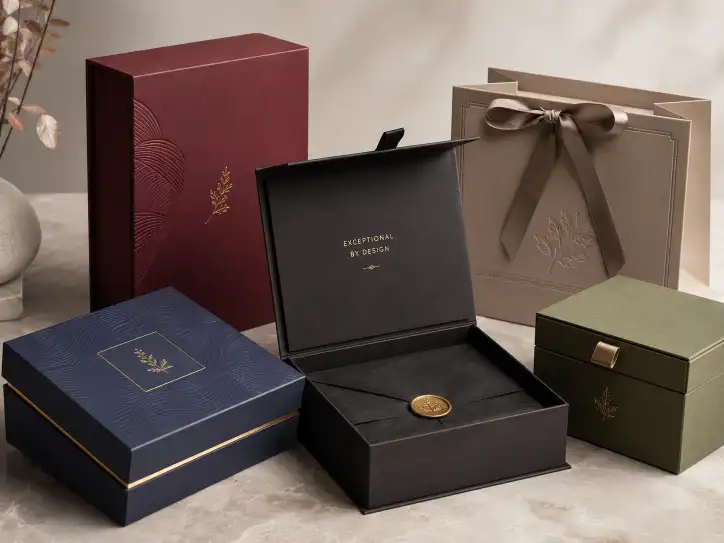
Board Materials: What Goes Inside the Box Structure
The core board determines the weight, rigidity, and durability of a luxury rigid gift box. Unlike folding cartons that ship flat, rigid boxes are built from thick board that holds its shape permanently.
Grey Board (Most Common)
Grey board, also called chipboard or millboard, is the standard core material for rigid boxes. It is made from recycled paper fibers pressed into dense sheets. The density and thickness control how the box feels in hand.
| Board Type | Typical Thickness | Best For | Key Note |
|---|---|---|---|
| Standard Grey Board | 1.0–2.0 mm | Most luxury rigid boxes | Good balance of cost and rigidity |
| High-Density Grey Board | 1.5–3.0 mm | Heavy products, large boxes | Higher density reduces flex in larger formats |
| Solid Black Board | 1.0–2.5 mm | Open-edge designs, dark interiors | No visible grey edge, cleaner internal look |
| White Board | 1.0–2.0 mm | Light-colored interiors | Avoids dark board showing through thin paper |
Grey board grades are differentiated by density and surface smoothness. Higher-density board costs more but reduces the risk of bowing in larger box sizes. For most luxury applications, 1.5 mm to 2.0 mm grey board is the working range.
Specialty Boards
Some luxury rigid gift boxes need non-standard core materials:
- Solid Black Board — Used when the box has exposed edges (no paper wrap covering the rim). The black edge looks intentional rather than unfinished.
- White Board — Often chosen for cosmetic packaging where the inside of the box must stay bright without additional lining paper.
- High-Density Board — Specified for heavy product sets or large-format boxes where standard board may flex under load.

Wrapping Papers: The Outer Surface That Defines Look and Feel
The paper wrapped around the board determines the visual appearance and tactile quality of a luxury rigid gift box. The board provides strength; the paper provides the brand surface.
Paper Types
| Paper Type | Finish | Typical Use | Cost Indicator |
|---|---|---|---|
| Art Paper / Coated Paper | Gloss or matte | Standard luxury boxes | Moderate |
| Uncoated Paper | Natural matte | Eco-conscious brands | Moderate |
| Textured Paper | Linen, felt, leatherette | Premium tactile effect | Higher |
| Metallic Paper | Shimmer finish | Seasonal, gift-focused brands | Higher |
| Kraft Paper | Natural brown | Rustic or sustainable positioning | Lower |
| Specialty Paper | Embossed, pearl, translucent | High-end bespoke projects | Highest |
Art paper (100–150 gsm) is the most common wrapping material for luxury rigid gift boxes. It accepts printing well and can be combined with most coating and finishing options.
Textured papers add a tactile dimension that printed flat paper cannot achieve. Linen and felt textures are popular for cosmetics and jewelry packaging. Leatherette paper is used for higher-end gift boxes where the surface needs to feel like a premium material.
Paper Selection Considerations
- Paper weight — Lighter papers (100–120 gsm) wrap corners more cleanly. Heavier papers (150+ gsm) feel more substantial but may crack at tight corners.
- Grain direction — Paper should be wrapped with the grain parallel to the fold line to reduce corner cracking.
- Lining paper — Interior lining paper does not need the same grade as the exterior. A lighter lining saves cost while maintaining the interior finish.

Construction Methods: How a Rigid Box Is Built
A luxury rigid gift box is constructed differently from a folding carton. The process involves wrapping paper around pre-cut board pieces, then assembling them into the final shape.
Core Construction Steps
- Board cutting — Grey board is die-cut or sheet-cut to size for each panel (lid, base, spine if applicable).
- Paper printing — The wrapping paper is printed with the brand artwork.
- Paper lamination — The printed paper is laminated onto the board pieces using adhesive.
- Creasing and folding — The wrapped board is creased at fold lines and folded into shape.
- Corner tucking — Paper corners are folded and tucked cleanly so no raw edge is visible.
- Assembly — Lid and base are assembled, and any additional components (hinge, magnet, ribbon) are added.
Common Construction Variations
| Construction Type | How It Works | Best For |
|---|---|---|
| Wrapped Edge | Paper covers all board surfaces, corners folded cleanly | Most luxury rigid boxes |
| Paper-Wrapped with Mitred Corners | Paper corners are cut and joined at 45° for seamless edges | High-end cosmetic and jewelry boxes |
| Open Edge | Board edge is exposed (often black or white board) | Modern minimal design |
| Cloth-Wrapped | Fabric replaces paper for the outer surface | Premium gift and keepsake boxes |
Mitred corners require more skill and time but produce a cleaner look at the edges. If your product positioning requires a seamless appearance, mitred corners are worth requesting during sampling.

Surface Finishes: Coatings and Laminations That Protect and Enhance
Once the box is assembled, the surface can be treated with a coating or lamination. These treatments protect the paper, adjust the tactile feel, and improve durability during handling and shipping.
Coating Options
| Coating | Finish Look | Feel | Durability | Best For |
|---|---|---|---|---|
| Aqueous Coating | Gloss or matte | Smooth | Moderate | Standard protection, fast production |
| UV Coating | High gloss | Smooth, reflective | Good | Bold visual impact, scratch resistance |
| Soft Touch Coating | Matte | Velvety | Moderate | Premium tactile feel, quieter look |
| Varnish | Gloss, satin, or matte | Smooth | Moderate | Economical option, printed in-line |
Soft touch coating is the most requested finish for luxury rigid gift boxes. It adds a velvety surface feel that signals premium quality without visual noise. However, soft touch is more prone to marking during handling, so it works best for boxes that will not be heavily stocked or moved repeatedly.
Lamination Options
| Lamination | Thickness | Protection Level | Best For |
|---|---|---|---|
| Gloss Lamination | Thin film | Good | General protection, color enhancement |
| Matte Lamination | Thin film | Good | Non-reflective surface, soft feel |
| Soft Touch Lamination | Slightly thicker film | Very good | Premium tactile feel + protection |
| Anti-Scratch Lamination | Standard film | Excellent | Boxes that will be handled frequently |
Lamination provides better protection than coating because it adds a physical film layer over the paper. For luxury rigid gift boxes that will ship long distances or be handled by multiple parties, lamination is the safer choice.
Decorative Effects: Foil, Embossing, and Applied Details
Decorative effects are applied after the surface finish. They add brand detail and visual hierarchy to the box.
Foil Stamping
Foil stamping uses heat and pressure to transfer a metallic or pigmented foil onto the box surface. Common foil colors include gold, silver, copper, rose gold, and black. Foil works best when used selectively — a logo, a brand name, or a single decorative line — rather than as a full-surface treatment.
Embossing and Debossing
- Embossing — A raised design on the surface, created by pressing the paper from behind into a die.
- Debossing — A recessed design, created by pressing the paper downward into a die.
- Registered Embossing — Embossing aligned precisely with a printed or foiled element. Requires more setup time but produces a cleaner result.
Applied Details
| Detail | Description | Typical Use |
|---|---|---|
| Ribbon | Fabric ribbon tied around or glued to the box | Gift boxes, seasonal sets |
| Magnetic Closure | Magnet embedded in the lid and base edge | All premium rigid boxes |
| Hinge | Fabric or paper hinge connecting lid and base | Book-style boxes |
| Window Patching | Clear panel cut into the lid | Product visibility on shelf |
Magnetic closures have become standard for luxury rigid gift boxes. Most premium rigid boxes use two magnets — one in the lid edge and one in the base edge — to create a secure but easy-to-open closure.

Material and Finish Selection Table by Product Category
| Product Category | Recommended Board | Recommended Paper | Recommended Finish | Closure |
|---|---|---|---|---|
| Cosmetics / Skincare | 1.5 mm grey board | Art paper, 120 gsm | Soft touch lamination | Magnetic |
| Jewelry | 1.5–2.0 mm grey board | Textured paper or leatherette | Matte lamination | Magnetic or ribbon |
| Perfume / Fragrance | 1.5 mm grey board | Art paper, coated | Soft touch or UV | Magnetic |
| Wine / Liquor | 2.0 mm grey board | Art paper or metallic paper | Matte lamination | Magnetic or hinge |
| Chocolate / Confectionery | 1.5 mm grey board | Art paper or kraft | Aqueous coating | Magnetic or ribbon |
| Candle | 1.5 mm grey board | Art paper or textured | Soft touch lamination | Magnetic |
| Electronics | 2.0 mm high-density board | Art paper | Matte lamination | Magnetic |
| Corporate Gifts | 2.0 mm grey board | Art paper or leatherette | Soft touch or UV select | Magnetic |
This table is a starting point. Final selection should always be confirmed through sampling, because the same board thickness can feel different depending on box size and shape.
How Material Choice Affects MOQ, Lead Time, and Cost
Material choices affect more than feel — they affect production parameters.
Cost Drivers
- Board grade — High-density board costs 15–30% more than standard grey board per sheet.
- Paper type — Textured and specialty papers cost more than standard art paper and may have longer sourcing lead times.
- Finish type — Soft touch lamination costs more than standard aqueous coating. Anti-scratch lamination costs more than standard matte lamination.
- Decorative effects — Each additional effect (foil, embossing, ribbon) adds a separate production pass.
MOQ Considerations
Standard grey board boxes with aqueous coating or matte lamination are the most accessible option for lower MOQ projects (500–1,000 units). Specialty boards, textured papers, and soft touch lamination typically require higher MOQs (1,000–3,000 units) because the materials are sourced in minimum quantities.
For smaller production runs, consider using stock board and paper grades that the manufacturer already carries. Custom-ordered materials add both cost and lead time.
Lead Time Impact
| Material Choice | Lead Time Impact |
|---|---|
| Standard grey board + art paper | No impact (stock items) |
| Specialty board or textured paper | +3–5 business days |
| Custom-matched paper color | +5–10 business days |
| Soft touch lamination | +2–3 business days |
| Multiple decorative effects | +3–7 business days per effect |
For more detailed cost planning, refer to the custom rigid box pricing guide.
Common Mistakes When Specifying Luxury Rigid Box Materials
1. Choosing finishes before structure
Many projects begin with finish selection before the board grade and box dimensions are confirmed. This leads to revisions when the finish behaves differently on the actual board than expected. Confirm the structure first, then select the finish.
2. Ignoring corner quality
The corners of a wrapped rigid box reveal the construction quality. Mitred corners produce a cleaner line than folded corners, but they cost more. If your box will sit on a retail shelf where customers can inspect it closely, mitred corners are worth the investment.
3. Specifying heavy paper for large boxes
Thicker paper (150+ gsm) cracks more easily at corners on large-format rigid boxes. For boxes over 250 mm in any dimension, 120 gsm paper or lower is safer.
4. Over-finishing
Stacking multiple finishes (foil + embossing + spot UV + soft touch) on one box does not make it look more premium. It makes the production more expensive and increases the risk of registration issues. One strong finish supported by clean construction usually produces a better result.
5. Not requesting a paper sample before production
Digital proofs show color. They do not show how the paper feels, how the foil reflects light, or how the embossing depth reads in hand. Request physical paper samples before approving material specifications.
FAQ
What is the best board thickness for a luxury rigid gift box?
For most products, 1.5 mm grey board is sufficient. Heavier products or larger box formats (above 250 × 200 mm) benefit from 2.0 mm board. Jewelry boxes often use 1.5 mm, while wine and electronics packaging typically use 2.0 mm.
Which paper type is most commonly used for rigid gift boxes?
Art paper (coated paper) in 100–120 gsm is the most common choice. It accepts printing well, wraps corners cleanly, and works with most coating and lamination options.
Is soft touch coating or lamination better for luxury boxes?
Soft touch lamination provides better durability than soft touch coating. The lamination adds a protective film layer that resists marking, while soft touch coating alone can mark more easily during handling.
What is the difference between matte lamination and soft touch lamination?
Matte lamination produces a flat, non-reflective surface with a smooth feel. Soft touch lamination produces a velvety surface texture. Both provide good protection, but soft touch adds a tactile premium element.
Does foil stamping work on textured paper?
Foil stamping is more difficult on textured paper because the uneven surface prevents consistent foil adhesion. If foil is required, a smooth paper or a smooth area within a textured sheet is recommended.
Can I use different board thicknesses for the lid and base?
Yes. Some designs use a thicker lid board for a heavier top feel and a thinner base board to reduce total weight. This is common for large gift boxes where weight matters for shipping.
How do I reduce material costs without reducing quality?
Use standard board and paper grades that the manufacturer stocks. Limit the number of decorative effects. Use a lighter lining paper for the interior. Confirm the smallest practical box size to reduce material consumption.
What is the minimum order quantity for luxury rigid gift boxes with custom finishes?
Standard finishes (aqueous coating, matte lamination) on standard board are available from 500 units. Soft touch lamination, textured papers, and multiple decorative effects typically require 1,000–3,000 units minimum.
How long does it take to produce luxury rigid gift boxes?
Standard production lead time is 15–25 business days from sample approval. Specialty materials or multiple decorative effects add 5–15 business days. Sample production takes 5–10 business days depending on complexity.
Should I approve a physical sample or a digital proof?
Always approve a physical sample. Digital proofs confirm artwork positioning and color. Physical samples confirm board density, paper wrap quality, corner finish, closure fit, and overall hand feel — all of which affect the perceived quality of a luxury rigid gift box.

