
An advent calendar box may look simple at first glance. But successful advent calendar packaging involves much more than creating an attractive outer box.
A calendar helps people mark the passing of time. Its packaging has another responsibility: protecting the products inside, presenting them beautifully, and making every opening feel intentional.
For beauty brands, gift companies, retailers, and importers, the real challenge is turning a creative packaging concept into a product that works consistently.
Can the compartments hold every item securely? Will the doors open smoothly? Can the chosen materials deliver the desired appearance? And most importantly, can the approved design be reproduced reliably during bulk production?
These details may not be obvious in product photography. But they become critical when a packaging concept moves from a digital design to a physical product.
Here are nine details worth checking before developing custom advent calendar boxes.
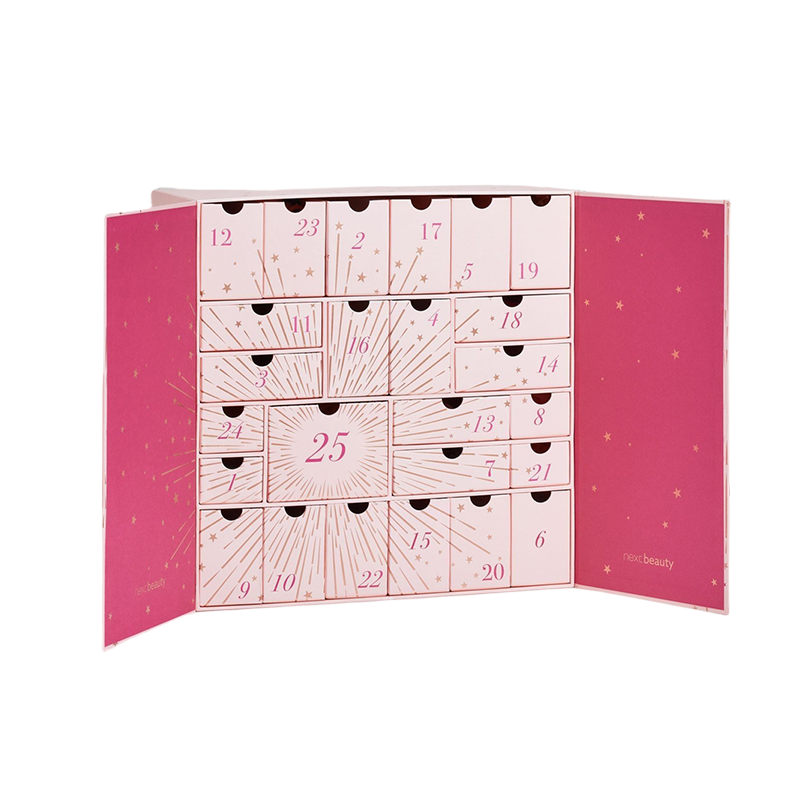
1. Start With the Products, Not the Box Shape
One of the most common mistakes in advent calendar packaging development is choosing the outer box design before confirming what will go inside.
A beautiful structure is not necessarily a practical one.
Consider a beauty advent calendar containing serum bottles, lipsticks, sample tubes, and skincare jars. Although the products may appear similar in a promotional rendering, their dimensions, weights, and shapes can vary significantly.
If the compartment layout is designed before these details are confirmed, the packaging may require extensive modifications later.
Before developing the structural design, prepare:
- The number of products in the calendar
- Individual product dimensions
- Product weight, including filled containers
- The orientation of each product
- Fragile areas such as glass bottles or pumps
- Required space for product removal
For a multi-product calendar, each compartment should be developed around the actual product rather than an estimated size.
A few millimeters can determine whether a product fits securely or becomes difficult to remove.
Buyer takeaway: Confirm the final product assortment before approving the calendar's outer dimensions.

2. Make Sure the Structure Protects the Contents
Advent calendar packaging often combines multiple components within one structure.
Depending on the design, these may include an outer rigid shell, internal partitions, removable drawers, paperboard inserts, and decorative panels.
Each component has a purpose.
The outer structure helps the calendar maintain its shape. Internal compartments separate products. Inserts hold items in position, while closing panels or drawers keep the contents organized until they are opened.
The challenge is making these components work together.
For example, a large advent calendar containing heavy glass products may require stronger internal support than one containing lightweight cosmetic samples.
If the internal structure is too weak, compartments can deform under the weight of the products.
If the insert is too loose, the products may shift during transportation.
A reliable design considers the complete packaging system rather than focusing only on the visible exterior.
For projects involving mixed-size products, buyers should review the structure of the internal compartments before finalizing the outer box.
Explore our custom advent calendar packaging options to see different construction styles.

3. Select Materials Based on Function and Presentation
Material selection affects more than appearance.
It can influence box strength, print quality, product protection, assembly, and the way the finished calendar feels when handled.
Common material options include rigid paperboard, folding paperboard, corrugated board, and different types of decorative wrapping paper.
The correct choice depends on the packaging design and the products inside.
| Material | Common Application | Important Considerations |
|---|---|---|
| Rigid paperboard | Premium book-style and drawer-style calendars | Board thickness, weight, shape retention |
| Folding paperboard | Lighter internal compartments and door panels | Folding accuracy, stiffness, opening function |
| Corrugated board | Protective internal parts or outer shipping cartons | Compression strength and product protection |
| Decorative wrapping paper | Outer surfaces of premium rigid boxes | Printing quality, lamination, texture, adhesion |
For a premium skincare advent calendar, rigid paperboard wrapped with printed specialty paper may create the desired presentation.
For internal compartments, lighter paperboard structures may be suitable if they provide sufficient product support.
However, thicker material is not automatically better.
Increasing board thickness can affect folding, assembly, overall weight, and shipping volume.
The material specification should support the design instead of making it unnecessarily complicated.
Buyer takeaway: Ask the manufacturer to recommend materials based on the complete product weight, box structure, and desired finish.

4. Test How Every Door or Drawer Opens
An advent calendar is different from an ordinary gift box because the customer interacts with it repeatedly.
The opening experience is part of the product.
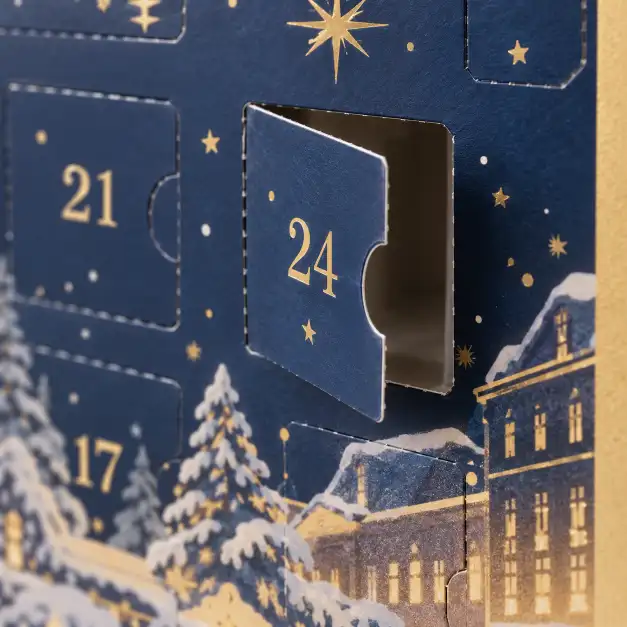
For a traditional numbered-door calendar, each door should remain closed until the customer opens it.
If the perforation is too weak, a door may open accidentally during packing or handling.
If the perforation is too strong, the customer may struggle to open it or damage the surrounding printed surface.
The opening design also needs to provide enough room to remove the product.
Drawer-style calendars introduce different requirements.
Drawers should slide smoothly without becoming loose, misaligned, or difficult to remove.
Pull tabs, ribbons, and finger notches should be positioned for comfortable use.
Common points to check include:
- Perforation strength
- Door alignment
- Drawer fit and movement
- Pull-tab placement
- Product accessibility
- Surface damage during opening
- Repeated opening and closing, where applicable
These issues cannot be fully evaluated through a digital rendering.
A physical structural sample is necessary to confirm the opening experience.
5. Design Inserts for Protection and Easy Packing
A well-designed insert does more than hold products in place.
It also influences how efficiently the calendar can be packed during production.
For calendars containing products of different shapes, every cavity should provide adequate support while allowing the packing team to insert the product without excessive force.
Common insert materials include:
- Die-cut paperboard
- Folded cardboard partitions
- Corrugated supports
- EVA foam
- Molded fiber trays
Paperboard inserts may be suitable for lighter products, while more specialized structures may be required for fragile or heavier items.
The insert must also be compatible with the calendar's opening mechanism.
For example, a product positioned too close to a perforated door could make the door difficult to open.
A drawer cavity that is too tight may slow down packing and create unnecessary pressure on the product.
When developing inserts, test them with the actual products and consider the complete packing process.
Our custom box inserts guide explains more about material and structural options.

6. Check the Artwork Against the Real Structure
Advent calendar packaging usually includes multiple printed surfaces, numbered compartments, decorative elements, and sometimes special finishing.
Artwork that looks perfect on a flat design file may not align correctly after folding and assembly.
This is particularly important when printed patterns extend across doors, panels, and connecting edges.
Before approving artwork, check:
Number alignment: Every number should be clearly visible and correspond to the intended opening.
Cutting positions: Important graphics should not be placed where cutting or perforation could damage them.
Folding areas: Text and key design elements should remain readable after assembly.
Internal printing: Visible internal surfaces should match the approved artwork and material specification.
Finishing positions: Foil stamping, embossing, and spot UV should be positioned with the structural limitations in mind.
For premium packaging, even small alignment differences can affect the finished appearance.
A printed sample should therefore be reviewed in its fully assembled form, not only as a flat sheet.
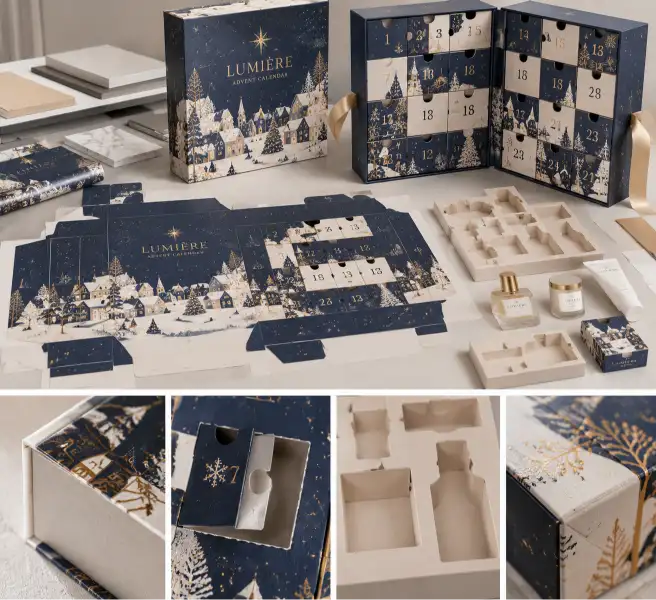
7. Consider Mass Production From the Beginning
A custom advent calendar box may look impressive as a single handmade prototype.
But producing hundreds or thousands of consistent units requires a different level of planning.
Complex structures can involve multiple die-cut components, folding operations, wrapping processes, adhesive applications, and assembly stages.
Every additional component introduces another point that needs to be controlled.
For example, a calendar with 24 individual drawers requires consistent drawer dimensions and reliable alignment.
If drawer sizes vary, some compartments may fit correctly while others become too tight or loose.
Similarly, a large door-opening calendar requires accurate cutting and positioning across the complete panel.
Before confirming bulk production, ask:
- Can the structure be assembled consistently?
- Are the materials suitable for repeat production?
- Are the cutting and folding details clearly documented?
- Can the products be packed efficiently?
- Can color and finishing be reproduced consistently?
- Are the final packing requirements confirmed?
Manufacturability should be considered during structural development, not after the final artwork has been approved.
For more information on production planning, see our Advent Calendar Boxes Wholesale Guide.

8. Approve a Physical Sample Before Full Production
A physical sample is one of the most useful tools for identifying packaging problems before a bulk order begins.
It allows the brand and manufacturer to evaluate the actual structure, materials, printing, inserts, and opening experience together.
During sample approval, check the following:
| Inspection Point | What to Confirm |
|---|---|
| Finished dimensions | Correct overall size and compartment measurements |
| Structural stability | No unwanted bending or deformation |
| Door or drawer function | Smooth, consistent opening |
| Product fit | Items remain secure and can be removed easily |
| Printing | Correct artwork, numbers, and color references |
| Finishing | Approved foil, lamination, embossing, and surface quality |
| Assembly | Clean corners, proper alignment, and consistent construction |
| Packing | Products and completed boxes can be packed efficiently |
The sample should ideally be tested with real products or accurate product equivalents.
A sample with empty compartments does not fully demonstrate how the final packed calendar will perform.
Any revisions should be documented before the sample is approved.
For complex designs, it can be helpful to separate structural approval from printed sample approval.
This allows the packaging team to confirm the construction before investing in final decorative details.
9. Do Not Overlook Export Packing and Transportation
Even a well-manufactured advent calendar can be damaged if the final packing method is unsuitable.
Advent calendar boxes may have large printed panels, exposed corners, delicate finishes, or multiple internal components.
These details need appropriate protection during storage and transportation.
Depending on the structure, the finished calendar may be shipped fully assembled, partially assembled, or in components.
The most suitable method depends on the design, materials, assembly requirements, and destination.
Before shipment, confirm:
- Units per master carton
- Carton size and weight
- Packaging orientation
- Corner and surface protection
- Internal separation materials
- Carton markings
- Pallet configuration, where required
For seasonal packaging, damaged or delayed deliveries can create additional complications because launch dates are often fixed.
Export packing should therefore be discussed before production is completed.

The Real Value of Good Advent Calendar Packaging
Good advent calendar packaging is not simply about making a product look festive.
It is about creating a complete packaging solution that works.
The outer design should communicate the brand. The structure should protect the products. The opening mechanism should feel natural. The materials should support the intended presentation. And the approved design should be practical for consistent manufacturing.
These details may not attract attention in a product photograph.
But they make a difference when the packaging moves from a design concept to a finished product.
At Gifts-Pack, we approach custom paper packaging as a connected process, combining structural development, material selection, sampling, printing, and production considerations.
Whether you are developing a beauty advent calendar, a seasonal gift collection, or a custom retail promotion, planning these details early can help reduce unnecessary revisions and improve the final result.
Planning a Custom Advent Calendar Packaging Project?
Explore our custom advent calendar boxes or contact Gifts-Pack to discuss your products, preferred structure, packaging materials, and production requirements.

