A brand manager needs 25,000 folding cartons for a national product launch. The first quote is $0.42 per unit at 10,000 units. The second quote is $0.28 per unit at 25,000 units. The difference? $3,500 in savings — enough to fund a finishing upgrade or an additional SKU. Understanding wholesale pricing tiers is the difference between a good procurement decision and a great one.
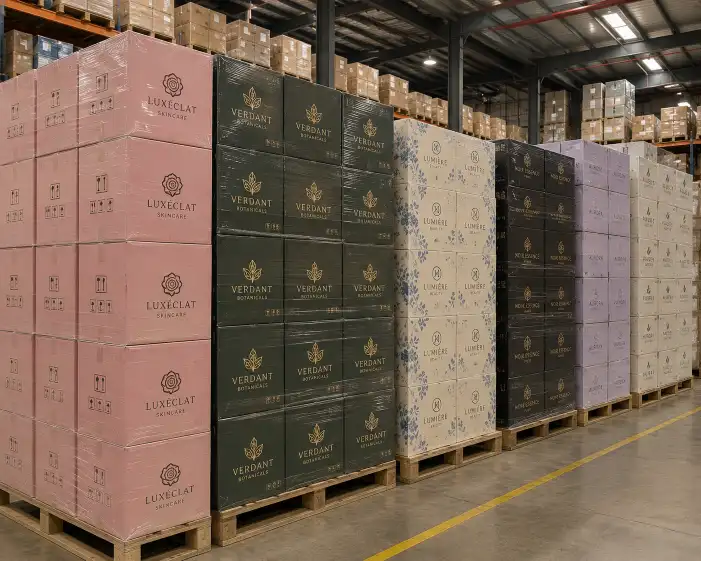
Wholesale custom boxes are priced on volume-based tiers — the more you order, the lower the per-unit cost. Typical wholesale pricing breaks at 1,000, 5,000, 10,000, and 50,000 units, with each tier reducing per-unit cost by 15–40%. The key to smart wholesale purchasing is knowing which tier fits your actual demand, optimizing your box specifications for volume production, and choosing a supplier that can deliver consistent quality at scale.
The Leader Giftspack Team has manufactured wholesale custom boxes for brands ranging from 1,000 to 500,000+ units across cosmetics, electronics, food, beverage, and gift industries. This guide covers everything you need to know about buying wholesale custom boxes — volume pricing tiers, how to optimize specifications for bulk production, supplier selection for large orders, quality control at scale, and strategies to maximize your packaging budget.
What Are Wholesale Custom Boxes?
Wholesale custom boxes are custom-manufactured packaging ordered in bulk quantities, typically 1,000+ units, at volume-based pricing. Unlike retail or small-batch packaging, wholesale orders benefit from:
- Economies of scale: Setup costs (tooling, plates, machine configuration) are spread across more units
- Material volume discounts: Paperboard, ink, and finishing materials are cheaper when purchased in bulk
- Production efficiency: Longer production runs reduce per-unit labor and machine time
- Consistent quality: Large runs from a single production batch ensure color and finish consistency
Wholesale vs Small-Batch — Key Differences
| Factor |
Small-Batch (200–1,000 units) |
Wholesale (1,000–50,000+ units) |
| Typical per-unit cost |
$1.00–$8.00 |
$0.20–$3.00 |
| Setup cost impact |
20–50% of total cost |
2–10% of total cost |
| Printing method |
Digital (preferred) |
Offset or flexo (preferred) |
| Lead time |
2–4 weeks |
4–8 weeks |
| Customization level |
High (flexible) |
Standardized (efficient) |
| Quality control |
Sample-based |
AQL-based batch inspection |
| Shipping |
Less-than-container (LCL) |
Full-container (FCL) preferred |
| Best for |
Product launches, testing |
Scale production, retail distribution |
Volume Pricing Tiers — How Quantity Affects Per-Unit Cost
Pricing Tiers for Folding Cartons (Standard 6"×4"×3", 4-Color Offset, Aqueous Coating)
| Quantity Tier |
Per-Unit Cost |
Total Cost |
Cost Reduction vs Previous Tier |
Setup Cost per Unit |
| 500 units |
$0.90–$1.50 |
$450–$750 |
— |
$0.40–$0.80 |
| 1,000 units |
$0.70–$1.20 |
$700–$1,200 |
20–22% lower |
$0.20–$0.40 |
| 3,000 units |
$0.45–$0.80 |
$1,350–$2,400 |
33–36% lower |
$0.07–$0.13 |
| 5,000 units |
$0.35–$0.60 |
$1,750–$3,000 |
22–25% lower |
$0.04–$0.08 |
| 10,000 units |
$0.25–$0.45 |
$2,500–$4,500 |
25–29% lower |
$0.02–$0.04 |
| 25,000 units |
$0.18–$0.35 |
$4,500–$8,750 |
22–28% lower |
$0.01–$0.02 |
| 50,000 units |
$0.14–$0.28 |
$7,000–$14,000 |
20–22% lower |
$0.004–$0.008 |
| 100,000+ units |
$0.10–$0.22 |
$10,000–$22,000 |
21–29% lower |
$0.002–$0.004 |
Pricing Tiers for Rigid Boxes (Standard 8"×6"×3", 4-Color Offset Wrap, Matte Lamination)
| Quantity Tier |
Per-Unit Cost |
Total Cost |
Cost Reduction vs Previous Tier |
| 500 units |
$6.50–$9.00 |
$3,250–$4,500 |
— |
| 1,000 units |
$4.00–$5.50 |
$4,000–$5,500 |
35–38% lower |
| 3,000 units |
$3.00–$4.20 |
$9,000–$12,600 |
22–25% lower |
| 5,000 units |
$2.50–$3.50 |
$12,500–$17,500 |
15–17% lower |
| 10,000 units |
$2.00–$3.00 |
$20,000–$30,000 |
14–20% lower |
| 25,000 units |
$1.50–$2.40 |
$37,500–$60,000 |
20–25% lower |
| 50,000+ units |
$1.20–$2.00 |
$60,000–$100,000 |
17–20% lower |
Where the Cost Savings Come From
| Cost Component |
At 500 Units |
At 10,000 Units |
At 50,000 Units |
| Material (per unit) |
$0.40 |
$0.25 |
$0.18 |
| Printing (per unit) |
$0.25 |
$0.08 |
$0.04 |
| Finishing (per unit) |
$0.15 |
$0.06 |
$0.04 |
| Labor (per unit) |
$0.30 |
$0.10 |
$0.06 |
| Setup/tooling (spread per unit) |
$0.60 |
$0.03 |
$0.006 |
| Total per unit |
$1.70 |
$0.52 |
$0.33 |
The biggest savings come from spreading setup costs across more units and the production efficiency of longer runs.
Wholesale Pricing by Box Type
Folding Carton Wholesale Pricing
| Carton Size |
1,000 Units |
5,000 Units |
10,000 Units |
25,000 Units |
50,000 Units |
| 2"×2"×1" (small) |
$0.40–$0.65 |
$0.20–$0.35 |
$0.15–$0.25 |
$0.10–$0.20 |
$0.08–$0.16 |
| 4"×3"×2" (standard) |
$0.55–$0.90 |
$0.28–$0.45 |
$0.20–$0.35 |
$0.15–$0.28 |
$0.12–$0.22 |
| 6"×4"×3" (mid-size) |
$0.70–$1.20 |
$0.35–$0.60 |
$0.25–$0.45 |
$0.18–$0.35 |
$0.14–$0.28 |
| 8"×6"×3" (large) |
$0.95–$1.60 |
$0.45–$0.80 |
$0.32–$0.60 |
$0.22–$0.45 |
$0.18–$0.35 |
| 10"×8"×4" (extra large) |
$1.30–$2.20 |
$0.60–$1.10 |
$0.45–$0.80 |
$0.30–$0.60 |
$0.24–$0.48 |
Rigid Box Wholesale Pricing
| Box Size |
1,000 Units |
5,000 Units |
10,000 Units |
25,000 Units |
50,000 Units |
| 4"×4"×2" (jewelry) |
$2.80–$3.80 |
$1.80–$2.50 |
$1.50–$2.20 |
$1.20–$1.80 |
$1.00–$1.50 |
| 6"×6"×3" (cosmetic) |
$3.50–$5.00 |
$2.20–$3.20 |
$1.80–$2.80 |
$1.40–$2.20 |
$1.10–$1.80 |
| 8"×6"×3" (standard gift) |
$4.00–$5.50 |
$2.50–$3.50 |
$2.00–$3.00 |
$1.50–$2.40 |
$1.20–$2.00 |
| 10"×8"×3" (electronics) |
$5.00–$7.00 |
$3.00–$4.50 |
$2.50–$3.80 |
$1.80–$3.00 |
$1.50–$2.50 |
| 12"×9"×4" (large gift) |
$6.00–$8.50 |
$3.50–$5.50 |
$3.00–$4.50 |
$2.20–$3.50 |
$1.80–$3.00 |
Corrugated Box Wholesale Pricing
| Box Size |
Board Grade |
1,000 Units |
5,000 Units |
10,000 Units |
50,000 Units |
| 12"×10"×8" |
32 ECT, C-flute |
$0.55–$0.85 |
$0.32–$0.50 |
$0.25–$0.40 |
$0.18–$0.30 |
| 16"×12"×10" |
32 ECT, C-flute |
$0.70–$1.10 |
$0.40–$0.65 |
$0.32–$0.52 |
$0.22–$0.38 |
| 20"×16"×12" |
44 ECT, BC-flute |
$1.20–$1.80 |
$0.70–$1.10 |
$0.55–$0.85 |
$0.40–$0.65 |
| 24"×18"×18" |
44 ECT, BC-flute |
$1.60–$2.50 |
$0.90–$1.50 |
$0.70–$1.20 |
$0.50–$0.90 |
Paper Bag Wholesale Pricing
| Bag Size |
Handle Type |
1,000 Units |
5,000 Units |
10,000 Units |
50,000 Units |
| 8"×10"×4" |
Twisted paper |
$0.25–$0.38 |
$0.16–$0.26 |
$0.12–$0.20 |
$0.08–$0.14 |
| 10"×14"×5" |
Twisted paper |
$0.35–$0.52 |
$0.20–$0.30 |
$0.15–$0.24 |
$0.10–$0.18 |
| 10"×14"×5" |
Cotton rope |
$0.50–$0.75 |
$0.30–$0.45 |
$0.24–$0.36 |
$0.18–$0.28 |
| 12"×16"×6" |
Cotton rope |
$0.65–$1.00 |
$0.38–$0.58 |
$0.30–$0.48 |
$0.22–$0.38 |
For a detailed cost breakdown of all packaging types, see our custom packaging cost guide.

How to Optimize Box Specifications for Volume Production
Standardization Strategies
| Strategy |
Cost Savings |
How It Works |
| Use standard box sizes |
10–20% |
Avoids custom die costs, uses stock material sizes with less waste |
| Reduce color count |
5–15% per color |
Each offset color requires a plate ($200–$500); fewer colors = lower setup |
| Limit finishes |
10–25% |
Each finish adds a production pass; combine finishes or limit to 1–2 |
| Simplify structure |
15–30% |
Complex auto-lock or multi-part boxes require more labor than simple tuck-top |
| Combine multiple SKUs in one run |
10–20% |
Same material, same printing, same finishing — only die changes between SKUs |
| Optimize dimensions for material yield |
5–10% |
Standard material sheet sizes waste less when box dimensions are optimized |
Material Optimization for Volume
| Material |
Standard Sheet Size |
Optimized Box Dimensions |
Waste Reduction |
| SBS paperboard |
28"×40" |
Box dimensions that fit the sheet in multiples |
5–15% |
| Corrugated board |
87"×varies |
Box dimensions that minimize flute direction waste |
5–10% |
| Greyboard (rigid) |
30"×42" |
Wrap dimensions that fit the greyboard sheet |
10–20% |
| Art paper (wrapping) |
28"×40" |
Wrap dimensions that fit the paper sheet |
10–20% |
Printing Optimization for Volume
| Optimization |
Cost Impact |
Notes |
| Combine multiple art files on one plate |
20–40% lower plate cost |
Print multiple SKUs in one pass |
| Use standardized colors (CMYK + 1–2 PMS) |
15–25% lower plate cost |
Each extra PMS color adds a plate |
| Print on one side only |
10–20% lower printing cost |
Interior printing adds cost with less visual impact |
| Use flexo instead of offset for simple designs |
20–30% lower cost at 10,000+ units |
Flexo is more efficient for 1–3 color designs |
| Gang-run multiple orders |
15–25% lower cost |
Combine with other orders from the same material |
For more on printing optimization, see our box printing methods guide.

Choosing a Wholesale Supplier
Supplier Evaluation Criteria
| Criterion |
What to Evaluate |
Red Flags |
| Production capacity |
Maximum monthly output, number of production lines |
Cannot meet your peak volume |
| Quality certifications |
ISO 9001, FSC, GMI, BSCI |
No certifications for a large manufacturer |
| Material sourcing |
Paperboard source, mill relationships |
Inconsistent material quality |
| Equipment |
Offset presses, die-cutters, finishing equipment |
Outdated equipment, limited capabilities |
| Quality control |
AQL inspection process, in-house QC team |
No QC documentation or process |
| Lead time reliability |
On-time delivery track record |
History of late deliveries |
| Communication |
English-speaking sales team, response time |
Slow responses, unclear communication |
| Sample process |
Sample approval before production |
No sample offered or rushed sample |
| Payment terms |
T/T, L/C, net terms |
100% upfront payment required |
| Minimum order |
MOQ for your box type |
MOQ higher than your requirement |
Offshore vs Domestic Suppliers
| Factor |
Chinese Manufacturer (Offshore) |
US/EU Manufacturer (Domestic) |
| Per-unit cost |
$0.20–$0.80 (for folding cartons) |
$0.50–$1.50 (for folding cartons) |
| Tooling cost |
$300–$800 |
$500–$1,500 |
| MOQ |
1,000–5,000 units |
2,000–10,000 units |
| Lead time |
4–8 weeks |
2–4 weeks |
| Shipping cost |
$300–$2,000+ (sea freight) |
$100–$500 (ground freight) |
| Shipping time |
3–6 weeks (sea) |
3–7 days (ground) |
| Communication |
Time zone difference, language barrier |
Same time zone, no language barrier |
| Quality control |
Third-party inspection recommended |
Factory visits easier |
| Best for |
Large orders, cost-sensitive |
Small-medium orders, time-sensitive |
Questions to Ask a Wholesale Supplier
| Question |
Why It Matters |
| What is your MOQ for my box type? |
Confirms they can handle your volume |
| Can you provide a sample of similar work? |
Verifies quality before committing |
| What is your lead time for the first order? Reorders? |
First orders may be longer due to tooling |
| Do you offer FOB, CIF, or DDP pricing? |
Affects total landed cost |
| What is your AQL inspection level? |
Ensures consistent quality across large orders |
| Can you hold inventory for split shipments? |
Reduces warehousing cost for the buyer |
| What is your defect return policy? |
Protection if boxes arrive damaged |
| Can you gang-run my order with others? |
Potential cost savings |
| Do you have FSC certification? |
Important for eco-conscious brands |
| Can you handle multiple SKUs in one order? |
Simplifies procurement for multi-product brands |
For more on supplier selection, see our custom box quote guide.
Quality Control for Large Orders
AQL (Acceptable Quality Limit) Inspection
| Order Size |
Sample Size |
Critical Defects |
Major Defects |
Minor Defects |
| 1,000–3,000 units |
125 units |
0 allowed |
5 allowed |
8 allowed |
| 3,001–10,000 units |
200 units |
0 allowed |
7 allowed |
10 allowed |
| 10,001–50,000 units |
315 units |
0 allowed |
10 allowed |
14 allowed |
| 50,001–150,000 units |
500 units |
0 allowed |
14 allowed |
21 allowed |
What to Inspect in a Wholesale Box Order
| Inspection Category |
What to Check |
Acceptable Tolerance |
| Dimensions |
Length, width, height, board thickness |
±1 mm (folding cartons), ±1.5 mm (rigid boxes) |
| Print quality |
Color accuracy, registration, ink coverage |
Match approved proof within visual tolerance |
| Finishing |
Lamination adhesion, foil alignment, embossing depth |
No peeling, misalignment under 1 mm |
| Structure |
Die-cut accuracy, folding lines, glue application |
Clean folds, secure glue, no open seams |
| Material |
Board grade, GSM, flute type |
Match specification within 5% |
| Color consistency |
Across batch, within same production run |
ΔE under 3 (industry standard) |
| Barcode readability |
Scan test, print contrast |
100% scannable |
| Packaging |
Case pack quantity, pallet stacking, stretch wrap |
Per your specification |
Pre-Shipment Inspection Checklist
Shipping and Logistics for Bulk Box Orders
Shipping Methods Comparison
| Shipping Method |
Cost |
Transit Time |
Best For |
Volume |
| Sea freight (FCL — full container) |
Lowest per-unit cost |
3–6 weeks |
Large orders, cost-sensitive |
1 full container (20' or 40') |
| Sea freight (LCL — less than container) |
Moderate |
3–6 weeks |
Medium orders, flexible |
1–20 pallets |
| Air freight |
Highest |
5–10 days |
Urgent orders, samples |
Small-medium volume |
| Express courier (DHL, FedEx, UPS) |
Very high |
3–7 days |
Samples, urgent small orders |
Under 100 kg |
| Rail freight (China–Europe) |
Moderate |
2–3 weeks |
Europe-bound orders |
Container-sized |
Container Capacity for Boxes
| Box Type |
Boxes per 20' Container |
Boxes per 40' Container |
| Folding cartons (shipped flat) |
30,000–60,000 (depending on size) |
65,000–130,000 |
| Rigid boxes (shipped assembled) |
2,000–8,000 (depending on size) |
4,500–18,000 |
| Rigid boxes (shipped flat/collapsible) |
10,000–30,000 |
22,000–65,000 |
| Corrugated boxes (shipped flat) |
8,000–20,000 |
18,000–45,000 |
| Paper bags (shipped flat) |
50,000–150,000 |
110,000–330,000 |
How to Reduce Shipping Costs for Bulk Orders
| Strategy |
Savings |
How It Works |
| Ship rigid boxes flat (collapsible) |
60–80% on freight |
Flat boxes take 1/5 the volume of assembled boxes |
| Use FCL instead of LCL |
20–40% per unit |
Full container is cheaper per volume than shared |
| Optimize pallet configuration |
10–15% |
Maximize box count per pallet, reduce wasted space |
| Consolidate multiple SKUs in one container |
15–25% |
Ship all products together to fill a container |
| Choose a port close to your destination |
5–15% |
Inland freight from port adds cost |
| Plan ahead — avoid air freight |
80–90% vs air |
Sea freight is dramatically cheaper than air |
Wholesale Buying Strategies
Strategy 1: Buy at the Right Tier
| Your Annual Need |
Optimal Order Quantity |
Why |
| 2,000–5,000 units/year |
One order of 3,000–5,000 units |
Better pricing than 1,000, lower inventory risk |
| 5,000–15,000 units/year |
Two orders of 5,000–7,500 units |
Balance of pricing and cash flow |
| 15,000–50,000 units/year |
One order of 25,000–50,000 units |
Best pricing, can warehouse for 6–12 months |
| 50,000+ units/year |
Quarterly orders of 15,000–25,000 units |
Regular production, consistent quality, negotiate annual pricing |
Strategy 2: Negotiate Annual Contracts
| Contract Type |
How It Works |
Typical Discount |
| Volume commitment |
Commit to X units per year, order in batches |
5–15% off standard pricing |
| Exclusive supplier |
Use one supplier for all packaging needs |
5–10% off |
| Annual price lock |
Lock in pricing for 12 months regardless of material cost changes |
3–5% premium for stability |
| Consignment inventory |
Supplier holds inventory, you pay as drawn |
0–5% premium (saves warehousing) |
Strategy 3: Optimize Across Multiple SKUs
| Approach |
Savings |
How It Works |
| Gang-run multiple SKUs |
10–20% |
Same material, same printing colors, same finishing — all SKUs in one production run |
| Standardize box sizes |
5–15% |
Use the same box dimensions for different products where possible |
| Standardize materials |
5–10% |
Use the same paperboard grade, lamination, and finishes across all SKUs |
| Combine inserts with box order |
10–15% |
Order inserts from the same supplier, ship together |
Strategy 4: Plan for Reorders
| Reorder Factor |
Why It Saves Money |
| Reuse existing dies |
No die cost on reorders (save $300–$800) |
| Reuse printing plates |
No plate cost on reorders (save $200–$800 per color) |
| Same material specification |
No material qualification needed |
| Faster lead time |
2–4 weeks vs 4–8 weeks for first order |
| Established quality baseline |
No need for initial sample approval |
FAQ
What is the minimum order quantity for wholesale custom boxes?
Wholesale MOQs typically start at 1,000 units for folding cartons, 1,000 units for rigid boxes, 500 units for corrugated boxes, and 1,000–2,000 units for paper bags. However, true wholesale pricing (with significant volume discounts) usually starts at 5,000–10,000 units. Some suppliers offer lower MOQs for a premium per-unit price.
How much do wholesale custom boxes cost per unit?
Wholesale custom box pricing depends on the box type, size, printing, and quantity. For folding cartons at 10,000 units, expect $0.25–$0.45 per unit. For rigid boxes at 10,000 units, expect $2.00–$3.00 per unit. For corrugated boxes, $0.25–$0.40 per unit. Volume pricing at 50,000+ units can reduce these costs by an additional 20–30%.
How can I get the best price on wholesale custom boxes?
To get the best price: (1) order at the highest volume tier your budget allows, (2) use standard sizes instead of custom dimensions, (3) limit printing to 1–4 colors, (4) use flexo printing for simple designs at high volume, (5) limit finishes to 1–2, (6) combine multiple SKUs in one production run, and (7) negotiate annual contracts with volume commitments.
What is the difference between wholesale and retail packaging pricing?
Wholesale pricing is based on volume production — setup costs are spread across thousands of units, materials are purchased in bulk, and production runs are longer and more efficient. Retail or small-batch pricing has higher per-unit costs because setup costs are spread across fewer units, materials are purchased in smaller quantities, and production runs are shorter.
How do I choose a wholesale packaging supplier?
Evaluate suppliers on: production capacity, quality certifications (ISO 9001, FSC, GMI), equipment capabilities, quality control processes, lead time reliability, communication quality, and payment terms. Request samples of similar work, ask for customer references, and consider a trial order before committing to a large volume.
Should I buy wholesale from China or a domestic supplier?
Chinese manufacturers offer 30–60% lower per-unit costs but require longer lead times (4–8 weeks production + 3–6 weeks shipping), higher MOQs, and more quality management. Domestic suppliers offer faster turnaround, easier communication, and simpler quality control but at higher per-unit costs. The choice depends on your order volume, timeline, and budget priorities.
How do I ensure quality on a large wholesale box order?
Use AQL-based inspection (random sampling from finished goods), require a pre-production sample, request in-process inspection during production, and conduct a pre-shipment inspection before the order leaves the factory. For overseas orders, hire a third-party inspection company. Establish clear quality standards and defect tolerances in your purchase agreement.
What is the best way to ship wholesale custom boxes?
For large orders (20,000+ folding cartons or 5,000+ rigid boxes), sea freight in a full container (FCL) offers the lowest per-unit shipping cost. For medium orders, LCL (less than container) sea freight is the most practical option. For rigid boxes, always ship them flat or collapsible to reduce shipping volume by 60–80%.
Can I get different box designs in the same wholesale order?
Yes. This is called gang-running — printing multiple SKUs in the same production run using the same material, printing colors, and finishing. Gang-running reduces setup costs by 10–20% compared to running each SKU separately. The key requirement is that all SKUs share the same material specification and printing method.
How do I negotiate pricing with a wholesale packaging supplier?
Negotiate on: (1) per-unit price at your target volume tier, (2) tooling/die costs (ask for waiver or reduction on first order), (3) payment terms (50/50 is standard; 30/70 is better for buyer), (4) shipping terms (FOB vs CIF vs DDP), and (5) annual volume commitment discounts. Always get multiple quotes and compare apples-to-apples specifications.


