
A beauty brand launches a new skincare line. The rigid box design looks perfect on screen — the colors are vibrant, the foil stamping catches the light, and the magnetic closure sits flush. When the pre-production sample arrives from the factory, the foil is misaligned by 3 mm, the magnetic closure is too weak to hold the lid closed, and the box color is two shades darker than the approved proof. The brand catches all of this before 10,000 boxes go into production. That is why samples exist.

Custom packaging samples come in four types: stock samples (existing boxes to evaluate supplier quality), structural samples (unprinted boxes to test fit and construction), pre-production samples (full printed and finished boxes matching production specs), and digital proofs (color and artwork confirmation). Each type serves a different purpose and costs differently — from free to $50–$300 per sample. The most important rule: never approve production without seeing a physical pre-production sample first.
The Leader Giftspack Team has produced thousands of samples for brands across cosmetics, electronics, jewelry, and gift industries over 16 years of manufacturing. This guide covers everything you need to know about ordering custom packaging samples — the types available, what each costs, how long they take, what to check when you receive one, and how to use samples to avoid costly production mistakes. Whether you are ordering your first custom box or your hundredth, understanding the sample process protects your investment.
Why Samples Matter — The Cost of Skipping Samples
Skipping the sample stage is the most expensive mistake a packaging buyer can make. Here is what can go wrong:
Real Cost of Sample vs Production Mistakes
| Issue | Cost If Caught in Sample | Cost If Caught in Production |
|---|---|---|
| Color mismatch | $50–$150 (new sample) | $2,000–$10,000 (discard and reprint 10,000 boxes) |
| Wrong dimensions (product does not fit) | $80–$200 (new structural sample) | $3,000–$15,000 (scrap + reorder entire batch) |
| Foil stamping misalignment | $100–$250 (adjust die + new sample) | $2,000–$8,000 (all boxes with misaligned foil are unusable) |
| Insert does not hold product securely | $50–$150 (redesign insert + resample) | $1,000–$5,000 (inserts must be remade at full cost) |
| Lamination peeling or bubbling | $100–$200 (adjust lamination settings) | $4,000–$12,000 (re-laminate or scrap) |
| Glue failure (box opens during use) | $80–$150 (change glue type or application) | $3,000–$8,000 (all boxes need regluing or replacement) |
| Barcode does not scan | $20–$50 (reprint barcode on sample) | $500–$3,000 (retailer chargebacks + relabeling) |
Industries with the Highest Sample Risk
| Industry | Typical Sample Cost | Production Order Value | Risk of Skipping Sample |
|---|---|---|---|
| Cosmetics | $100–$250 | $5,000–$50,000 | Color match, foil alignment, insert fit |
| Jewelry | $80–$200 | $3,000–$30,000 | Box size, cushion fit, closure security |
| Electronics | $150–$300 | $10,000–$100,000 | Foam cutout precision, structural strength |
| Food & beverage | $100–$250 | $8,000–$60,000 | Food-safe certification, seal integrity |
| Corporate gifting | $120–$300 | $10,000–$80,000 | Brand color accuracy, overall quality |
The Four Types of Packaging Samples
Type 1: Stock Samples (Existing Boxes)
Stock samples are existing boxes from the supplier's catalog. They are used to evaluate the quality of a supplier's work before committing to a custom design.
| Detail | Description |
|---|---|
| Purpose | Evaluate supplier quality, feel materials, assess construction |
| Customization | None — pre-made boxes from existing inventory |
| Cost | Free to $20 (shipping only) |
| Lead time | 3–7 days (ship from stock) |
| Best for | Initial supplier evaluation, comparing multiple suppliers |
| Limitations | Does not represent your specific design or dimensions |
Type 2: Structural Samples (Unprinted Mockups)
Structural samples are plain, unprinted boxes made to your exact dimensions and box style. They use the same board thickness and construction as your final box but without printing or finishing.
| Detail | Description |
|---|---|
| Purpose | Test box dimensions, product fit, structural integrity |
| Customization | Your dimensions and box style, no print |
| Cost | $30–$100 (plus shipping) |
| Lead time | 5–10 days |
| Best for | Confirming product fit, testing insert compatibility, checking structural strength |
| Limitations | No color, printing, or finish evaluation |
Type 3: Pre-Production Samples (Full Spec)
Pre-production samples (also called PP samples or approval samples) are made using the same materials, printing, finishing, and construction as your final production order. This is the most important sample type.
| Detail | Description |
|---|---|
| Purpose | Final approval before full production |
| Customization | Full — your design, materials, printing, finishes |
| Cost | $50–$300 (often deducted from production order) |
| Lead time | 10–20 days |
| Best for | Final color approval, finish quality check, overall product verification |
| Limitations | Hand-made sample may differ slightly from mass production (see next sample type) |
Type 4: Digital Proofs and Color Swatches
Digital proofs are electronic color simulations used to approve artwork layout and color placement before physical sample production. Color swatches show actual printed colors on your selected material.
| Detail | Description |
|---|---|
| Purpose | Approve artwork layout, color placement, font, and barcode position |
| Customization | Your artwork file |
| Cost | Free to $30 |
| Lead time | 1–3 days |
| Best for | Artwork approval, color proof before physical sample |
| Limitations | Screen colors differ from printed colors — do not approve color based on screen alone |
Sample Type Comparison Table
| Feature | Stock Sample | Structural Sample | Pre-Production Sample | Digital Proof |
|---|---|---|---|---|
| Shows dimensions | ✅ Yes | ✅ Yes | ✅ Yes | ❌ No |
| Shows product fit | ❌ No | ✅ Yes | ✅ Yes | ❌ No |
| Shows print quality | ❌ No | ❌ No | ✅ Yes | ⚠️ Limited |
| Shows color accuracy | ❌ No | ❌ No | ✅ Yes | ⚠️ Screen dependent |
| Shows finishing | ❌ No | ❌ No | ✅ Yes | ❌ No |
| Shows material feel | ✅ Yes | ✅ Yes | ✅ Yes | ❌ No |
| Cost | Free–$20 | $30–$100 | $50–$300 | Free–$30 |
| Lead time | 3–7 days | 5–10 days | 10–20 days | 1–3 days |
| Recommended order | First step | Second step | Final step | Before PP sample |
Sample Costs — What to Expect
Sample Cost by Box Type
| Box Type | Stock Sample | Structural Sample | Pre-Production Sample |
|---|---|---|---|
| Folding carton (standard size) | Free–$10 | $20–$50 | $50–$100 |
| Folding carton (custom size) | $10–$20 | $30–$70 | $80–$150 |
| Rigid box (simple, no print) | Free–$15 | $30–$60 | $60–$120 |
| Rigid box (with printing + finish) | $10–$20 | $40–$80 | $100–$250 |
| Rigid box (premium: foil, insert, magnet) | $15–$25 | $50–$100 | $150–$350 |
| Corrugated box (standard) | Free–$10 | $20–$50 | $50–$100 |
| Paper bag (printed) | Free–$10 | $20–$40 | $40–$80 |
| Box insert | $5–$15 | $15–$40 | $30–$80 |
| Tissue paper (printed) | $5–$10 | $10–$25 | $20–$50 |
Sample Cost Factors
| Factor | Impact on Sample Cost | Why |
|---|---|---|
| Box complexity | +20–50% for complex structures | More labor, more material to hand-assemble |
| Number of finishes | +$30–$100 per additional finish | Each finish (foil, embossing, UV) requires separate setup |
| Color count | +$20–$50 for 4-color vs 1-color | More ink colors, more setup time |
| Custom die | +$50–$200 if no existing die exists | Creating a new die for one sample is expensive |
| Inserts | +$20–$80 depending on type | Foam inserts cost more than cardboard |
| Rush order | +50–100% premium | Expedited production + shipping |
Sample Cost Recovery
Many suppliers deduct the sample cost from your production order if you proceed with production. Common policies:
| Policy | What It Means |
|---|---|
| Sample cost deducted | Sample cost is subtracted from the production invoice. Example: $200 sample, $5,000 production = pay $4,800 |
| Sample cost refunded on order | Sample cost is refunded when production order is placed. |
| Sample cost non-refundable | Sample cost is not recoverable. Most common for complex or heavily customized samples. |
| Free samples with shipping | Stock samples are free, buyer pays shipping only. |
Always ask about sample cost recovery before ordering.
For a complete cost breakdown of production orders, see our custom packaging cost guide.

Sample Lead Times
Standard Sample Lead Times
| Sample Type | Production Time | Shipping (Domestic) | Shipping (International) | Total Lead Time |
|---|---|---|---|---|
| Digital proof | 1–2 days | N/A (electronic) | N/A (electronic) | 1–2 days |
| Stock sample | 0–1 day | 2–5 days | 5–10 days | 2–6 days |
| Structural sample | 3–7 days | 2–5 days | 5–10 days | 5–17 days |
| Pre-production sample (simple) | 7–12 days | 2–5 days | 5–10 days | 9–22 days |
| Pre-production sample (complex) | 10–20 days | 2–5 days | 5–10 days | 12–30 days |
Sample Lead Time by Box Type
| Box Type | Structural Sample | Pre-Production Sample |
|---|---|---|
| Standard folding carton | 3–5 days | 7–10 days |
| Custom folding carton with die | 5–7 days | 8–12 days |
| Simple rigid box (no magnet) | 4–6 days | 8–12 days |
| Rigid box with magnetic closure | 5–7 days | 10–15 days |
| Premium rigid box (foil, insert, magnet) | 5–8 days | 12–18 days |
| Corrugated box | 3–5 days | 7–10 days |
| Paper bag | 3–5 days | 7–10 days |
How to Speed Up Sample Production
| Strategy | Time Saved | Risk |
|---|---|---|
| Use standard sizes (no custom die) | 3–7 days | Limited size options |
| Skip finishes on first sample | 3–5 days | Cannot evaluate finish quality |
| Approve digital proof before sample production | 2–3 days | None |
| Pay for rush/expedited service | 3–7 days | 50–100% cost premium |
| Use express shipping (DHL, FedEx) | 5–10 days | Higher shipping cost |
| Combine structural + pre-production into one step | 7–14 days | Higher risk — structural issues found late |
How to Request a Sample from a Supplier
Information to Provide
| Information | Why It Matters | Example |
|---|---|---|
| Box style | Determines which die/construction to use | "Lid-and-base rigid box, magnetic closure" |
| Internal dimensions (L×W×H) | Essential for correct sizing | "8" × 6" × 3" (inside) |
| Material specification | Board grade, thickness, color | "2.0 mm greyboard, wrapped in 150 GSM art paper, matte lamination" |
| Printing details | Color count, PMS colors, file format | "4-color CMYK + PMS 877C silver, artwork in AI format" |
| Finishing requirements | All finishes to be applied | "Matte lamination + gold foil stamping on logo + debossed border" |
| Insert requirements | Insert type, material, cutout shape | "EVA foam insert with custom cutout for serum bottle" |
| Quantity needed | How many samples | "2 samples — one for approval, one for archive" |
| Target production date | Helps prioritize sample timing | "Production planned for August 15" |
Questions to Ask About Samples
| Question | Why It Matters |
|---|---|
| What sample types do you offer? | Confirms supplier can provide the sample you need |
| What is the cost per sample? | Budget for sample stage |
| Is the sample cost deducted from production? | Saves money if you proceed |
| What is the sample lead time? | Plan your production timeline |
| Can I get a stock sample first to evaluate quality? | Low-cost way to vet supplier |
| Will the pre-production sample use production materials? | Confirms sample represents final product |
| Do you offer color swatches or paper samples? | Useful for material selection |
| Can I request revisions on the sample? | Most suppliers offer 1–2 rounds of sample revisions |
| How do I send artwork for the sample? | File format, resolution, and bleed requirements |
For more on supplier communication, see our custom box quote guide.
What to Check When You Receive a Sample
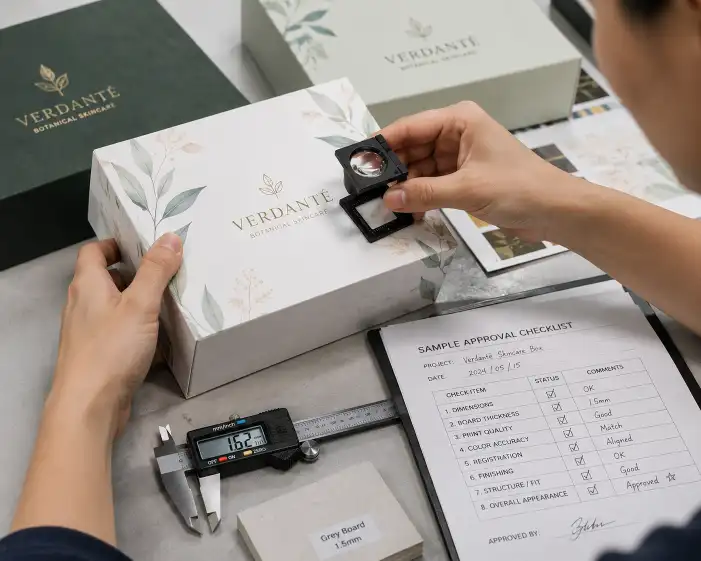
The 10-Point Sample Inspection
| Check Point | What to Look For | Pass/Fail Criteria |
|---|---|---|
| 1. Dimensions | Internal L×W×H matches spec, board thickness | ±1 mm for folding cartons, ±1.5 mm for rigid boxes |
| 2. Product fit | Does the product fit snugly without rattling or being tight? | Product should slide in easily with 1–2 mm clearance |
| 3. Print quality | Color accuracy, registration, sharpness, no ink spots | Match approved proof; no visible misregistration |
| 4. Color accuracy | Compare to approved color proof under daylight (5000K) lighting | ΔE under 3 (industry standard) |
| 5. Finishing quality | Lamination adhesion, foil sharpness, embossing depth | No peeling, bubbling, or misalignment over 1 mm |
| 6. Closure/mechanism | Magnet strength, ribbon pull, drawer slide, lid fit | Lid stays closed when shaken; drawer slides smoothly |
| 7. Insert fit | Product sits securely in insert; inserts fits snugly in box | Product does not shift when box is tilted |
| 8. Board/paper quality | Material matches spec (GSM, thickness, color) | Check with caliper if possible |
| 9. Glue/construction | Joints are secure, no gaps, no visible glue | Open and close repeatedly; no separation |
| 10. Barcode | Is barcode present? Does it scan? | 100% scannable; contrast ratio sufficient |
Tools You Need for Sample Inspection
| Tool | What It Checks | Estimated Cost |
|---|---|---|
| Caliper | Board thickness, material gauge | $15–$50 |
| Ruler / tape measure | Internal and external dimensions | $5–$15 |
| 5000K daylight lamp | Color accuracy evaluation | $30–$100 |
| PMS color fan deck | Spot color matching | $100–$300 |
| Barcode scanner | Barcode scanability | $20–$100 |
| Scale (gram) | Product + box weight for shipping | $15–$40 |
Sample Approval Checklist
Pre-Production Sample Approval Checklist
Use this checklist before approving a pre-production sample for mass production.
- Box dimensions match specification (internal L×W×H)
- Board thickness / material grade matches specification
- Product fits correctly — slides in easily, does not rattle
- Product is secure inside the box (no shifting when tilted)
- Insert holds product firmly without damage
- Print color matches approved proof under 5000K lighting
- Print registration is sharp — no misalignment between colors
- Text is readable — no blurring, no missing characters
- Lamination/coating is smooth — no bubbles, peeling, or scratches
- Foil stamping is sharp and correctly positioned
- Embossing/debossing depth is consistent and aligned
- Magnetic closure is strong enough (lid stays closed when shaken)
- Lid/hinge operates smoothly without cracking
- Glue joints are secure — no gaps, no visible glue residue
- Box material feels correct (paper texture, weight, thickness)
- Barcode scans correctly (if applicable)
- All brand elements (logo, colors, fonts) are correct
- Finishing matches specification (gloss/matte/soft touch)
- Sample is signed and dated for approval
- Any requested revisions are clearly documented
Sample Sign-Off Template
PROJECT: [Project Name]
SAMPLE TYPE: [Pre-Production / Structural]
SAMPLE RECEIVED: [Date]
APPROVED BY: [Name]

☐ APPROVED — Proceed to production
☐ APPROVED WITH CHANGES — Changes listed below; proceed after confirmation
☐ REJECTED — Revisions required (see notes)

REVISIONS NEEDED:
1. _________________________________________________
2. _________________________________________________
3. _________________________________________________

NOTES: ______________________________________________

SIGNATURE: ____________________ DATE: ______________
Common Sample Problems and How to Fix Them
| Problem | Likely Cause | How to Fix | Sample Stage |
|---|---|---|---|
| Product does not fit (too tight) | Internal dimensions too small | Increase box dimensions by 2–5 mm on each side | Structural |
| Product rattles inside | Internal dimensions too large | Decrease box dimensions or add insert | Structural |
| Color darker than proof | Printing pressure or ink density | Adjust printing settings; request corrected sample | Pre-production |
| Lamination peeling at edges | Lamination film not sealed properly | Adjust lamination temperature and pressure | Pre-production |
| Foil missing areas | Insufficient stamping pressure or worn die | Adjust foil stamping settings; replace die if needed | Pre-production |
| Magnet too weak | Magnet grade too low | Upgrade to N35 or N42 neodymium magnet | Pre-production |
| Box does not close flush | Board warp or lid misalignment | Check board moisture content; adjust lid alignment | Pre-production |
| Embossing too shallow | Insufficient pressure or wrong die angle | Increase embossing pressure; check die depth | Pre-production |
| Insert tears when placing product | Insert material too thin or cut too tight | Use thicker insert material or increase cutout size | Structural |
| Glue smell | Solvent-based glue used | Switch to water-based glue | Pre-production |
FAQ
How much does a custom packaging sample cost?
Custom packaging sample costs range from free (stock samples, shipping only) to $50–$350 for pre-production samples with full printing and finishing. The average cost for a pre-production sample of a standard rigid box with printing and lamination is $100–$250. Many suppliers deduct the sample cost from the production order if you proceed.
Can I get free samples of custom boxes?
Most suppliers offer free stock samples (existing boxes from inventory — you pay shipping only). For custom samples made to your specifications, a fee is standard because the supplier must allocate production time and materials. Custom structural samples cost $30–$100, and pre-production samples cost $50–$350.
What is the difference between a structural sample and a pre-production sample?
A structural sample is an unprinted box made to your dimensions to test product fit, box construction, and structural integrity. A pre-production sample uses the same materials, printing, and finishing as your final production order. You should order a structural sample first to confirm fit, then a pre-production sample to approve appearance.
How long does it take to get a packaging sample?
Stock samples: 3–7 days. Structural samples: 5–10 days. Pre-production samples: 10–20 days. Digital proofs: 1–3 days (electronic). International shipping adds 5–10 days. Rush service can reduce production time by 3–7 days for a 50–100% premium.
What should I check when I receive a packaging sample?
Check: dimensions (internal L×W×H), product fit, print color accuracy, print registration, finish quality (lamination, foil, embossing), closure mechanism, insert fit, board/paper quality, glue joints, and barcode scanability. Use the 10-point sample inspection checklist in this guide for a systematic review.
Is the sample cost refundable if I place a production order?
Many suppliers deduct the sample cost from your production invoice or refund it when you place an order. Policies vary — always ask before ordering. Some suppliers offer non-refundable samples, especially for complex or heavily customized boxes. Stock samples are typically free or charge shipping only.
How many sample rounds should I expect?
Most custom packaging projects require 1–2 sample rounds. The first round confirms the structural design and basic printing. The second round (if needed) verifies revisions from the first round. Complex projects with multiple finishes (foil, embossing, spot UV) may require 3 rounds. Each additional round adds 5–10 days and $50–$200 in cost.
Can I order a sample before providing final artwork?
Yes. Order a structural sample to confirm dimensions and product fit before finalizing artwork. The structural sample uses plain materials without printing. Once the structure is approved, you can finalize artwork and order a pre-production sample with full printing and finishing.
What happens if the sample does not match what I approved?
If the production boxes do not match the approved sample, you have grounds to reject the order. This is why the approved sample is the quality benchmark — both you and the supplier should keep a signed and dated reference sample. Always document the approval in writing with the sample as evidence of the agreed specification.
How do I compare samples from different suppliers?
Order structural samples from 2–3 shortlisted suppliers using the same specifications. Compare: dimensional accuracy, material quality, construction quality, and overall workmanship. Then order a pre-production sample from your preferred supplier. For a fair comparison, provide identical specifications to all suppliers. Consider that the cheapest sample may not represent the best production quality.

