
If you search for "how much do custom boxes cost," you will get one honest answer: it depends. But it does not depend on everything at once. In practice, the single biggest predictor of your price is the product going inside the box. A candle box is not a jewelry box, and neither one prices like a wine box — because the product drives the structure, the size, the insert, and the finishing. Once you know your product category, you can put a realistic number on your packaging before you ever ask a supplier for a quote.
This guide gives per-unit price ranges for the five categories brands ask about most — candles, jewelry, cosmetics and skincare, wine and spirits, and electronics — at the order quantities real buyers actually order. Use it to build a budget, then go deeper into the full cost breakdown in our custom packaging cost guide, which walks through every line item type by type.

Why Product Category Drives Custom Box Cost
Every custom box order starts the same way: a product arrives, and the packaging has to fit it, protect it, and sell it. That is why category predicts price better than almost anything else. A heavy 300 g jar candle needs a rigid wall and a snug tray; a 15 g ring needs a tiny precision box with a velvet-lined cavity; a 750 ml bottle needs a tall, structured box with a foam cradle. Each of those needs pulls a different structure, insert, and finish — and each has a different price.
Four things follow the product and drive the number:
- Structure — the box shape and how it opens. Rigid boxes cost roughly 3–5× more than folding boxes because they are built from formed board rather than scored flat sheets. Category convention matters: candles and cosmetics lean rigid, while lower-cost lines use folding cartons.
- Size and board — bigger footprint and thicker board mean more material. A wine box consumes several times the board of a ring box, which is why its unit price is higher even before labor.
- Insert — products that need to sit still in transit need custom box inserts: EVA foam trays, molded pulp cradles, or paperboard platforms. The more fragile and irregular the product, the more the insert costs.
- Finish — printing coverage, foil, embossing, and lamination set the premium feel. Category expectations push these choices: jewelry and cosmetics almost always add soft-touch and foil; candles often keep it simpler.
The category snapshot below is a budgeting starting point for rigid boxes at 1,000 and 5,000 units — the two quantity bands most new product launches fall into. Prices are USD per unit, pre-shipping, for standard sizes and full-color printing.
| Product category | Typical structure | Typical insert | Per unit @1,000 | Per unit @5,000 |
|---|---|---|---|---|
| Candle | Rigid lid-and-base or shoulder box | EVA foam disc tray | $4.50–$7.00 | $3.50–$5.50 |
| Jewelry | Rigid drawer or magnetic box | Velvet-coated EVA, slot cut | $4.00–$8.00 | $3.00–$6.00 |
| Cosmetic & skincare | Magnetic rigid box | EVA foam tray | $3.50–$6.50 | $2.80–$5.00 |
| Wine & spirits | Large rigid box (750 ml) | Foam or molded pulp cradle | $8.00–$15.00 | $6.50–$12.00 |
| Electronics | Rigid box | Custom foam or molded pulp | $5.00–$12.00 | $4.00–$9.00 |
Treat these as planning numbers, not quotes. Each category section below explains what is inside the range, what pushes it up, and what pulls it back down.
Candle Box Cost: What to Budget
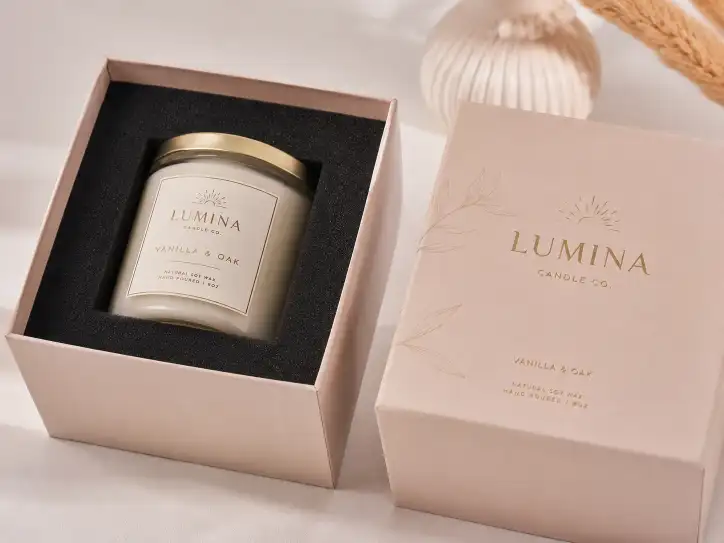
A candle box is one of the most forgiving categories to price because the product does most of the design work. A jar candle has a round footprint, a known height, and a weight that rarely exceeds a few hundred grams, so the box structure is straightforward. Most candle brands choose a rigid lid-and-base or shoulder box in a square or round footprint, with a round EVA tray that holds the jar by friction so it does not shift in transit.
The budget range at 1,000 units is roughly $4.50–$7.00 per unit. What moves it:
- Round vs square — round boxes wrap printed paper around a curve, which adds a labor step. For the full structure comparison, our round shape box page covers when the circle is worth it.
- Board thickness — a 1.5 mm core is enough for a standard jar candle; going to 2.0 mm adds heft and about 10–15% to material cost.
- Finishing — a matte laminate on the wrap is baseline. Adding foil to the lid typically adds $0.30–$0.60 per unit.
- Quantity — at 5,000 units the same box usually lands at $3.50–$5.50, because setup and die costs spread thinner.
For candle brands comparing structures, the candle industry collection shows the box styles in active production, and the custom packaging materials guide explains how board grade and paper weight change both feel and cost.
Jewelry Box Cost: What to Budget
Jewelry boxes price differently from other categories for one reason: the box is smaller but the precision is higher. A ring box may be 3.5 inches across, but it needs a velvet-coated cavity cut to a few millimeters of tolerance, a hinge or drawer mechanism that opens cleanly thousands of times, and finishes — foil, embossing, micro-suede lining — that the category expects on every piece. Small size lowers material cost, but precision and finishing keep the unit price in the rigid-box band.
Expect roughly $4.00–$8.00 per unit at 1,000 units. What moves it:
- Mechanism — a drawer box or magnetic closure costs more than a simple lift-off lid because of the extra assembly. The mechanism is usually worth it for jewelry, where the open moment is the point.
- Insert — a velvet-covered EVA tray with a slot for a pendant or ring adds $1.00–$2.50 versus a flat pad. It is the difference between a box and a presentation.
- Foil and emboss — a logo debossed on the lid and foil-stamped on the interior card is standard for premium jewelry lines; combined they add roughly $0.50–$1.50.
- Quantity — jewelry launches often start small, so per-unit costs run high at 500 pieces and fall sharply by 2,000–5,000.
The jewelry industry collection is a good reference for the drawer, hinged, and magnetic styles jewelry brands actually order.
Cosmetic and Skincare Box Cost: What to Budget
Cosmetics is the category where rigid boxes and folding cartons split most clearly. A serum or cream set sold at retail almost always uses a magnetic rigid box with a soft-touch laminate, an EVA tray that holds the bottles in place, and a lid that reads premium the moment it opens. A single lipstick or balm sold at a lower price point often moves to a folding carton instead. The category price depends heavily on which of those two you need.
At 1,000 units, a magnetic rigid box runs $3.50–$6.50 per unit; a folding carton equivalent is typically $1.00–$2.00. What moves it:
- Rigid vs folding — the custom cosmetic boxes range shows both ends. Rigid dominates for sets and gifting; folding dominates for single-unit shelf products.
- Magnetic closure — a magnet pair in the lid and body adds assembly and roughly $0.40–$0.80 over a plain lid. The ready magnetic box product page shows the standard options.
- Insert complexity — a multi-slot EVA tray for a set of three products costs more than a single cavity; molded pulp is the eco alternative and prices similarly at volume.
- Finishing — soft-touch lamination plus spot UV is the beauty-category baseline; expect $0.30–$0.70 for the combination.
For brands designing the full look, the cosmetics industry collection and our packaging lamination guide cover the finishing choices that carry most of the premium feel.
Wine and Spirits Box Cost: What to Budget
Wine and spirits boxes are the top of the per-unit range because the box has to be large, tall, and strong enough to hold a full bottle through transit, plus present it as a gift. A 750 ml bottle needs an interior height of roughly 12 inches, a foam or molded pulp cradle that cups the bottle base and neck, and a rigid structure that does not flex under the bottle's weight. This is the category where material quantity alone — a much larger sheet of board per box — pushes pricing up before any finishing is added.
Budget $8.00–$15.00 per unit at 1,000 units, coming down to $6.50–$12.00 at 5,000. What moves it:
- Structure — a tall rigid box with a lift-off lid or hinged front panel; the hinged version adds cost but is standard for premium gifting.
- Cradle — molded pulp or die-cut foam that secures the bottle adds $1.50–$3.00. For fragile glass in transit, it is not optional.
- Accents — a ribbon, a magnetic close, and foil on the front panel are the norm for retail spirits; expect to allocate $1.00–$2.00 for them.
- Corrugated alternative — brands shipping high volumes sometimes switch to a printed corrugated gift box, which drops the range to roughly $3.00–$6.00 with less premium feel.
The wine industry collection shows the structures used for bottle packaging across retail and gifting.

Electronics Box Cost: What to Budget
Electronics packaging is driven by protection first and unboxing second. The box is typically a rigid structure sized to the device, with a custom foam or molded pulp cradle that holds the product immobile and lifts it out for a clean reveal. Accessories — cables, chargers, manuals — get their own slots or a lower deck. Because every device is a different shape, electronics boxes are the least standardized and therefore the most likely to need a structural design pass and a physical sample.
Plan on $5.00–$12.00 per unit at 1,000 units. What moves it:
- Insert design — custom-cut EVA or molded pulp is the single biggest variable; it can add $2.00–$4.00 over a simple tray. This is why insert choice matters so much in this category.
- Structure — a hinged or book-style lid is common for premium devices; it costs more but keeps the lid attached during the reveal.
- Printing — multi-page booklets, foil logos, and full-color interior printing add up; the box printing methods guide explains how print coverage changes cost.
- Sample-first — electronics almost always require a packaging sample before production because fit tolerance is tight and the product is expensive to replace.
The electronics industry collection lists the box styles used across devices, wearables, and accessories.
Small-Batch Budgeting: Lowering Your Per-Unit Cost
Most new product launches start small — 300 to 2,000 units — and that is exactly where per-unit pricing is highest. You do not need to order 10,000 boxes to get a reasonable price; you need to control the variables that inflate small orders. Four moves save real money at small quantities:
- Standardize the size — a box that fits a standard die and production sheet avoids custom tooling. Shaving an inch off a dimension can cut material waste noticeably.
- Pick the right structure for the price point — if the product does not need a rigid box, a folding carton or a printed corrugated mailer can cut cost by half or more. Match the structure to the channel, not to the dream version.
- Simplify the insert — a paperboard platform instead of a precision foam tray can save $1.00–$2.00 per unit for products that sit stable on their own.
- Consolidate finishes — one hero finish (foil on the lid, or soft-touch, or emboss) reads premium; stacking all three adds cost without adding proportionally to perceived value.
Minimums matter too. Our what is MOQ in packaging explainer and the rigid box MOQ guide show the typical order floors for these structures, and the MOQ, sample, and lead time reference connects the three numbers that set your launch calendar. When you are ready to price a real specification, the custom packaging quote guide lists exactly what to send so the first quote is close to the final one.
The Five Cost Levers Behind Every Category
If you strip the category labels away, every custom box price is built from the same five levers. This table shows what each lever costs at the low end and the high end, so you can see exactly where your budget is going.
| Cost lever | Low-cost choice | High-cost choice | Typical price impact |
|---|---|---|---|
| Structure | Folding carton | Rigid magnetic box | 3–5× folding to rigid |
| Size | Standard die size | Oversized or non-standard | +15–30% |
| Insert | Paperboard tray | Custom foam or molded pulp | +$0.50–$3.00 |
| Finish | Matte lamination | Foil + emboss + soft-touch | +$0.50–$2.00 |
| Quantity | 5,000+ units | 500–1,000 units | Per-unit drops 20–40% at higher volume |
For the material-by-material detail behind these numbers — board grades, paper weights, printing processes, and finishing costs — the custom packaging cost guide is the deep reference, and the packaging terminology hub translates any term you run into while comparing quotes.
FAQ
How much does a custom candle box cost?
A rigid candle box typically costs $4.50–$7.00 per unit at 1,000 units, dropping to about $3.50–$5.50 at 5,000. A folding-carton candle sleeve costs less, usually $1.50–$3.00.
How much do custom jewelry boxes cost?
Custom jewelry boxes generally run $4.00–$8.00 per unit at 1,000 units, depending on mechanism (drawer or magnetic), velvet-covered insert, and foil or emboss finishing. Small size does not make them cheap, because precision and finishing dominate.
Why do custom cosmetic boxes cost more than standard mailer boxes?
Cosmetic boxes are usually rigid magnetic structures with soft-touch lamination and custom EVA inserts, while a mailer is a printed corrugated or paperboard shipping box. The rigid structure, closure, and insert together put cosmetics at roughly $3.50–$6.50 versus $1.00–$2.50 for a mailer.
What is the cheapest box structure for a product category?
Folding cartons are the lowest-cost structure across categories, typically $0.70–$2.00 per unit at 1,000, followed by printed corrugated boxes for shipping-led products. Rigid boxes cost more but are the standard when presentation is the goal.
How can I lower my custom box cost per unit?
Standardize the box size, choose the simplest structure that fits the price point, simplify the insert, consolidate finishing to one hero effect, and order at a higher quantity. Together these moves typically cut per-unit cost by 20–40%.
Conclusion
"Custom boxes cost" does not have one answer, but it has a predictable one. The product category sets the structure, size, insert, and finishing, and those four decisions set the price: candles in the mid-single digits, jewelry in the $4–8 band, cosmetics at $3.50–6.50 for rigid, wine boxes in the $8–15 range, and electronics between $5 and $12 at 1,000 units. Budget against those bands, control the five levers, and send a complete specification so the first quote is the right one.
Independent sources worth keeping in the loop: the International Safe Transit Association (ISTA) publishes the transit-testing standards that justify a box design before production, and the Forest Stewardship Council (FSC) certifies the responsibly sourced board and paper that premium categories increasingly specify. When you are ready to price your exact product, send your dimensions, target quantity, and channel to our packaging team — we will recommend the structure and insert for your category and quote it against your quantity band.

