
The gable box is the packaging almost everyone has held and almost nobody can name. It is the paperboard box with a peaked top and a built-in handle — the takeaway box for cookies, the candy box at a gift shop, the popcorn box at a fair. What makes it distinctive is that the handle is not an add-on; it is cut out of the box itself, and the top folds into a triangle that carries the whole structure. That combination — a self-carrying package that needs no bag and no extra handle — is why gable boxes keep appearing everywhere food and gifts are handed over.
This guide explains how custom gable boxes are made, which materials and variants are available, how to size and insert them, what they cost, and when they beat the alternatives. It is written for brand and procurement teams who need to spec a gable box with confidence — bakery owners, chocolatiers, cafes, retail buyers, and gift set brands.
Part 1: What a Gable Box Is
A gable box is a folding carton — a single die-cut sheet of paperboard that folds into a box — with a top that forms a triangular "gable" peak and a handle cut into the gable. It is part of the folding boxes family rather than the rigid box family, which is what keeps it light, shippable flat, and inexpensive per unit. The structure is folded up from one blank, so the box ships flat and pops open in seconds.
The anatomy of a gable box has four parts:
- Body — the four-sided base that holds the product
- Gable top — the peaked triangle formed when the top edges fold together
- Handle — the cut-out opening in the gable that turns the box into a carrying package
- Optional components — a cellophane or PET window, a tuck closure, a seal sticker, or an insert
The defining trait is that the handle comes from the material itself. There is no separate bag handle, no ribbon, no added part — which is why gable boxes are one of the most economical "portable" packages a brand can order.
Part 2: How Gable Boxes Are Manufactured
Gable boxes are produced like other folding cartons, with one structural addition: the gable and handle geometry. The manufacturing sequence:
- Printing — the flat sheet is printed with your artwork, usually by offset for volume or digital for short runs, on one side (outside) or both.
- Die cutting — the printed sheet is cut into the box blank, including the gable peak, the handle cut-out, and the fold scores. This is the step where the gable shape is literally made.
- Creasing and folding — the blank is creased along the fold lines so the gable folds cleanly.
- Gluing or locking — the blank is glued along the side seam, or folded with a self-locking tab so it can be popped open without glue.
- Window patching — if the design includes a window, a transparent film is applied over the opening before the blank is folded flat.
- Shipping flat — finished blanks are bundled flat and shipped to the brand, who pops them open for packing.
The design implication of the gable is that the handle and the top must survive repeated opening and closing. A handle that is too thin tears; a gable that is not scored correctly does not fold. This is why gable box artwork is prepared on a proper dieline for print — a handle cut-out drawn at the wrong size can fail in the first week of use. If the structural terms here are new, the packaging terminology hub defines the vocabulary in plain language.

Part 3: Materials and Finishes
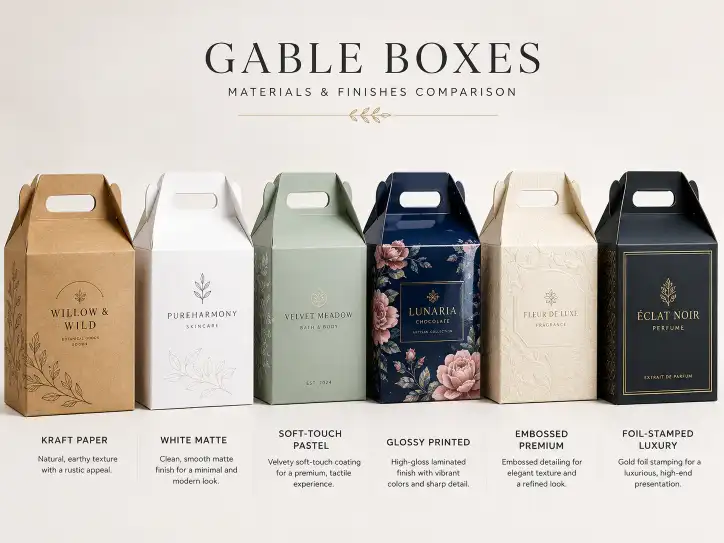
Gable boxes are usually printed on paperboard, with heavier options for larger or heavier contents.
- Paperboard (SBS) — the default for food and retail gable boxes. Coated one side for bright, crisp printing; available in 300–400 GSM and above. Clean white for premium looks.
- Kraft board — the natural brown option for a rustic bakery or eco position. Kraft prints less vibrantly but reads as natural and recycled.
- Corrugated — for large or heavy gable boxes (e.g., multi-bottle or bulk food), corrugated board adds strength. The custom corrugated boxes for ecommerce and shipping guide covers board strength and flute choices.
- Food-grade options — for direct food contact, confirm food-safe inks and coatings with your packaging partner.
Finishing is where a gable box earns its positioning. A lamination or aqueous coating protects the surface and adds a matte or gloss feel; a foil-stamped logo on the gable turns a bakery box into a gift box. Because the gable and handle are curved surfaces, finishes that flex — like coatings rather than heavy board-mounted effects — work best on the top; embossing is more reliable on the flat body panels. The custom packaging materials guide has the full comparison of board grades and paper types.
Part 4: Gable Box Structure Variants
Gable boxes are a family, not one box. The variant you choose changes how the box opens, closes, and presents.
| Variant | How it works | Best for | Relative cost |
|---|---|---|---|
| Standard handle | Peaked gable with die-cut handle | Bakery, candy, takeaway | Baseline |
| No-handle gable | Peaked top without cut-out | Shelf display, gift sets | Baseline |
| Window gable | Clear film panel on the body | Seeing the product (pastry, sweets) | Slightly higher |
| Self-locking | Tab locks without glue | Fast packing, e-commerce | Slightly higher |
| Tie-top | Handle area closes with ribbon or tie | Gift and premium presentation | Higher |
The standard handle version is the classic gable box and the most economical. Windows add a small cost but can lift sales by showing the product — the reason bakeries put pastries on display in window gable boxes. Tie-top versions move the gable into gifting territory, which is often where a gable box is the right choice over a more expensive structure.
Part 5: Sizing, Fit, and Inserts
Gable boxes are sized by length, width, and height, and the handle adds a vertical dimension to account for. Unlike a rigid box, the folding carton is built to the product with a small tolerance for the product to sit and lift out cleanly.
Most gable box products are food or light goods that sit directly in the box — cookies, candies, pastries, small retail items. For fragile or premium contents, an insert converts the open cavity into a secured fit. Options for gable boxes:
- Corrugated pad — a flat pad on the base to cushion and level
- Paperboard divider — compartment dividers for multi-item sets (e.g., six cookies or a curated candy mix)
- Clear window + insert — combine product visibility with a secure seat
- Tissue and seal sticker — the low-cost finishing layer for gift presentation
For the material-by-material comparison, the custom box inserts guide covers corrugated, paperboard, foam, and molded pulp options. Fit is confirmed the same way as any carton: order a packaging sample, load the real product, and check that the box closes, the handle holds, and the contents do not shift.

Part 6: Cost, MOQ, and Lead Time
Gable boxes are folding cartons, so they sit at the affordable end of packaging. At 1,000 units, a standard printed gable box typically runs $0.40–$1.80 per unit, with windows, corrugated board, and premium finishes at the higher end. Setup costs — the die, plates, and window tooling — dominate small orders, and material and printing dominate large ones. The pricing structure follows the same rules as other folding cartons, explained in the custom packaging cost guide.
Minimums are lower than rigid boxes because the box is a simple printed carton. The what is MOQ in packaging explainer and the MOQ, sample, and lead time reference show typical order floors and how they scale with printing. In practice, expect gable boxes to carry a lower MOQ than rigid structures, with production in the same band as folding cartons.
Part 7: When Gable Beats Other Structures
The gable box is a specific tool. The table below shows when its built-in handle wins and when another structure is the smarter call.
| If your need is... | Gable box wins | Alternative wins |
|---|---|---|
| Carry without a bag | Handle is built into the box | Paper bags for loose items |
| Show the product at retail | Window gable displays contents | Rigid box hides product behind lid |
| Light food and bakery | Economical, food-safe, charming | Rigid boxes for heavy or premium |
| Premium gift presentation | Tie-top gable for a rustic-gift feel | Magnetic rigid box for formal luxury |
| E-commerce shipping | Folds flat, low cost | Mailer box for durability in transit |
The summary: gable boxes win when the product is light, the moment is handing over (carry-out, gifting, retail impulse), and the brand wants an economical structure with character. If the product is heavy, fragile, or being shipped long distances, a stronger box is the rational choice. If the box is part of a formal luxury unboxing, a rigid structure carries more weight.
FAQ
What is a gable box?
A gable box is a folding carton with a peaked triangular top and a handle cut into the top. The handle is part of the box itself, which makes it a self-carrying, portable package commonly used for bakery goods, candy, and retail gifts.
Can gable boxes be custom printed with brand colors?
Yes. Gable boxes are printed full-color on paperboard by offset or digital printing, with lamination, spot UV, and foil stamping available. The gable and handle are curved surfaces, so artwork should be prepared on a dieline that accounts for the fold and handle geometry.
How much do custom gable boxes cost?
Custom gable boxes typically run $0.40–$1.80 per unit at 1,000 units, depending on size, board, printing, and whether a window is added. As folding cartons, they cost less than rigid boxes and often carry lower minimums.
What products work best in a gable box?
Light products that benefit from a built-in handle: cookies, pastries, chocolates, candy, popcorn, small retail gifts, and gift sets. Products that are heavy, fragile, or shipped long distances are better served by a stronger structure.
Are gable boxes food-safe?
Gable boxes can be made food-safe by specifying food-grade board, inks, and coatings with your packaging partner. For direct food contact, confirm the food-safe status of the materials before production.
Conclusion
A custom gable box is one of the most economical structures a brand can order, and its built-in handle makes it genuinely useful — a package that carries itself, displays its product, and folds flat until it is needed. It is not the strongest or the most formal box, but for light food, bakery, candy, and gift retail, it is often the right box. Choose a gable when the product is light and the moment is hand-to-hand, and let the variants, windows, inserts, and finishing details in this guide shape your specification.
For authoritative reference on food-safe materials, the FDA publishes the food-contact regulations that bakery and candy packaging must meet, and the Forest Stewardship Council (FSC) certifies the responsibly sourced board a branded gable box can be printed on. When you are ready to spec your gable box, send your product dimensions, target quantity, and whether you need a window to our packaging team — we will recommend the board, size, and closure, then send a sample you can fold, fill, and carry.

