
Mailer box size matters twice for an e-commerce brand: once when the product goes in, and again when the box goes to the carrier. A box that is too small does not fit the product with padding; a box that is too large wastes material and — because carriers now bill on dimensional weight — can quietly raise your shipping cost on every single order. That second cost is the one most brands miss. Getting the size right is one of the cheapest improvements an e-commerce operation can make, because it saves money on every order, not once.
This guide covers standard mailer box sizes by product, how to measure and choose the right fit, and how DIM weight shipping math changes the size decision. It is written for e-commerce brands, subscription boxes, and retail teams that ship branded mailer boxes and want to cut cost without cutting unboxing quality.
Why Size Matters Twice
A mailer box does two jobs, and both are size-dependent. The first is protection: the product needs to sit inside with enough room for a small amount of padding so it does not slide against the walls. The second is cost: carriers bill each box on the greater of its actual weight or its dimensional weight — the amount of space the box takes up on the truck. A box that is an inch too big in each direction can push the billable weight into the next price band, on every shipment.
This is why the right size is not "the size that fits." It is the smallest size that fits the product with proper padding, which is a specific and learnable calculation. Brands that standardize on correct sizes typically reduce shipping cost per order and, because the box is tighter, often reduce product damage and void-fill material at the same time. The custom corrugated boxes for ecommerce and shipping guide covers the board strength behind that protection; this guide covers the sizing math in front of it.
Standard Mailer Box Sizes by Product
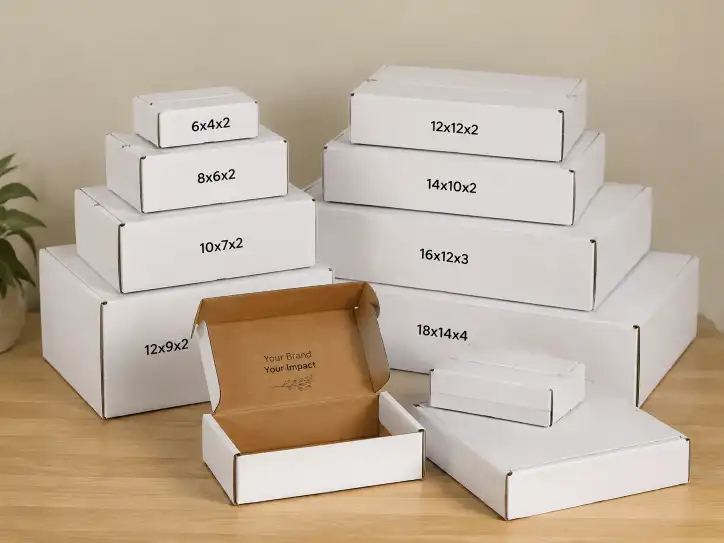
Mailer boxes are measured length × width × depth, with length being the longest side and depth the thin dimension. The table below shows the standard sizes e-commerce brands actually order, with the product types each fits. These are starting points, not rules — a brand's real fit depends on product dimensions plus padding.
| Box size (L×W×D) | Typical contents | Common use |
|---|---|---|
| 6 × 4 × 2 in | Jewelry, lipstick, small accessories | Subscription insert, small gifts |
| 8 × 6 × 4 in | Cosmetics, skincare bottles, phone cases | Beauty sets, retail |
| 10 × 7 × 5 in | Apparel, socks, small devices | Clothing, accessories |
| 12 × 8 × 6 in | Sneakers, medium electronics, candle sets | Footwear, gift sets |
| 14 × 10 × 7 in | Handbags, larger apparel, multiple items | Retail and gifting |
| 16 × 12 × 8 in | Laptops, bundles, subscription boxes | Electronics, monthly boxes |
| 18 × 14 × 10 in | Large bundles, multiple products | Multi-item sets, wholesale |
The pattern to notice: each step up adds roughly an inch in every direction, which nearly doubles the volume between adjacent sizes. That matters because shipping cost tracks volume, not length — a 16×12×8 box has roughly four times the volume of a 10×7×5 box, and a much larger billable weight.
How to Measure and Choose the Right Size
Choosing the right mailer size is a three-step process:
- Measure the product — the longest, widest, and deepest points of the product in its selling configuration (with its own retail packaging if it has one).
- Add padding allowance — add roughly 1–2 inches total in each direction for standard corrugated mailers, more for fragile items that need extra void-fill or a protective insert. The custom box inserts guide covers the pads and dividers that keep products centered without oversized boxes.
- Match to a standard size — pick the smallest standard size that holds product plus padding. If the product needs an unusual footprint, that is the case for a custom size.
Two checks before you commit: confirm the box closes flat with the product inside and no bulging, and confirm the product does not slide when shaken with padding in place. Both are verified in hand, which is why ordering a packaging sample before the bulk run is the standard practice — a box that looks right on paper can fit badly with a real product and real padding.

DIM Weight and How It Changes the Math
Dimensional weight is the carrier's way of charging for space, not just mass. The formula is the same across carriers: length × width × depth, divided by a divisor. A larger divisor is more favorable to the shipper. Current U.S. ground and air rates from FedEx and UPS use a divisor of 139 for domestic shipments; international shipments are often calculated in centimeters with a divisor of 5,000; USPS applies dimensional weight to packages larger than one cubic foot using a divisor of 166. Always confirm the current divisor with your carrier, because it changes.
The billable weight is the larger of actual weight and dimensional weight. This is where an oversized box silently raises cost:
| Box size (L×W×D) | Actual weight | Dim weight (÷139) | Billable weight |
|---|---|---|---|
| 12 × 8 × 6 in | 2 lb | 4 lb | 4 lb |
| 14 × 10 × 7 in | 3 lb | 7 lb | 7 lb |
| 16 × 12 × 8 in | 4 lb | 11 lb | 11 lb |
In every row, the dim weight is roughly double the actual weight — which means the shipper is paying for empty space, not product. The single most effective size move is to reduce the box in the dimension that adds the most volume, typically the depth, until it only just fits the product and padding. Shaving a few inches of depth across a standard box can drop it below a weight-band threshold and reduce every shipment's cost. If you are sourcing boxes for a marketplace with strict receiving rules, the Amazon FBA packaging requirements guide covers the size limits that apply there too.
Custom Sizes vs Standard Sizes
Standard sizes are cheaper and faster because the tooling already exists, but they are a compromise: your product rarely fills a standard box perfectly. Custom sizes let you match the box to the product exactly, which cuts both material waste and dimensional weight.
The trade-off is a one-time die cost to cut a new blank. For a box that ships in high volume, that setup cost is recovered quickly through the material and shipping savings. For a low-volume or first-order run, a standard size is usually the better call until volume justifies the custom die. The custom packaging cost guide breaks down how size, board, and tooling set the price, and the what is MOQ in packaging explainer covers the order floors for each path. When you ask a supplier to quote, specify the loaded dimensions (product + padding) rather than the product alone, so the box is sized to ship, not just to fit — the how to request a quote guide lists exactly what to include.

FAQ
What are the most common mailer box sizes?
Common e-commerce mailer sizes are 6×4×2, 8×6×4, 10×7×5, 12×8×6, 14×10×7, 16×12×8, and 18×14×10 inches. The right one depends on your product size plus padding allowance.
How do I choose the right mailer box size?
Measure your product in its selling configuration, add 1–2 inches per direction for padding, then pick the smallest standard size that fits. Order a sample to confirm the box closes flat and the product does not shift.
What is dimensional weight (DIM weight)?
Dimensional weight is a carrier pricing method based on box volume: length × width × depth divided by a divisor (139 for most U.S. FedEx/UPS shipments). Carriers bill on the greater of actual or dimensional weight, so oversized boxes raise shipping cost.
Can I order custom mailer box sizes?
Yes. Custom sizes match the box to the product exactly and reduce material and shipping waste, at the cost of a one-time die charge. Custom dies pay off fastest on high-volume boxes.
Does mailer box size affect shipping cost?
Yes. Larger boxes have higher dimensional weight, which can push a shipment into a more expensive weight band. Using the smallest box that fits the product with padding is one of the easiest ways to reduce per-order shipping cost.
Conclusion
Mailer box size is a cost lever, not just a fit decision. Choose the smallest standard size that holds the product and its padding, verify it with a physical sample, and watch the dimensional-weight math — because every extra inch of box is billable space you are paying for on every order. For high-volume boxes, a custom size that fits exactly pays for its die through material and shipping savings. The combination of right-size and right-board is the difference between paying for a box and paying for a shipment.
For the official dimensional-weight rules, the UPS and FedEx sites publish current divisors and weight-band tables, and the International Safe Transit Association (ISTA) publishes the transit-testing standards that confirm your box and padding actually protect the product. When you are ready to spec your mailer, send your loaded product dimensions and monthly volume to our packaging team — we will recommend the smallest standard size or a custom size, and send a sample you can fit, pad, and weigh before the bulk run.

