
Amazon enforces packaging standards at every fulfillment center. When a shipment arrives, the boxes are checked against those standards before they are accepted, and a box that does not comply is rejected, returned, or charged an inbound defect fee. For sellers ordering custom packaging, this is not a checklist to review later — it is the specification the box has to meet from the start. Getting it right the first time avoids the two outcomes that hurt sellers most: receiving delays that cause stock-outs, and fees that quietly eat margin.
This guide covers the current Amazon FBA packaging requirements that matter when you order custom boxes: box construction and materials, dimensions and weight limits, the labels every box needs, prep rules, and what happens when a shipment does not comply. It is written for sellers who want to order compliant boxes and move through receiving without surprises.
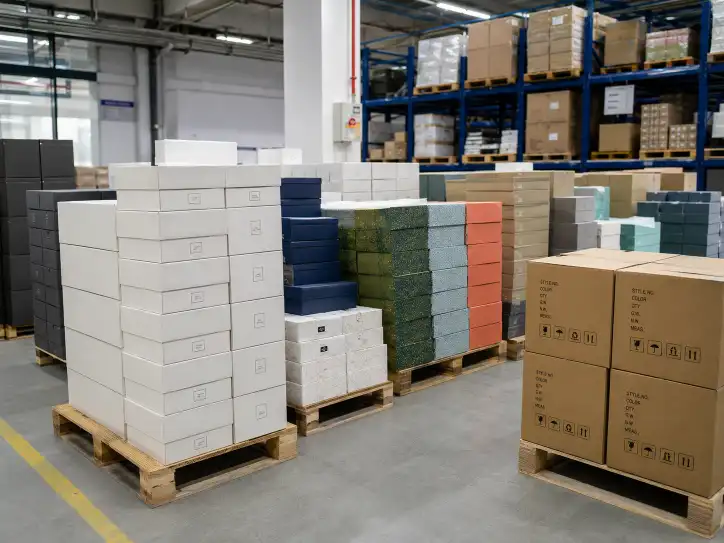
Box Construction and Materials
Amazon requires shipping boxes to be sturdy, six-sided corrugated cartons strong enough to protect the product and survive stacking in transit. The standard for most sellers is a corrugated board rating of at least 32 ECT (edge crush test), and boxes carrying more than about 9 kg should move to double-wall or high-strength board. If the technical terms are unfamiliar, the packaging terminology hub explains ECT, flute, and board grade in plain language, and the custom packaging materials guide compares the board options available when you order.
Four rules matter most at the box-construction level:
- Seal with tape, not staples — close the box with strong tape at least 5 cm wide covering the center seam (H-taping). Staples, strings, and straps are prohibited.
- No loose fill — all types of packing peanuts are prohibited, including biodegradable ones. Use paper, corrugated, or air pillows that are acceptable to the fulfillment center.
- No empty space — a box with empty space collapses in transit. Fill voids with dunnage so contents cannot shift.
- No protruding features — handles, lips, and expanded cushioning count toward the box dimensions and can cause rejection, so measure everything that protrudes.
When a product is fragile, the box alone is rarely enough. A compliant insert keeps the item stationary and turns an ordinary carton into a protected shipment — the custom box inserts guide covers foam, paperboard, corrugated, and molded pulp options that meet fulfillment center expectations.
Box Dimensions and Weight Limits
Amazon sets minimums and maximums on every shipping box, and both matter at receiving. For standard multi-item shipments:
- Minimum box size: about 15.2 × 10.0 × 2.5 cm — any smaller is not accepted.
- Maximum box size: about 63.5 cm on any side (25 inches). Boxes larger than this on any side are treated as oversized and handled differently.
- Minimum weight: about 0.15 kg per box.
- Standard maximum weight: about 23 kg (50 lb) per box.
Boxes containing a single oversized item may weigh more, but no more than about 30 kg, and anything over that requires enrollment in the FBA Heavy and Bulky program. There is also a labeling trigger at 15 kg: any box weighing more than 15 kg must display "Team Lift" / heavy-parcel safety labels on the top and all four sides — five labels in total.
| Box weight | Requirement |
|---|---|
| 0.15–15 kg | Standard box; no special handling labels |
| 15–23 kg | Standard box + Team Lift labels on top and all four sides |
| 23–30 kg | Single oversized item only; Team Lift labels required |
| Over 30 kg | FBA Heavy and Bulky program only |
The practical takeaway for custom-box buyers: design the outer box to stay under 63.5 cm on any side and under 23 kg loaded, and you avoid the oversized and special-handling tiers entirely.

Labels Every Box Needs
Missing or unreadable labels are the most common reason shipments are rejected. Every FBA shipment needs four label groups, and each has a specific format:
- FBA Box ID label — every box in a shipment gets its own unique FBA Box ID label, generated in Seller Central when you prepare the shipment. Labels cannot be photocopied, reused, or modified. This label is what the fulfillment center scans to know which shipment the box belongs to.
- FNSKU product labels — each unit must carry an FNSKU barcode about 5.1 × 2.5 cm, printed at 300 DPI or higher in Code 128 or UPC-A format. The label must be flat, wrinkle-free, and placed to cover any original manufacturer barcode, not on seams, edges, or curved surfaces.
- Shipment label (outer box) — about 9.4 × 12.7 cm, applied with at least two labels on adjacent faces of the box. Cover shipment labels with matte (not glossy) tape so scanners can read them without glare.
- "Made in China" origin label — the country-of-origin mark must be permanent, clearly legible, and printed with a minimum font height of about 1.6 mm on the product or its smallest sales package — not just on the outer shipping box.
The pattern sellers should notice: labels are the cheapest part of the shipment and the most common cause of failure. Printing them to spec, placing them flat, and covering them with matte tape costs almost nothing and prevents the most frequent rejections.
Prep Requirements by Product Type
Beyond the box and labels, products themselves have prep requirements that the packaging must support:
- Poly bags — bags with an opening of 5 inches or more must be transparent and carry the required suffocation warning, with the barcode visible through the bag.
- Fragile items — must be secured so they cannot shift or contact the box wall; this is where an insert or dunnage does the work.
- Expiration-dated products — units with expiration dates must show the date clearly, and the shipment contents must list those dates for the fulfillment center.
- Sets and bundles — a multi-item set sold as one ASIN must be packaged so it cannot be separated accidentally; the outer box should make the bundle unmistakable.
- Hazmat — products classified as dangerous goods require hazmat-compliant packaging and labeling; check the classification before ordering custom boxes.
The shared principle is that the package must make the product's requirements obvious to a worker handling it at speed. A printed note on the box, a labeled insert, and a barcode that scans cleanly all remove the guesswork that leads to defects.
How to Order Custom Boxes That Already Comply
The most efficient approach for sellers is to order custom boxes that are compliant by design, so nothing has to be fixed after arrival. When you brief a packaging partner, cover these points:
- Specify the loaded box dimensions and weight — target under 63.5 cm per side and under 23 kg loaded to stay in the standard tier.
- Specify the corrugated rating — confirm at least 32 ECT, and double-wall or high-strength board if the product is heavy. Our custom corrugated boxes for ecommerce and shipping guide explains how to match board strength to product weight.
- Build the labels into the spec — print FNSKU and origin labels as part of the custom box or confirm they will be applied at packing; a printed box with the label area clearly positioned avoids placement mistakes.
- Design the insert — for fragile or shifting products, order the insert with the box so the fit is confirmed once. See the samples guide for what to check before production.
- Order a physical sample — fit and print can only be confirmed in hand. Order one, load the real product, and verify weight and dimensions before the bulk run.
- Confirm shipping terms — know whether your quote is FOB or DDP, since it changes who handles freight and customs clearance. The FOB vs DDP guide covers the difference, and the how to request a quote guide lists the exact details to send so the first quote is complete.
Cost and minimums follow the same rules as any packaging order. The what is MOQ in packaging explainer and the rigid box MOQ guide show typical order floors, and the custom packaging cost guide breaks down how corrugated, inserts, and printing set the price. If you are sourcing from Asia, the how to source custom packaging from China guide covers the sample-to-bulk workflow that FBA sellers rely on.
What Happens When a Shipment Does Not Comply
Non-compliance is not a warning system — it has direct costs and operational consequences:
- Inbound defect fees — units or boxes that fail the receiving check can be charged fees per defective unit.
- Receiving delays — a rejected box goes to problem-solving, which delays the whole shipment and can cause a stock-out at the worst moment.
- Restricted inbound privileges — repeated violations can lead to limits or holds on your ability to send inventory at all.
This is why the standard is worth meeting on the first order rather than fixing after a rejection. The box, the labels, and the prep are all things a seller controls completely — unlike the product itself — so compliance is the part of FBA the seller should be able to get exactly right.
FAQ
What are the Amazon FBA box size requirements?
Standard shipping boxes must be at least about 15.2 × 10.0 × 2.5 cm and no more than about 63.5 cm on any side. Oversized boxes are handled in a separate tier and face higher fees.
What is the weight limit for an FBA box?
Standard boxes must weigh at least about 0.15 kg and no more than about 23 kg (50 lb). Boxes over 15 kg need Team Lift labels on the top and all four sides. A single oversized item may weigh up to about 30 kg, and anything over that requires the FBA Heavy and Bulky program.
What labels does an FBA shipment need?
Each box needs a unique FBA Box ID label, each unit needs an FNSKU barcode (about 5.1 × 2.5 cm, 300 DPI or higher), the outer box needs shipment labels on at least two adjacent faces, and the product or smallest sales package needs a country-of-origin label.
What type of box is required for FBA?
A sturdy six-sided corrugated box, typically rated at least 32 ECT, sealed with tape at least 5 cm wide (H-taping). Double-wall or high-strength board is recommended for boxes over about 9 kg. Staples, strings, straps, and packing peanuts are prohibited.
Can I use custom printed boxes for Amazon FBA?
Yes. Custom printed corrugated boxes are used by thousands of FBA sellers. Just ensure the box meets the dimension, weight, and corrugated standards, and that barcode and origin labels are printed or applied to spec.
Conclusion
Amazon FBA packaging requirements are not suggestions — they are the receiving standards that determine whether a shipment clears quickly or becomes a fee, a delay, or a stock-out. Meeting them is entirely within a seller's control: order a corrugated box that stays under the size and weight tiers, seal it with tape, include the FNSKU, box ID, shipment, and origin labels, and prep fragile and expiration-dated products so nothing is left to interpretation.
For the official rules, the Amazon Seller Central help library is the authoritative source for packaging and prep requirements, and the International Safe Transit Association (ISTA) publishes the transit-testing standards that justify a box design before it ships. When you are ready to order compliant boxes, send your product dimensions, loaded weight, and target quantity to our packaging team — we will spec the corrugated rating, size the box to stay in the standard tier, and send a sample you can load and weigh before the bulk run.

