
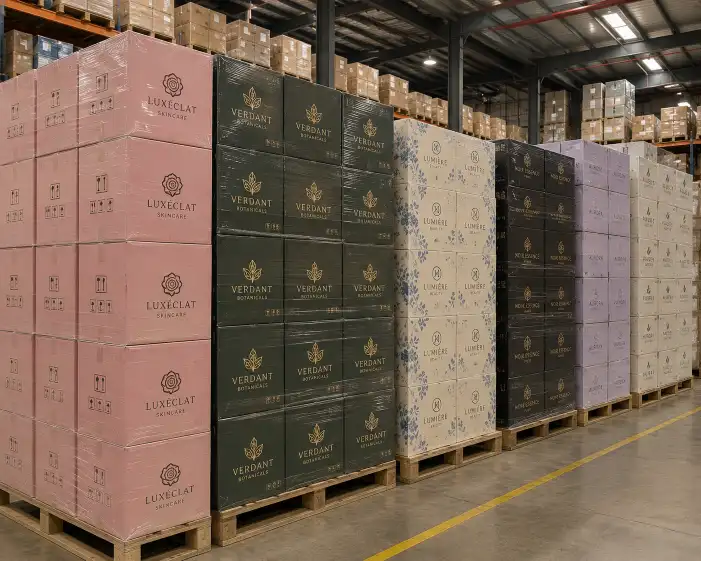
The price on a packaging quote is never the price you pay. Between the factory and your door sits freight, insurance, export clearance, import duty, and a chain of intermediaries — and the only thing that decides who pays for each step is the shipping incoterm written on that quote. Buyers who skip this topic discover the difference the hard way, with surprise customs bills and cargo held at port. This guide is the industry-standard reference: what the terms mean, which ones actually appear on packaging orders, and how to pick the one that fits your budget and your risk.
If you are still choosing the box itself first, start with our custom rigid boxes and custom folding boxes ranges, then come back to this guide before you compare freight quotes.

What Are Shipping Incoterms?
Incoterms (short for international commercial terms) are a standardized set of rules published by the International Chamber of Commerce (ICC) that define exactly where responsibility, cost, and risk pass from seller to buyer during a shipment. The current edition is Incoterms 2020, and it defines 11 terms. You do not need all 11 — for ordering custom packaging from overseas, most buyers only ever encounter five.
The term on your quote answers three questions:
- Cost — who pays freight, insurance, customs, and delivery?
- Risk — at what point does the shipment become your problem if it is damaged or lost?
- Control — who is responsible for arranging the transport and clearing customs?
This matters more for packaging than for most products, because packaging is heavy and bulky relative to its value. A single rigid box MOQ run of 1,000 units can easily occupy most of a pallet, and freight can be 10 to 30 percent of your total order cost. The term you choose decides which side of that freight bill you are on.
The Incoterms You Will See in a Packaging Quote
In practice, packaging suppliers quote on a small set of terms. The table below is the industry-standard breakdown of the five that matter to a box buyer.
| Term | Full name | Risk transfers | Freight paid by | Import customs paid by | Typical use |
|---|---|---|---|---|---|
| EXW | Ex Works | At seller's factory | Buyer | Buyer | Local pickup, experienced importers |
| FOB | Free On Board | Loaded on the vessel at origin port | Buyer | Buyer | Ocean freight from China — the default |
| CIF | Cost, Insurance and Freight | Loaded on the vessel at origin port | Seller (sea freight + insurance) | Buyer | Sea shipment where seller arranges freight |
| DAP | Delivered At Place | At your door (not unloaded, not cleared) | Seller | Buyer | Door-to-door freight without duty handling |
| DDP | Delivered Duty Paid | At your door, cleared | Seller | Seller | Courier parcels, first-time importers |
Two points worth reading twice. First, CIF is a sea-only term — it does not apply to air freight or courier. Second, for FOB and CIF the risk transfers at the origin port, so even when the seller pays the freight (CIF), the goods are insured by the seller but the risk of damage in transit sits with you. That is why experienced buyers often combine FOB or CIF with their own cargo insurance decision rather than assuming the seller's policy covers them.
FOB vs DDP: The Two Terms That Matter Most
Almost every first order from China comes down to a choice between FOB and DDP, and the difference is simpler than it looks.
FOB puts the seller's responsibility at the port of origin. The factory pays to get your boxes packed for export, cleared through Chinese customs, and loaded onto the vessel. From that point forward — the ocean freight, the import clearance, the duty, the final delivery — everything is on you or your freight forwarder. FOB is the term you will see most often because it gives you control: you choose the freight forwarder, the shipping line, and the delivery speed.
DDP pushes the seller's responsibility all the way to your door, with import duty already paid. The supplier (or their shipping agent) arranges the whole journey — courier or freight, customs, and duty — and you pay one all-in price. DDP is the standard for small parcel courier shipments (FedEx, DHL, UPS) and is the least stressful option for first-time importers who do not yet have a freight forwarder or a customs broker.
The trade-off is control versus convenience. FOB gives you a lower quoted freight rate and full visibility, but it puts the customs work on you. DDP gives you a fixed delivered price with no surprises, but it bundles hidden margins into the freight, and some customs authorities hold the consignee responsible for duty declarations even under DDP. Both are legitimate; the right one depends on your volume, your experience, and your cash flow.

What Each Incoterm Costs You
To see why a "$1.20 FOB" quote and a "$1.65 DDP" quote can be the same deal, break the journey into its cost components. The table below shows who pays each line under the four terms you will actually be quoted.
| Cost item | EXW | FOB | CIF | DDP |
|---|---|---|---|---|
| Export packing & inland haulage to origin port | Buyer | Seller | Seller | Seller |
| Export customs clearance | Buyer | Seller | Seller | Seller |
| Origin terminal & loading | Buyer | Seller | Seller | Seller |
| Ocean / air freight | Buyer | Buyer | Seller | Seller |
| Cargo insurance | Buyer | Buyer | Seller | Seller |
| Import customs & duties | Buyer | Buyer | Buyer | Seller |
| Destination delivery & final mile | Buyer | Buyer | Buyer | Seller |
The takeaway is that the price gap between an FOB and a DDP quote is not profit — it is the freight, insurance, and duty that you would otherwise pay yourself. Before you compare two suppliers on price, convert both to the same term, otherwise you are comparing apples to oranges. For a full view of everything that goes into a box price, read our custom packaging cost guide.

For shipments where duty is the scary part, note that the goods' declared value and the HS code (the customs classification for paper boxes) drive the charge — and packaging from China commonly qualifies for de minimis duty-free treatment on small-value shipments under many countries' thresholds. That is one reason small DDP courier orders can be so clean.
How to Choose the Right Incoterm for Your Box Order
Match the term to your situation rather than to the supplier's preference.
- You have a freight forwarder, or you plan to → FOB. You get the best freight rate, visibility, and control. This is the right choice for ocean container shipments and repeat orders.
- It is your first order and the boxes are small enough for courier → DDP. The supplier handles customs, duty, and delivery; you get a landed price and you learn the process without building an import operation.
- You are ordering from the EU, US, or UK and want the supplier fully responsible end-to-end → DDP with a reputable supplier, and confirm in writing who files the import declaration in your country.
- You already have an import broker and a delivery address → DAP lets the seller handle freight while your broker clears customs, often the cheapest professional setup.
Whichever term you pick, get the full journey in the quote. A supplier who will only quote EXW or a vague "door-to-door" price is a sign you need to see the cost breakdown. For the information to gather before you ask, our guide on what buyers should send before requesting a packaging quote lists the specs that make any term comparable.
Two more things to pin down in the same conversation: MOQ and lead time. The term affects price, but the minimum order quantity and the production schedule decide whether the shipment is economical at all. See our custom gift box MOQ, sample and lead time guide for how those numbers work together, and for rigid boxes specifically, our guide to how long it takes to design, produce and ship custom rigid boxes.
Red Flags in Incoterm Negotiations
The term is written into the quote, but a few common mistakes cost buyers real money:
- FOB quoted but the freight forwarder is the supplier's. FOB means you choose the forwarder. If the seller insists on their own, you are paying a bundled margin — effectively CIF without the insurance.
- CIF assumed to include risk coverage for you. CIF insurance is minimal and covers the seller's exposure, not your goods. If the freight value is significant, arrange your own cargo insurance.
- DDP with an unclear "delivery" address. DDP to a port or a terminal is not DDP to your door. The final-mile leg must be named.
- No Incoterms year stated. An old contract citing "FOB" without "Incoterms 2020" may default to legacy rules that differ. Always write the edition.
- Customs responsibility assumed away. Some jurisdictions make the importer of record liable for duty regardless of DDP. Confirm who the importer of record is before you pay the DDP premium.
When you are ready to compare suppliers, our checklist on working with a China gift box manufacturer covers the questions to ask beyond shipping, and the custom box manufacturer selection checklist will help you evaluate quotes on the same term.
FAQ
What does FOB mean in packaging shipping?
FOB (Free On Board) means the supplier is responsible for the boxes until they are loaded on the vessel at the origin port. From that point, the buyer pays and arranges the ocean freight, import clearance, duty, and final delivery. FOB is the most common term for sea shipments of custom boxes from China.
What is the difference between FOB and DDP?
Under FOB, the buyer handles freight, insurance, and import after the goods are loaded at the origin port. Under DDP (Delivered Duty Paid), the seller pays freight, insurance, import duty, and delivery to the buyer's door. FOB gives more control and usually a lower freight rate; DDP gives a fixed landed price with less work.
Is DDP more expensive than FOB?
DDP is usually a higher all-in price because it includes freight, insurance, import duty, and the seller's handling of customs. However, once you add the same freight, duty, and customs costs to an FOB quote, the two are typically close. Always compare quotes on the same incoterm.
Which incoterm should I use for my first packaging order from China?
For a small first order shipped by courier, DDP is the easiest choice because the supplier handles customs and delivery and you pay one landed price. For larger ocean shipments or repeat orders, FOB with your own freight forwarder usually gives the lowest total cost and the most control.
Who pays customs duty under CIF and DDP?
Under CIF the buyer pays import customs and duty; the seller only pays the sea freight and marine insurance. Under DDP the seller pays import duty as part of the delivered price. Note that in some countries the buyer may still be the importer of record for legal purposes even under DDP.
Conclusion
The incoterm on your packaging quote decides who pays the freight, who clears customs, and who carries the risk — and it is the difference between a $1.20 FOB price and a $1.65 DDP price that are actually the same deal. For first orders, DDP removes the complexity; for established programs, FOB with your own forwarder gives control and lower cost. Whatever you choose, compare suppliers on the same term, write the Incoterms 2020 edition into the contract, and know who is the importer of record.
For authoritative reference, the full rules are published by the International Chamber of Commerce at ICC Incoterms 2020. For customs and duty guidance in your market, your national customs authority is the definitive source (for example, US CBP in the United States). And when you are ready to move past shipping and actually spec the box, request samples before you finalize — see our custom packaging samples guide for what to check on arrival.

