
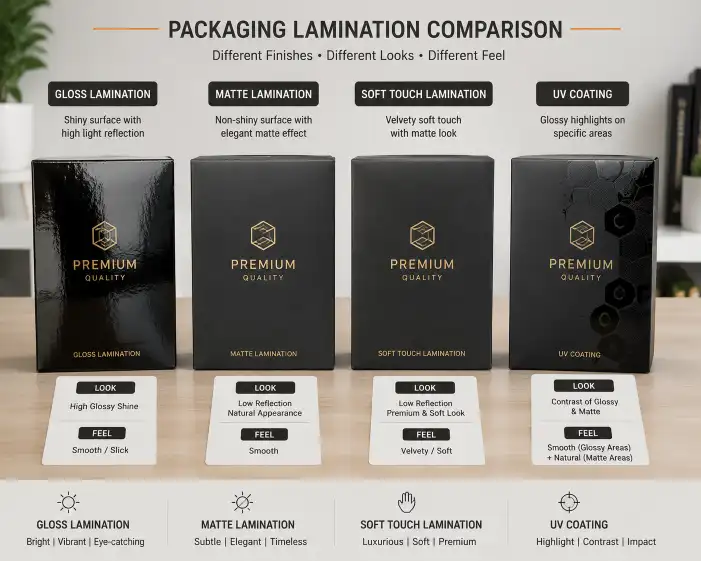
A beauty brand spends $12,000 on custom rigid boxes with full-color offset printing. The boxes are beautiful — until they arrive at the retailer. The glossy finish scuffs during shipping, and the brand's name looks faded after two weeks on the shelf. The problem was not the printing. The problem was the finish. Choosing the wrong lamination or coating can ruin an otherwise perfect packaging investment.
Packaging lamination and coating are surface finishes applied to printed boxes to protect the print and enhance the appearance. The five main options are gloss lamination (shiny, durable), matte lamination (non-reflective, elegant), soft touch lamination (velvet-like tactile feel), UV coating (high-gloss, scratch-resistant), and aqueous coating (eco-friendly, low-cost). Each option differs in durability, cost, recyclability, and visual effect.
The Leader Giftspack Team has manufactured custom packaging with a wide range of finishes for brands across cosmetics, electronics, jewelry, and gift industries. This guide covers everything you need to know about packaging lamination and coating options — the differences, costs, durability, applications, and how to select the right finish for your custom box project. By the end, you will know exactly which finish to specify for your next packaging order.
What Is Packaging Lamination and Coating?
Packaging lamination and coating are surface treatments applied to printed paper, cardstock, or rigid board boxes. They serve two purposes: protecting the printed surface from scuffs, moisture, and handling, and enhancing the visual and tactile appearance of the packaging.
Lamination vs Coating: The Basic Difference
| Feature | Lamination (Film) | Coating (Liquid) |
|---|---|---|
| Application method | Plastic film bonded to surface | Liquid applied and dried/cured |
| Thickness | 0.001"–0.002" film layer | Microscopic layer (microns) |
| Durability | Very high — resists tearing, moisture, scuffs | Moderate to high depending on type |
| Feel | Film-like (gloss/matte/soft touch) | Liquid-like (smooth, can be textured) |
| Recyclability | Low — mixed materials (paper + plastic) | High (aqueous) to low (UV) depending on type |
| Cost | Higher | Lower to moderate |
| Best for | Premium packaging, frequent handling | High-volume, cost-sensitive, eco-friendly |
The Five Main Options
| Finish | Type | Durability | Cost Level | Best Use |
|---|---|---|---|---|
| Gloss lamination | Film lamination | Very high | High | Premium boxes, high-traffic retail |
| Matte lamination | Film lamination | Very high | High | Luxury branding, anti-glare applications |
| Soft touch lamination | Film lamination | High | Very high | Premium tactile experience |
| UV coating | Liquid coating | High | Moderate | High-gloss accents, spot coating |
| Aqueous coating | Liquid coating | Moderate | Low | Eco-friendly, high-volume, economical |
Gloss Lamination — Shiny, Durable, and Protective
Gloss lamination is the most widely used film lamination for custom packaging. It applies a thin, transparent plastic film with a shiny finish to the printed surface.
Characteristics
| Property | Description |
|---|---|
| Appearance | Shiny, reflective — enhances color saturation and contrast |
| Feel | Smooth, plastic-like surface |
| Protection | Excellent — resists scuffs, scratches, moisture, and tearing |
| Thickness | 1.0–1.5 mil (0.001"–0.0015") |
| Recyclability | Low — mixed material (paper + plastic film) |
Advantages
- Color enhancement: Makes colors appear brighter, deeper, and more saturated. Best for packaging with rich photography or vibrant brand colors.
- Durability: The most protective finish against scuffs, scratches, and handling damage. Ideal for boxes that will be handled by retail customers.
- Moisture resistance: Protects against humidity and light moisture.
- Cost-effective at volume: Film lamination costs less per unit at higher volumes compared to soft touch.
Disadvantages
- Glare: The reflective surface can make reading text difficult under direct store lighting.
- Fingerprints: Shows fingerprints more readily than matte finishes.
- Not eco-friendly: The plastic film prevents the box from being fully recyclable.
Best Applications
| Industry | Why Gloss Lamination Works |
|---|---|
| Cosmetics | Makes product photography pop on shelf |
| Food and beverage | Moisture-resistant, durable for refrigerated environments |
| Electronics | Protects against handling, shows product images vibrantly |
| Retail packaging | High-traffic shelves, frequent handling |
For more detail on box types that pair well with gloss lamination, see our folding box guide and rigid box guide.
Matte Lamination — Sophisticated and Non-Reflective
Matte lamination applies a non-reflective plastic film that creates a smooth, sophisticated surface without glare.
Characteristics
| Property | Description |
|---|---|
| Appearance | Flat, non-reflective — muted colors, elegant look |
| Feel | Smooth, silky surface without shine |
| Protection | Excellent — same durability as gloss lamination |
| Thickness | 1.0–1.5 mil (0.001"–0.0015") |
| Recyclability | Low — mixed material (paper + plastic film) |
Advantages
- No glare: Text and images are readable from any angle under any lighting. Preferred for packaging with heavy text content.
- Premium appearance: Matte finishes are associated with luxury, sophistication, and understated elegance.
- No fingerprints: Does not show fingerprints or smudges like gloss finishes.
- Same durability as gloss: Provides the same level of protection against scuffs, scratches, and moisture.
Disadvantages
- Color muting: Colors appear less vibrant than gloss. Not ideal for packaging that relies on bright, saturated imagery.
- Higher cost than coating: Film lamination costs more than aqueous or UV coating.
- Not eco-friendly: Same plastic film issue as gloss lamination.
- Shows scuffs differently: While it hides fingerprints, matte can show rub marks from friction more visibly than gloss.
Matte vs Gloss: Which One for Your Brand?
| Factor | Choose Gloss | Choose Matte |
|---|---|---|
| Product photography | Bright, saturated images | Refined, elegant imagery |
| Text-heavy design | May have glare issues | Readable from all angles |
| Brand positioning | Mass market, vibrant | Luxury, understated |
| Retail lighting | Fluorescent overhead | Spot lighting, boutique |
| Target customer | Broad audience | Premium segment |
Best Applications
| Industry | Why Matte Lamination Works |
|---|---|
| Luxury cosmetics | Understated elegance, premium feel |
| Jewelry packaging | Sophisticated, non-distracting background |
| Premium spirits | High-end look, matte black or white |
| Corporate gifting | Professional, refined presentation |
Soft Touch Lamination — Velvet-Like Tactile Premium Feel
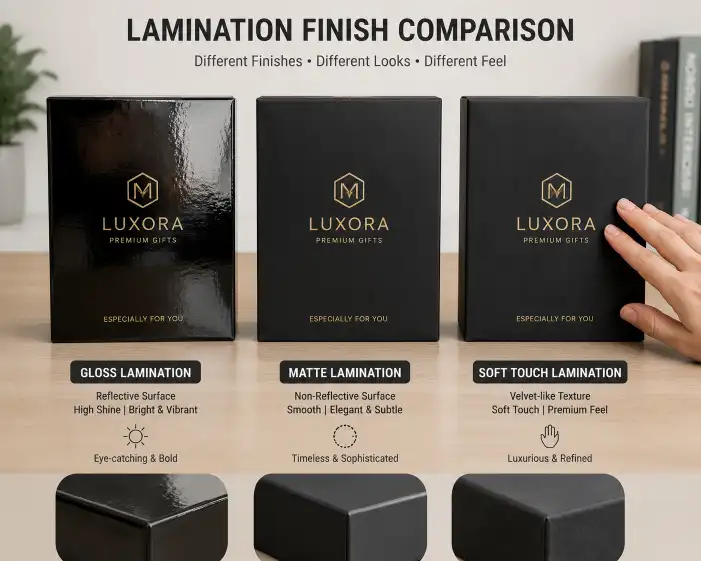
Soft touch lamination is a specialized film lamination that creates a velvet-like, tactile surface. It is the most premium finish available for custom packaging and is increasingly popular for luxury gift boxes.
Characteristics
| Property | Description |
|---|---|
| Appearance | Low-sheen matte — similar to matte but with depth |
| Feel | Velvet-like, rubberized, warm to the touch |
| Protection | High — resists scuffs and scratches well |
| Thickness | 1.2–1.8 mil (slightly thicker than standard lamination) |
| Recyclability | Low — mixed material (paper + specialty plastic film) |
Advantages
- Tactile impact: The velvet feel creates an immediate perception of luxury and quality. Customers pick up the box simply because of how it feels.
- Premium positioning: Soft touch is the standard finish for high-end cosmetics, premium electronics, and luxury gift packaging.
- No glare: Like matte, it does not reflect light.
- No fingerprints: Does not show handling marks.
Disadvantages
- Higher cost: Soft touch is the most expensive lamination option — typically 25–50% more than standard gloss or matte lamination.
- Shows wear over time: The velvet texture can show scuff marks or "polishing" from repeated handling.
- Limited color enhancement: Colors appear muted — not as vibrant as gloss.
- Not eco-friendly: Same plastic film issue as other laminations.
For more detail on soft touch coating (a liquid alternative to lamination), see our soft touch coating guide.
UV Coating — High-Gloss and Scratch-Resistant
UV coating is a liquid coating applied to the printed surface and cured instantly under ultraviolet light. It creates a very high-gloss finish that can be applied as a full coverage or selective spot coating.
Characteristics
| Property | Description |
|---|---|
| Appearance | Extremely high-gloss — glossier than gloss lamination |
| Feel | Hard, smooth, plastic-like |
| Protection | High — excellent scratch and scuff resistance |
| Application | Liquid spray or roller, cured by UV light |
| Recyclability | Low — UV coating interferes with repulping |
Full UV Coating vs Spot UV Coating
| Feature | Full UV Coating | Spot UV Coating |
|---|---|---|
| Coverage | Entire printed surface | Specific areas (logo, text, images) |
| Effect | Uniform high-gloss surface | High-gloss highlights on matte or uncoated background |
| Cost premium | Moderate | Higher (requires secondary plate) |
| Visual impact | Shiny, reflective overall | Contrast effect — draws attention to specific elements |
| Best for | High-impact retail packaging | Premium branding, logo emphasis |
Advantages
- Maximum gloss: UV coating produces the shiniest, most reflective surface available for packaging.
- Excellent scratch resistance: The cured coating is hard and resistant to scuffs and scratches.
- Fast production: UV coating dries instantly — no drying time needed.
- Spot UV capability: Can be applied selectively for striking contrast effects.
Disadvantages
- Cracking risk: UV coating can crack when the box is folded or creased, especially on rigid board.
- Higher cost than aqueous: UV coating is more expensive than aqueous coating.
- Not eco-friendly: The cured coating prevents full recyclability.
- Glare: The extremely reflective surface can make text difficult to read.
Best Applications
| Industry | Why UV Coating Works |
|---|---|
| Cosmetics | High-gloss shelf appeal, spot UV on logo |
| Premium gift boxes | Full UV for luxury look |
| Brand accent | Spot UV for logo, product name, or decorative elements |
Aqueous Coating — Eco-Friendly and Cost-Effective
Aqueous coating is a water-based liquid coating applied to the printed surface. It is the most environmentally friendly finishing option and the most economical for high-volume production.
Characteristics
| Property | Description |
|---|---|
| Appearance | Clear, available in gloss, matte, or satin |
| Feel | Smooth, natural paper feel |
| Protection | Moderate — protects against light scuffs and fingerprints |
| Application | Water-based liquid, dried by heat or air |
| Recyclability | High — fully recyclable and biodegradable |
Advantages
- Eco-friendly: Water-based, no VOCs, fully recyclable, biodegradable. The best choice for sustainable packaging programs.
- Lowest cost: The most economical finishing option — ideal for high-volume production.
- Fast drying: Dries quickly, allowing fast production turnaround.
- Available in finishes: Comes in gloss, matte, and satin options.
- Food-safe: Can be formulated for food contact packaging.
Disadvantages
- Lower durability: Provides less protection than lamination or UV coating. Not ideal for heavy handling.
- Limited gloss: Gloss aqueous coating is not as shiny as gloss lamination or UV coating.
- Not waterproof: Provides some moisture resistance but will break down under extended exposure.
- Not suitable for outdoor use: Designed for indoor packaging applications.
Best Applications
| Industry | Why Aqueous Coating Works |
|---|---|
| Eco-conscious brands | Fully recyclable packaging |
| High-volume production | Lowest cost-per-unit finishing option |
| Retail packaging | Adequate protection for standard retail handling |
| E-commerce packaging | Sufficient protection for shipping and unboxing |
Complete Comparison Table
| Feature | Gloss Lamination | Matte Lamination | Soft Touch Lamination | UV Coating | Aqueous Coating |
|---|---|---|---|---|---|
| Appearance | Shiny, reflective | Flat, no glare | Low-sheen matte, deep | Ultra high-gloss | Clear, any sheen |
| Feel | Smooth plastic | Smooth, silky | Velvet-like, rubberized | Hard, smooth | Natural paper |
| Durability | Very high | Very high | High | High | Moderate |
| Scratch resistance | Excellent | Excellent | Good | Excellent | Moderate |
| Moisture resistance | Excellent | Excellent | Good | Excellent | Low-moderate |
| Color vibrancy | Enhanced | Muted | Muted | Maximized | Natural |
| Fingerprint resistance | Poor | Excellent | Excellent | Poor | Good |
| Glare | High | None | None | Very high | Depends on sheen |
| Recyclability | Low | Low | Low | Low | High |
| Cost level | High | High | Very high | Moderate | Low |
| Best coating match | N/A | N/A | N/A | Spot UV on matte | N/A |
Cost Comparison by Volume
Finish costs vary significantly by quantity. This table shows approximate per-unit cost premiums for each finish at different order volumes, based on a standard rigid box or folding carton (not including base box cost).
Finishing Cost Per Unit (USD)
| Finish | 500 Units | 1,000 Units | 5,000 Units | 10,000 Units |
|---|---|---|---|---|
| No finish (raw) | $0.00 | $0.00 | $0.00 | $0.00 |
| Aqueous coating | $0.08–$0.15 | $0.05–$0.10 | $0.03–$0.06 | $0.02–$0.05 |
| UV coating (full) | $0.20–$0.40 | $0.12–$0.25 | $0.08–$0.15 | $0.05–$0.12 |
| Spot UV coating | $0.35–$0.60 | $0.20–$0.40 | $0.12–$0.25 | $0.08–$0.18 |
| Gloss lamination | $0.40–$0.80 | $0.25–$0.50 | $0.15–$0.30 | $0.10–$0.22 |
| Matte lamination | $0.40–$0.80 | $0.25–$0.50 | $0.15–$0.30 | $0.10–$0.22 |
| Soft touch lamination | $0.60–$1.20 | $0.35–$0.75 | $0.22–$0.45 | $0.15–$0.35 |
Total Finishing Cost Example (1,000 Units)
| Finish | Per-Unit Premium | Total Finishing Cost | vs. No Finish |
|---|---|---|---|
| No finish | $0.00 | $0 | Baseline |
| Aqueous coating | $0.08 | $80 | +$80 |
| UV coating | $0.18 | $180 | +$180 |
| Gloss lamination | $0.35 | $350 | +$350 |
| Matte lamination | $0.35 | $350 | +$350 |
| Soft touch lamination | $0.55 | $550 | +$550 |
For a complete understanding of how finishing fits into your total packaging budget, see our box printing methods guide and foil stamping guide.
How to Choose the Right Finish for Your Packaging
Use this decision framework to select the optimal finish for your custom box project.
The Five-Factor Decision Matrix
| Factor | Question to Ask | Impact on Decision |
|---|---|---|
| 1. Usage | How will the box be handled? By whom? How long? | High handling = lamination, low handling = coating |
| 2. Appearance | Should colors pop (gloss) or look subdued (matte)? | Vibrant = gloss or UV, Elegant = matte or soft touch |
| 3. Tactile feel | Does the customer need to touch the box? | Yes = soft touch or matte, No = any finish |
| 4. Budget | What is the per-unit finishing budget? | Tight = aqueous, Moderate = UV, Generous = lamination |
| 5. Sustainability | Is recyclability important? | Yes = aqueous coating, No = any finish |
Decision Workflow
Step 1: Is recyclability a priority?
  ├── Yes → Aqueous coating (gloss, matte, or satin)
  └── No → Go to Step 2

Step 2: Will the box be handled frequently?
  ├── Yes → Lamination (gloss, matte, or soft touch)
  └── No → Go to Step 3

Step 3: Do you want maximum color vibrancy?
  ├── Yes → UV coating (full or spot)
  └── No → Go to Step 4

Step 4: Do you want a tactile, premium feel?
  ├── Yes → Soft touch lamination
  └── No → Matte lamination (safe premium choice)
Common Finish Combinations
| Package Type | Recommended Finish | Why |
|---|---|---|
| Luxury cosmetic rigid box | Soft touch lamination + spot UV on logo | Tactile premium feel + logo emphasis |
| Premium rigid gift box | Matte lamination | Understated elegance, no glare |
| Mass-market folding carton | Aqueous coating (gloss) | Cost-effective, decent protection, recyclable |
| Jewelry box | Soft touch lamination | Velvet feel matches jewelry perception |
| Retail product box | Gloss lamination | Color vibrancy, best durability |
| Eco-friendly brand packaging | Aqueous coating (matte) | 100% recyclable, natural look |
| Holiday gift box | UV coating or gloss lamination | High-gloss festive appearance |
| Heavy text packaging | Matte lamination | Readable from any angle |
Finishes That Pair with Other Processes
| Process | Best Finish Match | Why |
|---|---|---|
| Foil stamping | Matte lamination or aqueous matte | Foil contrasts better against non-shiny background |
| Embossing / debossing | Any lamination or coating | Works well under all finishes |
| Spot UV | Matte lamination or aqueous matte | Maximum contrast effect |
| Soft touch coating | Can be used alone | Soft touch coating is a finish itself |
For more detail on how finishes pair with other decorative techniques, see our foil stamping guide, embossing vs debossing guide, and soft touch coating guide.
FAQ
What is the difference between lamination and coating?
Lamination applies a thin plastic film to the printed surface for maximum protection. Coating applies a liquid layer that dries or cures on the surface. Lamination is more durable but more expensive and not recyclable. Coating (especially aqueous) is eco-friendly and lower cost but offers less protection.
Which packaging finish is the most durable?
Gloss lamination and matte lamination are the most durable finishes. The plastic film resists scuffs, scratches, moisture, and tearing. UV coating is also highly durable but can crack when folded. Aqueous coating offers the least protection.
Which finish is best for eco-friendly packaging?
Aqueous coating is the best choice for eco-friendly packaging. It is water-based, contains no VOCs, and is fully recyclable and biodegradable. All film laminations (gloss, matte, soft touch) and UV coating are difficult to recycle because they mix plastic with paper fiber.
What is soft touch lamination?
Soft touch lamination is a specialty film lamination with a velvet-like, rubberized texture. It provides a premium tactile experience that signals luxury quality. It is the most expensive lamination option and is commonly used for high-end cosmetics, jewelry, and premium gift boxes.
What is the cheapest packaging finish?
Aqueous coating is the cheapest finishing option, typically adding $0.02–$0.10 per unit at moderate volumes. It offers decent protection and is fully recyclable. For the lowest cost with basic scuff protection, gloss or matte aqueous coating is the standard choice.
What is spot UV coating?
Spot UV coating applies a high-gloss UV coating to specific areas of the packaging (such as the logo, product name, or decorative elements) while leaving the rest of the surface uncoated or with a matte finish. This creates a contrast effect that draws attention to the coated areas.
Does matte lamination make colors less vibrant?
Yes. Matte lamination mutes colors slightly compared to gloss finishes. If your packaging relies on bright, saturated product photography or vibrant brand colors, gloss lamination or UV coating will make those colors appear more vivid. For refined, understated designs, matte works well.
Can I combine different finishes on one box?
Yes. Common combinations include matte lamination with spot UV on the logo, soft touch lamination with foil stamping, and aqueous coating (body) with UV coating (specific panels). Each additional finish adds cost and production time but creates a more distinctive result.
Which finish is best for foil stamping?
Matte lamination or matte aqueous coating are the best backgrounds for foil stamping. The non-reflective matte surface creates maximum contrast with metallic foil. Gloss backgrounds reduce the visual impact of foil because both surfaces are reflective.
How do I choose between gloss and matte lamination?
Choose gloss if your design relies on vibrant colors and product photography and you want maximum shelf impact. Choose matte if your design emphasizes typography and understated elegance and you need readability under all lighting conditions. For luxury positioning, matte is standard. For mass-market retail, gloss is more common.


