
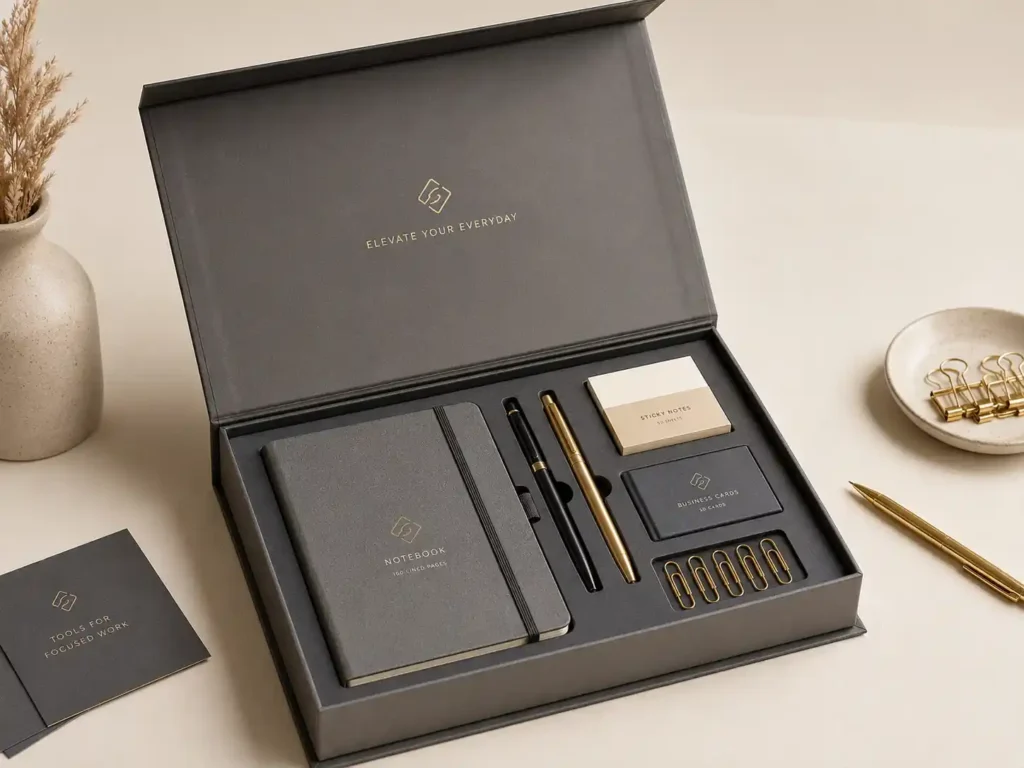
A stationery gift box can turn pens, notebooks, sticky notes, rulers, clips, desk pads, cards, and small accessories into a more organized desk set. The challenge is not only making the outside look premium, but also making every item sit cleanly, ship safely, and feel easy to open.
For many packaging projects, stationery looks simple until the insert is tested. Long pens roll, notebooks shift, paper corners bend, and small clips disappear under larger products. A good custom gift box plan starts with the product mix, not the decoration.
Stationery Gift Box Ideas Start With Product Fit
Desk sets often combine items with different thickness, surface finish, and weight. A hard-cover notebook may need a deeper cavity, while pens and pencils need slim channels that stop movement. If the box includes sticky notes, cards, or envelopes, the insert should protect corners and keep paper edges flat.
In our experience, buyers often send a product list first and choose the box style later. That works better than forcing every item into a preset box size. A practical request should include product dimensions, product weight, preferred set arrangement, and whether the box will be used for retail display, corporate gifting, eCommerce shipping, or seasonal promotion.
Useful stationery gift box layouts include:
- Notebook on one side, pen set on the other side
- Layered insert with cards underneath and writing tools above
- Drawer-style opening for a premium desk set reveal
- Magnetic rigid box with a clean top-view presentation
- Foldable rigid box for lower storage volume before assembly
- Mailer-style gift box when the set needs stronger shipping behavior
If your desk set includes fragile rulers, acrylic accessories, or small metal clips, the insert structure matters more than the outer finish. The outside creates the first impression. The inside controls the user experience.

Choosing the Right Box Structure for a Stationery Gift Box
The best structure depends on how the set will be sold, stored, shipped, and opened. A premium retail stationery kit may benefit from a rigid box. A subscription-style paper product set may work better in a printed mailer box. A lightweight notebook and pen bundle may only need a folding carton if the insert is designed well.
Magnetic gift box for premium desk sets
A magnetic rigid box gives desk sets a clean presentation and a smooth opening feel. It works well for corporate stationery kits, launch gifts, conference gifts, and retail-ready writing sets. The board thickness can usually be adjusted based on product weight and box size, while the paper wrap can carry brand color, texture, foil, embossing, or debossing.
For premium gift packaging, magnetic gift boxes are often selected when the buyer wants a strong outer form and a display-like opening. They also pair well with molded pulp, paperboard, EVA, or foam inserts when multiple writing products need fixed positions.
Drawer box for a controlled reveal
A drawer box is useful when the set should open with a pull-out experience. It can separate a notebook from pens or create a second layer for cards, clips, refills, or stickers. For structure planning, the sleeve needs enough clearance so the drawer slides smoothly after paper wrapping and bulk assembly.
If you are comparing rigid styles, this drawer box vs magnetic box guide can help frame the decision. The same structure logic applies to stationery sets: drawer boxes create a slower reveal, while magnetic boxes show the set more directly.
Mailer box for shipping-friendly presentation
When stationery sets go through courier delivery, a mailer box may be more practical than a premium rigid box. Corrugated mailer structures can combine branding and shipping strength in one pack. They can also include internal paperboard dividers, belly bands, or folded supports.
For eCommerce-style desk sets, mailer boxes can reduce the need for an extra outer carton. The key is to test the closing tension, corner protection, and product movement before bulk production.
Stationery Gift Box Structure Comparison
| Box structure | Best use for desk sets | Main advantage | Watch-out during sampling |
|---|---|---|---|
| Magnetic rigid box | Premium notebook and pen sets | Strong presentation and gift feel | Magnet placement, lid alignment, insert height |
| Drawer box | Layered stationery kits | Controlled reveal and organized storage | Drawer clearance after wrapping |
| Lid and base box | Classic retail gifting | Simple structure with large branding area | Lid fit, paper wrap corners, stack pressure |
| Foldable rigid box | Larger seasonal or corporate sets | Saves storage and freight volume before assembly | Folding joints, corner stiffness, assembly time |
| Mailer box | Shipped stationery bundles | Better transit behavior and flat shipping surface | Compression strength and product movement |
| Folding carton | Lightweight paper sets | Cost-efficient and retail-friendly | Board grade, crease lines, insert support |
This comparison is not about choosing the most expensive structure. It is about matching the structure to the product weight, channel, quantity, and opening experience.
Insert Planning: The Part Buyers Notice After Opening
A stationery gift box often fails when the insert is treated as an afterthought. Inserts decide whether the pen sits straight, whether the notebook corner stays clean, and whether the full set looks intentional when opened.
Common insert options include:
- Paperboard tray for paper-based and recyclable packaging goals
- Molded pulp insert for a natural texture and stronger cavities
- EVA or foam insert for precise holding of pens and small accessories
- Corrugated insert for heavier desk sets or shipping support
- Layered paper insert for mixed items with different depths
For many desk set projects, a paperboard or molded pulp insert gives a balanced result. It keeps the packaging aligned with paper-based materials while giving enough support for light and medium-weight items. More precise items, such as metal pens, glass paperweights, or premium desk tools, may need EVA or foam to avoid shifting and surface scratches.
If the set uses multiple cavities, the insert drawing should be reviewed with product samples, not only digital dimensions. Pen clips, notebook elastic bands, spiral binding, shrink wrap, and paper thickness can all change fit. Custom box inserts are worth planning early because insert tooling, material choice, and hand assembly can affect both unit cost and lead time.

Materials, Paper Wrap, and Finishes That Make Sense
Good stationery packaging does not need every finish at once. A matte art paper wrap with a small foil logo may look more refined than a full-surface metallic design. A textured paper can work well for writing sets because it connects with paper, notebooks, and desk materials.
Material decisions should cover:
- Greyboard or rigid board thickness for box shape and weight support
- Coated paper, specialty paper, or kraft paper for the outer wrap
- Paperboard or corrugated board for inserts and shipping support
- Lamination choice for scuff resistance and surface feel
- FSC-certified paper options when responsible sourcing is required
For responsible sourcing, the Forest Stewardship Council is a useful reference for understanding FSC-related material and chain-of-custody topics. For quality-management expectations, ISO 9001 provides a recognized framework for process control, documentation, and continual improvement.
Print and finish choices should match the desk set style. For example, a student stationery pack may use bright colors and simple spot UV. A corporate writing set may use muted tones, foil stamping, and embossing. A seasonal desk gift may use patterns, ribbon, sleeves, or a belly band.
Keep one rule in mind: finishes add value only when the structure and insert already work. Foil cannot fix loose products. Embossing cannot fix weak corners.
Artwork and Branding Details That Affect Production
Stationery sets often contain flat products, so small artwork mistakes become easy to notice. A crooked logo on a lid, a misaligned pattern on a drawer sleeve, or poor color matching across a notebook and box can weaken the finished set.
Before sampling, the artwork file should confirm:
- Logo size and placement on lid, sleeve, or inner panel
- Printing colors, Pantone references, and finish layers
- Bleed and safe area for paper wrapping
- Spine, drawer pull, ribbon, or thumb notch position
- Barcode, warning text, recycle marks, or product information
- Inner tray color and visible insert edges
Dieline review matters. A box may look correct in a flat layout but change after wrapping, folding, gluing, and assembly. For rigid boxes, corners and lid edges should be checked carefully because paper stretch and wrap thickness can affect final alignment. For folding boxes, crease lines, locking tabs, and board grain direction are more important.
Sampling and Quality Checks Before Bulk Production
A sample is not only a photo approval. It is a working test of structure, fit, color, opening feel, and packing method. In our factory experience, many improvements happen between the first white sample and the printed pre-production sample.
A practical sampling process may include:
- Confirm product dimensions and set layout.
- Make a white structural sample for fit and opening.
- Adjust cavities, insert height, board thickness, or lid clearance.
- Prepare printed sample with paper, color, and finish.
- Test product loading, hand assembly, closing, and export packing.
- Confirm final specification before bulk production.
For shipped gift sets, transit validation should not be skipped. The International Safe Transit Association offers packaging test procedures used across many distribution environments. Not every project needs the same test level, but the idea is useful: the gift box should survive the shipping path the product will face.
Quality control should focus on both appearance and function. Check lid alignment, drawer movement, magnet position, glue marks, foil registration, insert fit, scuffing, carton packing, and barcode readability. For export orders, master carton strength, pallet plan, moisture protection, and carton markings can also affect delivery condition.
Seasonal and Retail Stationery Gift Box Ideas
Stationery products are often used in seasonal campaigns, school promotions, office gifts, conference packs, and holiday sets. The structure can change depending on the campaign.
A back-to-school set may use a folding carton or mailer box with bright artwork and a simple paper insert. A premium desk set for a product launch may need a magnetic box with a fitted insert and foil logo. A holiday stationery set may use a rigid box with a sleeve, ribbon, or multi-compartment layout.
For seasonal multi-item packaging, the logic used in advent calendar boxes can inspire stationery kits with separate compartments. Small drawers, numbered doors, or layered sections can turn pens, cards, clips, notes, and stickers into a more interactive gift.
This is where practicality should guide creativity. If every compartment needs hand loading, the assembly time rises. If the items vary in height, the insert may need stepped cavities. If the box ships long distance, each cavity should hold products through vibration and handling.

Cost Drivers Buyers Should Understand
A stationery gift box price is influenced by more than size. Structure, board thickness, insert complexity, material choice, printing, finishes, assembly, and packing all affect the final quotation.
Main cost drivers include:
- Rigid box size and board thickness
- Number of insert cavities and material type
- Hand assembly time for multi-product sets
- Foil, embossing, debossing, spot UV, or special paper
- Quantity and production efficiency
- Export carton size and shipping volume
- Sample rounds and tooling requirements
Foldable rigid boxes can reduce storage space before assembly, but they may add assembly steps. Magnetic boxes create a premium feel, but magnets and rigid board increase material cost. Mailer boxes can support shipping, but they may need corrugated board and transit testing. Folding cartons can reduce unit cost, but they may not suit heavier desk sets without inner support.
A strong inquiry gives the manufacturer enough detail to quote the right structure rather than guess. Share product sizes, weight, quantity, preferred box style, insert type, artwork status, reference images, packing method, and expected delivery time. If you are unsure about the structure, send the product list first and ask for a packaging plan.
Ready to Plan a Stationery Gift Box for Your Desk Set?
The best stationery gift box is built around the products first: how they sit, how they open, how they ship, and how the set should feel when received. Decoration comes after the structure, insert, sample, and packing method are under control.
Gifts Pack has worked with custom paper packaging since 2004, covering rigid gift boxes, magnetic boxes, drawer boxes, lid and base boxes, foldable rigid boxes, mailer boxes, folding cartons, advent calendar structures, and custom inserts. For a new desk set project, Gifts Pack factory support can help review the product mix, recommend a box structure, develop inserts, prepare samples, and plan bulk production with export packing in mind.
Send the real product dimensions, photos, quantity, artwork direction, and delivery plan. The earlier those details are clear, the faster your stationery gift box can move from idea to sample, then from sample to production.

