
MOQ for custom advent calendar boxes is one of the first questions buyers ask. It should be. The number affects cost, structure choice, insert planning, and how realistic the whole project is from sample stage to shipment. If the MOQ is misunderstood at the start, the calendar often has to be resized, simplified, or delayed later.

Why does MOQ matter so early in a calendar box project?
Start with the structure. A calendar box is not a simple carton.
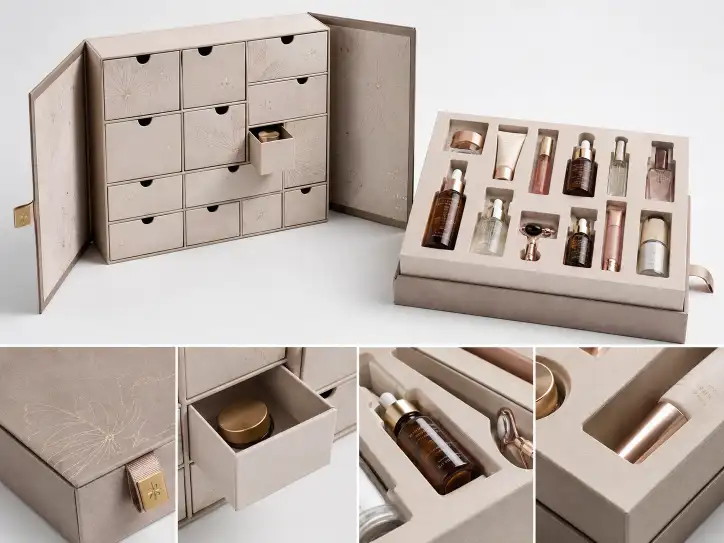
A custom advent calendar box often includes many compartments, a shaped tray, printed numbering, and a stronger outer shell than a standard pack. Some projects use drawers. Some use a book-style opening. Some use front doors with a tray behind them. Each route changes material use, assembly time, and production setup.
That is why MOQ matters early. It is not only about how many boxes a buyer wants. It is about whether the project has enough volume to support the structure being requested.
A plain carton and a premium calendar box do not behave the same way in production. One may move through the line with fewer steps. The other may need hand assembly, tray fitting, drawer alignment, and repeated inspection before packing even starts.
If you are still choosing the outer format, begin with custom advent calendar boxes before discussing price alone. The MOQ often makes more sense after the structure is clear.
What does MOQ for custom advent calendar boxes usually depend on?
There is no one fixed number for every project. That is the first thing buyers need to know.
MOQ for custom advent calendar boxes usually changes with these factors:
- box structure
- box size
- product count such as 12-day or 24-day
- insert type
- material thickness
- surface finishing
- assembly complexity
- packing method
A 12-day beauty calendar with a book-style opening and paperboard fitment is not built the same way as a 24-drawer premium calendar with mixed product sizes. The second project uses more parts, more labor, and more control during production. That often pushes the starting quantity higher.
Keep it practical. MOQ is tied to setup, not only demand.
How does structure change the MOQ?
The structure is usually the biggest driver after size. It decides how much work the factory has to set up before the first finished box is even packed.
Book-style advent calendar box
A book-style calendar can be a more efficient route when the product layout stays controlled and the tray can be built on one main platform. It often uses fewer separate parts than a full drawer structure.
That helps. In many cases, the MOQ can stay more workable because the production flow is more direct.
This does not mean every book-style project is simple. A large calendar with deep cavities, foil finishing, or mixed product sizes can still require a more serious setup.
Drawer advent calendar box
A drawer calendar often needs more components. Each drawer has to be made, wrapped or printed, inserted, aligned, and checked. The outer shell also needs enough strength to keep the full set stable after repeated use.
This pushes labor up. It also pushes board usage up.
That is why MOQ for custom advent calendar boxes often rises when the project moves into a drawer format, especially when the drawer count is high and the sizes vary across the front.
Door-opening advent calendar box
A door-opening structure can work well for lighter items and more standardized layouts. It may be a useful route when the brand wants the calendar feel without stepping into the heavier drawer format.
If the products are light and the tray is well planned, this route can sometimes support a lower starting quantity than a more complex premium build.
| Structure | Setup Load | Typical Effect on MOQ | Main Reason |
|---|---|---|---|
| Book Style | medium | more flexible | fewer separate components in many projects |
| Drawer Style | high | often higher | more parts and more assembly work |
| Door Opening | medium | can stay lower for lighter sets | simpler front-opening format |
How do inserts affect MOQ for custom advent calendar boxes?
The insert has more impact than many buyers expect. That part gets underestimated.
A simple paperboard fitment for flat masks, mini tubes, or lighter items usually gives the project more flexibility. It is easier to revise during sampling, easier to group by section, and often easier to load on the line when the products are low weight.
A shaped tray or cavity insert changes the setup. Once the product sizes are fixed, the cavity map becomes more exact. That gives better control, though it also means changes later can affect the whole tray and push more work into sampling and tooling decisions.
Drawer partitions add another layer. They can make mixed-size layouts easier to manage, but they also increase the amount of board work inside the project.
This is why MOQ for custom advent calendar boxes often cannot be discussed in a useful way until the insert route is clear. A buyer may think the calendar only differs by print or finish, while the factory is looking at a completely different internal build.
If the project includes mixed product sizes, start with custom box inserts early. Waiting until the outer shell is approved usually creates more revisions than expected.
Does product count change the MOQ?
Yes. It often does.
A 12-day calendar and a 24-day calendar may look similar in concept, but they do not create the same production load. More positions usually mean more tray work, more numbering, more product-matching pressure, and more time on the packing line.
That matters. The box count may stay the same, but the job behind each unit becomes heavier.
A 24-position structure may also need a larger front face or a deeper shell, depending on the products inside. Once that happens, board usage rises, storage changes, and export packing may need another review.
This does not mean a lower-count box is always the better choice. It means the buyer should decide the product count early, not treat it like a small change that can be made after the sample route is already moving.
Why do finishing and materials affect the starting quantity?
Because each added detail changes setup. Some changes are small. Some are not.
Foil, embossing, soft-touch lamination, specialty wraps, magnetic parts, thicker board, or textured paper can all change how the project runs. A calendar box with plain print on standard board is one thing. A calendar with wrapped rigid construction, foil details, and a more demanding insert is another.
Each layer adds control points. Those control points affect what quantity makes sense.
If the calendar also needs a premium finish for launch images or shelf presentation, the buyer should ask whether the finish supports the planned quantity or whether a cleaner material route would make the order easier to start.
For paper-based material direction, it helps to align the discussion with FSC paper packaging guidance where relevant. Material direction should not be left until the end.

Can a buyer reduce MOQ without damaging the project?
Sometimes, yes. The structure may need to change first.
If the requested quantity is below what the original build supports, there are often three paths: simplify the structure, simplify the insert, or simplify the finish. That does not mean the project has to lose all impact. It means the build has to match the volume.
A book-style calendar may become more realistic than a full drawer layout. A paperboard fitment may make more sense than a more exact multi-part insert. A cleaner wrap or print finish may help the project stay workable at the requested scale.
This is where honest discussion matters. A factory can often suggest a better route if the buyer shares the real target quantity early instead of asking for a premium build first and only discussing the volume later.
MOQ is not a punishment. It is a reflection of setup.
What mistakes do buyers make when asking about MOQ?
The first mistake is asking for a number before sharing the structure. Without the format, count, and insert route, the answer can only stay rough.
The second mistake is changing the product list after quoting starts. A new jar height, a wider bottle, or extra items in the set can change the insert and the shell. That can also change the order setup.
The third mistake is assuming the same MOQ should apply to every calendar style. It should not. A drawer advent calendar box and a book-style beauty calendar do not carry the same production load.
The fourth mistake is focusing only on the price per unit. MOQ also affects storage, packing rhythm, material planning, and how stable the production route will be once the job moves beyond the sample.
The fifth mistake is ignoring shipping and handling. If the project will move through parcel delivery or export packing, the starting quantity should be considered alongside transit support and sample testing. For that side of the review, it helps to check ISTA packaging test guidance before final approval.
What should buyers prepare before asking about MOQ for custom advent calendar boxes?
A good MOQ discussion starts with a clear file. No file, no useful answer.
Before asking for a quote or minimum order guidance, prepare these details:
- target calendar format such as 12-day or 24-day
- product list
- dimensions for each item
- product weight
- preferred structure
- insert direction
- finish requirements
- target launch timing
- shipping method
- real target quantity
That list changes the conversation. Instead of asking for a generic MOQ, the buyer can get a response tied to the real project.
If the product mix is still being decided, it is often better to say so early. That lets the supplier suggest a safer structure before the sample route becomes too fixed.
How should brands think about MOQ for custom advent calendar boxes?
MOQ for custom advent calendar boxes should be treated as part of the structural plan, not as a final pricing footnote. The minimum often reflects how much setup the project needs, how many parts it contains, and how exact the insert and finish must be before production can move cleanly.
That is the useful way to read it. A lower MOQ may be possible with a simpler build. A more complex premium calendar may need a stronger starting quantity to stay realistic. Once the product list, structure, insert route, and target launch window are fixed, the next step is simple: send the real project file, compare the build options against the target quantity, and move the sample forward before the seasonal schedule gets tight.

