
A brand designs a premium rigid gift box for a skincare set. The box structure is right. The paper wrap is right. The foil stamping is right. Then the factory asks: what type of magnet do you want? What hinge? What ribbon closure?
The brand has not thought about any of these.
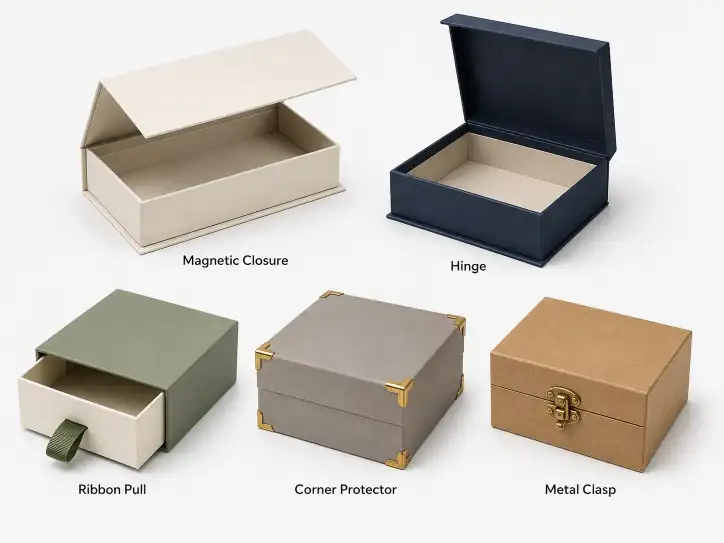
Hardware components — magnets, hinges, ribbons, clasps, corner protectors — are the parts of a gift box that customers touch, pull, and open. They define the [[Custom Rigid Box Supplier Checklist- How to Choose a Manufacturer|unboxing feel more than the box materials or printing]]. A weak magnet makes the box feel cheap. A hinge that does not open flat frustrates the user. A ribbon that frays after three pulls signals poor quality.
Yet most buyers focus entirely on the box structure and artwork, treating hardware as an afterthought. This guide covers the five main categories of gift box hardware — what each type does, how to choose, cost trade-offs, and the quality thresholds that separate premium from substandard.
01 Why Hardware Matters in Gift Boxes
Hardware is the tactile interface between the customer and the packaging. Unlike paper or ink (which are purely visual), hardware components are physically interacted with. The customer feels the magnet snap, pulls the ribbon, and sees how the lid aligns. These interactions form the customer's perception of box quality.
The cost paradox: Hardware represents 5–15% of the total box cost but determines 50%+ of the perceived quality. A $10 box with a weak magnet feels like a $3 box. A $10 box with a properly specified neodymium magnet and smooth hinge feels like a $20 box.
Common hardware failures buyers encounter:
- Magnet falls out after 10 openings
- Ribbon frays or detaches from the box
- Hinge breaks at the glue joint
- Metal clasp scratches the box surface
- Corner protector peels off during shipping
These failures are avoidable with correct hardware specification. This guide covers how to specify each component so the factory delivers consistent quality at bulk scale.
02 Magnetic Closures
Magnetic closures are the most common hardware component in premium gift boxes. The "snap" feel is the primary tactile signal of box quality.
Magnet Types
| Magnet Type | Strength | Cost per Unit | Best For | Risk |
|---|---|---|---|---|
| Neodymium (NdFeB) | Strongest | $0.10–$0.50 | Premium rigid boxes, heavy lids | Can interfere with electronics; shipping restrictions |
| Ferrite (Ceramic) | Moderate | $0.02–$0.10 | Standard gift boxes, lightweight lids | Weaker hold; larger size needed for same strength |
| Rubberized magnet sheet | Weak | $0.01–$0.05 | Folding cartons, lightweight closures | Not suitable for rigid box lids |
| Magnetic tape | Weak | $0.005–$0.02 per inch | Temporary closures, PDQ displays | Fails after repeated openings |
How Magnets Are Installed
| Installation Method | Appearance | Cost Impact | Durability |
|---|---|---|---|
| Embedded in board (counterbore) | Invisible from outside | +$0.05–$0.15 per magnet | High — magnet is inside the board |
| Surface-mounted under paper wrap | Invisible from outside | +$0.03–$0.10 per magnet | Medium — paper can peel over time |
| Metal plate + hidden magnet | Visible metal plate inside | +$0.10–$0.30 per pair | High — common in luxury boxes |
| Exposed magnetic snap button | Visible on box surface | +$0.15–$0.50 per pair | High — industrial strength |
How to Specify Magnets
Required specifications:
- Magnet grade (N35, N42, N52 for neodymium — higher number = stronger)
- Magnet dimensions (diameter × thickness — e.g., 10mm × 3mm)
- Installation method (counterbore / surface / plate)
- Holding force required (grams or Newtons)
- Coating (Ni+Cu+Ni plating for neodymium to prevent corrosion)
Holding force guidelines by box type:
| Box Type | Recommended Holding Force | Magnet Suggestion |
|---|---|---|
| Small jewelry box (under 100g) | 200–400g | 6mm × 2mm N35 |
| Standard gift box (100–500g) | 400–800g | 10mm × 3mm N42 |
| Large rigid box (500g–2kg) | 800–1500g | 15mm × 3mm N42 or dual magnets |
| Heavy display box (2kg+) | 1500g+ | 20mm × 4mm N52 or multi-magnet array |
Common Magnet Mistakes
Magnet too weak: The lid does not stay closed. Product falls out during handling. Customer perceives low quality.
Prevention: Specify holding force requirements in grams, not just magnet dimensions. Test the sample with the actual product weight inside.
Magnet too strong: The lid requires two hands to open. The user struggles and the experience feels unrefined.
Prevention: Test with one-hand opening. For large lids, use a ribbon pull to assist opening (see Section 04).
Magnet falls out: The magnet detaches from the board after repeated use, leaving a loose piece inside the box.
Prevention: Specify counterbore installation over surface-mount. Counterbore locks the magnet inside the board; surface-mount relies entirely on glue.
Magnet interferes with product: Neodymium magnets in a box containing electronics (headphones, smart devices) can cause interference.
Prevention: Use ferrite magnets for electronics packaging, or place magnets at least 20mm from the product compartment.

03 Hinges
Hinges control how the lid opens and stays open. For rigid gift boxes (book-style, shoulder box, hinged lid boxes), the hinge is a structural component that affects both function and appearance.
Hinge Types
| Hinge Type | Opening Angle | Cost per Box | Best For |
|---|---|---|---|
| Paper hinge (score line) | 90–120° | $0.00 (included in board) | Folding cartons, lightweight rigid boxes |
| Cloth hinge (fabric strip) | 90–180° | $0.05–$0.15 | Book-style boxes, drawer box wraps |
| Concealed metal hinge | 180° | $0.15–$0.50 | Heavy lids, high-use boxes |
| Piano hinge (continuous) | 180° | $0.30–$1.00 | Large display boxes, heavy-duty packaging |
Paper Hinge
A score line in the paperboard that creates a fold. This is the default hinge for folding cartons and lightweight rigid boxes. It costs nothing extra but has limited durability (typically 50–100 open/close cycles before the paper starts cracking).
Best for: Single-use or short-term packaging. Folding cartons. Lightweight boxes under 1kg.
Not suitable for: Heavy lids. Boxes that will be opened repeatedly (subscription boxes, storage boxes). Products with long shelf life (12+ months).
Cloth Hinge
A fabric strip (muslin, cambric, or synthetic) glued to the box board at the hinge point. This is the standard hinge for book-style rigid boxes. It allows 180° opening and lasts for hundreds of cycles.
Best for: Book-style rigid gift boxes. Premium retail packaging. Boxes expected to be reused.
Quality indicators:
- Cloth weight: 80–120 gsm (too thin = tears easily; too thick = stiff opening)
- Glue coverage: full surface bond, not spot glue
- Hinge gap: 2–3mm between lid and base for smooth opening
Concealed Metal Hinge
A small metal hinge (typically brass or steel) concealed between the box board and the paper wrap. It provides the most durable opening mechanism but adds cost and assembly time.
Best for: Heavy lids (over 500g). High-end boxes expected to open hundreds of times. Display boxes that need to lie flat.
Cost note: Concealed metal hinges are labor-intensive to install (manual alignment + wrapping). At scale (1,000+ units), the cost drops to $0.15–$0.30 per box.
How to Specify Hinges
| Box Requirement | Recommended Hinge |
|---|---|
| Single-use folding carton | Paper hinge (score) |
| Premium gift box, moderate use | Cloth hinge |
| Heavy lid, frequent opening | Concealed metal hinge |
| Display box, 180° lay-flat | Cloth hinge or concealed metal hinge |
| Subscription box, monthly use | Cloth hinge or concealed metal hinge |
04 Ribbon Pulls and Closures
Ribbons serve two functions in gift boxes: they help the customer open the lid (ribbon pull), and they secure the box closed (ribbon tie). Both functions affect the unboxing experience.
Ribbon Types for Gift Boxes
| Ribbon Type | Material | Cost per Meter | Best For |
|---|---|---|---|
| Satin ribbon | Polyester | $0.05–$0.20 | Luxury look, ribbon pulls |
| Grosgrain ribbon | Polyester | $0.08–$0.25 | Ribbon ties, durable handling |
| Organza ribbon | Polyester | $0.10–$0.30 | Decorative bows, transparent effect |
| Velvet ribbon | Nylon/polyester | $0.20–$0.50 | Premium tactile feel |
| Cotton tape | Cotton | $0.05–$0.15 | Eco-friendly packaging |
| Recycled polyester ribbon | RPET | $0.10–$0.25 | Sustainable packaging |
Ribbon Installation Methods
| Method | Appearance | Cost per Box | Durability |
|---|---|---|---|
| Glued under paper wrap | Invisible attachment | +$0.05–$0.15 | Medium — glue bond may fail |
| Inserted into box board slot | Clean finish | +$0.10–$0.25 | High — mechanical lock |
| Knotted through pre-cut hole | Visible knot inside | +$0.03–$0.10 | High — simple and secure |
| Heat-sealed to paper | Clean edge | +$0.08–$0.20 | Medium — heat seal strength varies |
| Metal ribbon clamp | Premium hardware look | +$0.15–$0.40 | High — mechanical + glued |
Ribbon Pull Specifications
Length: Ribbon pull should extend 15–25mm above the box edge. Too short and the user cannot grip it. Too long and it looks messy.
Width: 6–10mm for small boxes, 10–15mm for standard gift boxes, 15–25mm for large boxes.
Heat-cut vs laser-cut: Heat-cut ribbon ends (sealed) prevent fraying. Laser-cut provides a clean edge but may require an additional sealant for polyester ribbons.
Ribbon Tie Specifications
Length for tying: Box perimeter × 2 + 200mm (for bow). Example: a 200mm × 150mm box needs approximately 900mm of ribbon for a complete tie with bow.
Fray resistance: Specify heat-sealed ends. Grosgrain frays less than satin. Organza requires careful handling.
Common Ribbon Mistakes
Ribbon detaches: The ribbon pull comes out of the box after a few uses. The magnet is now inaccessible and the box is hard to open.
Prevention: Use slot insertion or metal clamp methods instead of glue-only attachment. If glue is used, specify hot-melt adhesive with 24-hour cure time.
Ribbon frays quickly: The edge of the ribbon unravels after repeated handling, creating a cheap appearance.
Prevention: Specify heat-cut ends for synthetic ribbons. For natural fibers, specify a sealed hem or use grosgrain (which resists fraying better than satin).
Ribbon too thin for the box: A 6mm ribbon on a large 300mm × 200mm box looks disproportionately small. The visual balance is wrong.
Prevention: Match ribbon width to box scale. Larger boxes need wider ribbon for visual proportion.

05 Corner Protectors and Metal Clasps
Corner Protectors
Metal corner protectors (also called corner guards or box corners) are small metal fittings applied to the corners of a rigid box. They protect the box corners from wear and add a decorative hardware element.
| Material | Finish Options | Cost per Corner | Best For |
|---|---|---|---|
| Brass | Gold, silver, matte black | $0.15–$0.40 | Premium luxury boxes |
| Zinc alloy | Electroplated (gold, silver, rose gold) | $0.10–$0.30 | Mid-range decorative |
| Stainless steel | Brushed, polished | $0.20–$0.50 | Industrial/edgy aesthetic |
| Plastic (ABS) | Painted metallic | $0.05–$0.15 | Budget option |
Installation: Corner protectors are typically glued and/or crimped onto the box corner. Some are pre-formed to fit 90° corners. Custom shapes are available for MOQ of 1,000+ pairs.
When to use corner protectors:
- Boxes that will be handled frequently (display boxes, store samples)
- Premium positioning where hardware detail signals quality
- Large boxes where corners are vulnerable to shipping damage
When to skip:
- Small boxes where corners add bulk (jewelry boxes under 100mm)
- Folding cartons (corners are folded, not applicable)
- Budget-constrained projects (corner protectors add $0.60–$1.60 per box)
Clasps and Latches
| Type | Security Level | Cost | Best For |
|---|---|---|---|
| Magnetic push latch | Low-medium | $0.20–$0.50 | Simple closure, quick access |
| Metal turn latch | Medium | $0.30–$0.80 | Security, child-resistant options |
| Hook-and-eye clasp | Medium | $0.20–$0.60 | Vintage / craft aesthetic |
| Buckle clasp (metal with strap) | High | $0.50–$1.50 | Luxury luggage-style boxes |
| Lock and key (small) | High | $1.00–$3.00 | Jewelry, keepsake boxes |
Latches add a mechanical closure element that goes beyond magnetic hold. They are less common in standard gift boxes (where magnets are sufficient) but relevant for specialty packaging.
06 Hardware Cost Comparison Summary
| Component | Cost per Box (Low) | Cost per Box (High) | % of Total Box Cost |
|---|---|---|---|
| Magnet (neodymium, 2 pcs) | $0.20 | $1.00 | 2–8% |
| Magnet (ferrite, 2 pcs) | $0.04 | $0.20 | 0.5–2% |
| Cloth hinge | $0.05 | $0.15 | 0.5–1.5% |
| Concealed metal hinge (2 pcs) | $0.30 | $1.00 | 3–10% |
| Ribbon pull | $0.05 | $0.40 | 0.5–4% |
| Ribbon tie (full wrap) | $0.15 | $0.80 | 1.5–8% |
| Corner protectors (4 pcs) | $0.60 | $2.00 | 6–20% |
| Metal clasp | $0.30 | $1.50 | 3–15% |
| Total hardware (typical premium box) | $0.80 | $3.50 | 5–15% |

07 Decision Framework: How to Choose Gift Box Hardware
Step 1: Define the interaction
| How the Box Is Used | Recommended Hardware |
|---|---|
| Customer opens once, removes product, discards box | Basic magnet (ferrite), paper hinge, no ribbon |
| Customer opens frequently, keeps the box | Neodymium magnet, cloth hinge, ribbon pull |
| Box is shipped and should arrive closed | Neodymium magnet with holding force ≥ product weight × 2 |
| Box is displayed on a shelf | Strong magnet, corner protectors for retail durability |
Step 2: Match hardware to box type
| Box Type | Recommended Hardware Configuration |
|---|---|
| Magnetic lid box (lid and base) | 2× neodymium magnets (embedded), no hinge, no ribbon |
| Book-style box | Cloth hinge, 1–2× neodymium magnets, optional ribbon pull |
| Shoulder box | No hinge, 2× neodymium magnets (lid), ribbon tie optional |
| Drawer box | 1× neodymium magnet (optional, for drawer stop), ribbon pull |
| Folding carton | No hardware (paper hinge, tuck flap) |
| Display box (heavy) | Concealed metal hinge, 2× neodymium magnets, corner protectors |
Step 3: Verify with a sample
Always confirm hardware performance on a physical sample before bulk production:
- Magnet holds the lid closed with product inside
- Lid can be opened with one hand
- Hinge opens 180° without resistance
- Ribbon pull does not detach after 50 pulls
- Corner protectors are flush with the box surface
- No visible glue marks near hardware attachment points
08 How to Specify Hardware in Your Box Brief
When sending a [[Custom Box Manufacturer Selection Checklist for Gift Boxes|gift box factory brief]], include hardware specifications to ensure the supplier matches the quality level your brand requires.
Magnets:
- Type (neodymium / ferrite)
- Grade (N35 / N42 / N52)
- Size (diameter × height)
- Installation (counterbore / surface mount)
- Holding force requirement in grams
- Coating requirement (Ni+Cu+Ni for neodymium)
Hinge:
- Type (paper / cloth / concealed metal)
- Cloth weight (gsm) for cloth hinges
- Opening angle requirement (180° recommended)
- Hinge gap (2–3mm between lid and base)
Ribbon:
- Material (satin / grosgrain / velvet / cotton)
- Width (mm)
- Length (mm, measured from attachment point)
- Installation method (glued / slot / clamp)
- End finish (heat-cut / sealed)
Corner protectors:
- Material (brass / zinc / stainless steel)
- Finish (gold / silver / matte black)
- Size (mm per side)
Sample Specification Text
"The box requires two neodymium magnets, grade N42, 10mm × 3mm, installed in counterbore holes in both the lid and base. Each magnet must be coated with nickel-copper-nickel plating. Minimum holding force: 600g with the lid assembled. The hinge must be 100 gsm muslin cloth, allowing 180° opening with a 2.5mm hinge gap. A 12mm wide satin ribbon pull is required, slot-inserted into the lid board, extending 20mm above the box edge, with heat-sealed ends to prevent fraying."
09 Common Hardware Mistakes
Mistake 1: Choosing magnets by size, not force
A buyer specifies "12mm magnets" without specifying the grade. The factory uses N35 (weakest). The lid does not stay closed.
Prevention: Always specify grade (N35/N42/N52) and holding force in grams. Never specify by size alone.
Mistake 2: Using paper hinge on a box that will be reused
A subscription box uses a paper hinge. After 3 months, the hinge cracks. The customer perceives the box as low quality.
Prevention: For any box expected to open more than 20 times, specify cloth hinge or concealed metal hinge.
Mistake 3: Gluing ribbon without mechanical reinforcement
A ribbon pull is glued under the paper wrap. After 15–20 pulls, the ribbon separates from the glue. The box is now harder to open.
Prevention: Use slot insertion or metal clamp for ribbon attachment. If glue-only is required for cost reasons, specify hot-melt adhesive and test with 50+ pulls before approving.
Mistake 4: Adding corner protectors without testing fit
Corner protectors that extend beyond the box edge catch on shelves and scratch neighboring boxes during shipping.
Prevention: Require corner protectors to be flush with or slightly recessed from the box surface. Measure after installation on the sample.
Mistake 5: Forgetting that hardware adds assembly time
A complex clasp adds $0.50 in parts but $1.50 in manual assembly labor. The total hardware cost doubles.
Prevention: Ask the factory for the installed cost (parts + labor), not just the component cost. Simple components with easy installation are often cheaper in total than cheaper parts with complex labor.
10 Hardware Specification Checklist
- Magnet type and grade specified
- Magnet holding force tested with product inside
- Hinge type matched to box use frequency
- Hinge opening angle confirmed (180° if lay-flat required)
- Ribbon material, width, and length specified
- Ribbon attachment method confirmed (not glue-only if avoidable)
- Ribbon ends heat-sealed to prevent fraying
- Corner protectors flush with box surface
- Hardware cost confirmed as parts + labor, not parts only
- Physical sample tested for all hardware functions
- Hardware tested with the actual product weight inside
- Shipping test: hardware survives transport without damage


