
A beauty brand prepares a holiday gift set. The packaging team sources FSC-certined paper for the outer box. The insert is made from recycled paperboard. The ribbon is polyester. The product is a glass bottle with a plastic pump. The brand prints "eco-friendly packaging" on the box.
A retailer asks: which certification covers the ribbon? Which one covers the paper? Is the label actually verified?
The brand does not have an answer.
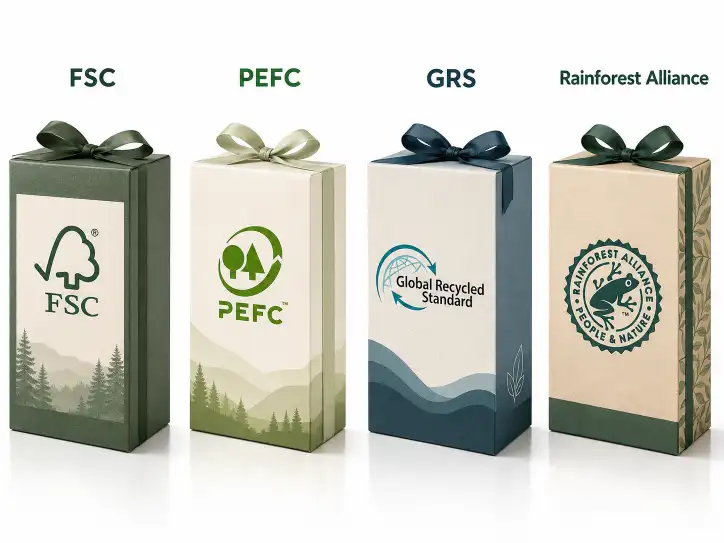
Eco-certifications for gift box packaging are not interchangeable. FSC covers paper sourcing. GRS covers recycled content in any material. PEFC covers forest management differently than FSC. Each certification serves a different purpose, costs differently, and carries different credibility with retailers and consumers. Choosing the wrong one — or claiming the wrong one — creates compliance risk and reputational damage.
This guide compares the major gift box eco-certifications — what each one covers, how to choose, what retailers require, and how to avoid common certification mistakes. Choosing the right certification starts with understanding your [[Gift Box Types Guide- 12 Rigid Box Styles for Custom Packaging|gift box type]] and the materials it uses.
01 Why Eco-Certification Matters for Gift Boxes
Gift box packaging sits at the intersection of brand perception and regulatory compliance. Unlike industrial packaging, gift boxes are seen by the end customer. A certification label on a gift box communicates environmental responsibility at the moment of unboxing.
Retailer requirements are tightening:
- Sephora's sustainability program asks suppliers about packaging certification
- Target requires suppliers to report on packaging material sourcing
- EU Packaging and Packaging Waste Regulation (PPWR) is phasing in certified content requirements
- UK Plastic Packaging Tax affects gift boxes with plastic components — certified recycled content reduces liability
- Amazon's Climate Pledge Friendly program prioritizes certified products in search rankings
A brand that cannot answer "what certification does your gift box carry?" may lose retail placement or face delisting from sustainability programs. For a broader view of how certification fits into [[Sustainable Gift Box Packaging- FSC Paper, Recyclability, and Smarter Material Choices|sustainable gift box packaging strategy]], see our full sustainability guide.
Beyond retail compliance, certification affects consumer trust. According to industry surveys, a majority of consumers recognize the FSC logo and associate it with responsible sourcing. A certified gift box supports the brand's ESG narrative at the point of sale.
02 Certification Comparison Overview
| Certification | Scope | What It Verifies | Material Focus | Cost Impact | Retail Recognition |
|---|---|---|---|---|---|
| FSC 100% | Forest sourcing | All fiber from FSC-certified forests | Paper, paperboard | +10–20% paper cost | High — global standard |
| FSC Mix | Forest sourcing | ≥70% FSC-certified or recycled fiber | Paper, paperboard | +5–10% paper cost | High — most common FSC label |
| FSC Recycled | Recycled content | 100% post-consumer recycled fiber | Paper, paperboard | Similar to standard recycled | High — growing preference |
| PEFC | Forest sourcing | Fiber from PEFC-certified sustainable forests | Paper, paperboard | +5–15% paper cost | Moderate — Europe strong, US lower |
| GRS (Global Recycled Standard) | Recycled content | Recycled content in any material, plus social/environmental criteria | Any (paper, plastic, textile) | +5–20% material cost | Moderate — fashion/beauty sector |
| OBP (Ocean Bound Plastic) | Waste collection | Plastic waste collected from ocean-bound areas | Plastic components | +15–30% material cost | Emerging — niche recognition |
| Rainforest Alliance | Agricultural sourcing | Sustainable farming practices | Paper, cartonboard (cocoa, coffee related) | +5–15% | Moderate — food/beverage sector |
| Cradle to Cradle | Full product lifecycle | Material health, recyclability, renewable energy, water, social fairness | All packaging | +20–40% | Low-moderate — premium niche |
Which Certifications Apply to Gift Boxes
| Gift Box Component | Available Certifications |
|---|---|
| Paper outer wrap / paperboard | FSC, PEFC, Rainforest Alliance |
| Rigid box board (greyboard) | FSC Mix, FSC Recycled |
| Folding carton | FSC, PEFC |
| Ribbon / textile tie | GRS (if recycled content) |
| Plastic insert / tray | GRS, OBP |
| Foam insert | GRS (if recycled content) |
| Glue / adhesive | Cradle to Cradle (material health) |
| Ink | Cradle to Cradle, GRS (if recycled ink) |

03 FSC — Forest Stewardship Council
What FSC Certifies
FSC is the most widely recognized forest certification globally. It covers the full chain of custody from forest to finished product. For gift boxes, FSC certification means the paper or paperboard fiber comes from responsibly managed forests that meet FSC's environmental and social standards.
FSC Label Types
| Label | Requirement | Best For | Typical Premium |
|---|---|---|---|
| FSC 100% | All virgin fiber from FSC-certified forests | Brands with strong forest conservation commitments | +10–20% |
| FSC Mix | At least 70% FSC-certified or recycled fiber (the balance is "controlled wood") | Most standard gift box applications | +5–10% |
| FSC Recycled | 100% post-consumer recycled content, no virgin fiber | Brands prioritizing circular economy message | +0–5% |
When to Specify FSC
- Retailer requires it — Many European retailers (M&S, Waitrose, Sainsbury's) require FSC certification for paper packaging
- Brand has forest sourcing policy — If the brand's ESG policy includes responsible forestry, FSC is the recognized standard
- Consumer-facing claim — The FSC logo is widely recognized (70%+ consumer recognition in key markets)
- Export to EU — EU regulations increasingly reference FSC or equivalent certification
How to Verify FSC Certification
- Request the factory's FSC Chain of Custody (CoC) certificate number
- Verify on info.fsc.org
- Confirm the certificate scope covers the specific paper grade and mill
- For printed boxes, confirm the printer also holds FSC CoC certification (required for labeled products)
- Specify which FSC label (100% / Mix / Recycled) in the artwork for logo printing
Common FSC Misconception
Many buyers assume FSC certification is about recycled content. It is not. FSC is about forest management. FSC Recycled happens to also verify recycled content, but the primary purpose is ensuring virgin fiber comes from responsibly managed forests. If recycled content is the sole goal, FSC Recycled or GRS may be more appropriate than FSC 100%.
04 PEFC — Programme for the Endorsement of Forest Certification
How PEFC Differs from FSC
PEFC is the other major forest certification system. The practical difference for gift box buyers:
| Factor | FSC | PEFC |
|---|---|---|
| Global market share | ~200 million hectares certified | ~330 million hectares certified |
| Primary strength | Strong brand recognition | Strong in Europe, especially Scandinavia |
| Chain of custody | Strict — full physical separation required | Percentage-based system allows mixing |
| Cost impact | +5–20% | +5–15% |
| Retailer preference | Preferred by most global retailers | Accepted but less demanded |
| Consumer recognition | High (70%+ in key markets) | Moderate (30–40%) |
When PEFC Makes Sense
- European market focus — PEFC is widely accepted in European retail, particularly Germany and Scandinavia
- Cost sensitivity — PEFC paper can be slightly cheaper than equivalent FSC paper due to the percentage-based chain of custody system
- Supplier availability — Some mills carry PEFC but not FSC certification
- Dual certification — Many paper mills hold both FSC and PEFC certification, giving flexibility
When to Choose FSC Over PEFC
- US retail — FSC is the dominant forest certification in North America; PEFC has lower recognition
- Consumer-facing claim — FSC's logo recognition is significantly higher globally
- UK retail — Most UK retailers specify FSC rather than PEFC
- Brand ESG report — FSC is more commonly referenced in sustainability reporting

05 GRS — Global Recycled Standard
What GRS Covers
GRS is a voluntary standard that verifies the recycled content of a product and tracks it through the supply chain. Unlike FSC (which focuses on forest management), GRS applies to any material type — paper, plastic, textile, or metal.
For gift boxes, GRS certification is relevant when:
- The box contains recycled plastic components (inserts, trays, ribbon)
- The brand wants a verified recycled content claim across multiple materials
- The retailer or certification program requires third-party recycled content verification
GRS Requirements
| Requirement | Detail |
|---|---|
| Minimum recycled content for labeled product | 20% (50% for "GRS" claim, 20% for "Recycled Content" claim) |
| Chain of custody | Full transaction certification (TC) required for each stage |
| Social criteria | Compliance with ILO labor standards required |
| Environmental criteria | Wastewater treatment, energy use monitoring, chemical restrictions |
| Chemical restrictions | Restricted substance list (RSL) compliance required |
GRS vs FSC Recycled
| Factor | GRS | FSC Recycled |
|---|---|---|
| Material scope | Any material | Paper only |
| Recycled content requirement | Minimum 20% | 100% post-consumer |
| Additional requirements | Social + environmental criteria | Forest management criteria (not applicable for recycled) |
| Logo recognition | Moderate (B2B, fashion) | High (consumer) |
| Best for | Mixed-material boxes with recycled plastic inserts | All-paper gift boxes |
When GRS Is Worth It
- The gift box contains recycled plastic components — FSC does not cover plastic, so GRS fills the gap
- The brand sells into fashion or beauty retail — GRS is increasingly requested by fashion retailers (H&M Group, Inditex)
- The brand needs a multi-material recycled content claim — GRS covers paper, plastic, and textile in one certification
- The box has a ribbon or textile component — GRS can certify recycled content in fabric ties
06 Certification Cost Comparison

| Certification | One-Time Audit Cost | Annual Renewal | Cost per Unit Impact | Supply Chain Work |
|---|---|---|---|---|
| FSC Chain of Custody | $1,000–$3,000 | $500–$1,500 | +5–20% on paper cost | Moderate — CoC tracking |
| PEFC Chain of Custody | $800–$2,500 | $400–$1,200 | +5–15% on paper cost | Moderate — percentage system simpler |
| GRS | $3,000–$8,000 | $1,500–$4,000 | +5–20% on applicable materials | High — TC tracking per batch |
| OBP | $5,000–$10,000 | $2,000–$5,000 | +15–30% on plastic | High — collection verification |
| Cradle to Cradle | $10,000–$40,000 | $5,000–$15,000 | +20–40% total box cost | Very high — full material assessment |
Who Pays for Certification
The factory typically holds the chain of custody certification. The brand pays for the certified material premium in the unit price. For most gift box projects, the brand does not need to hold its own certification — the factory's CoC certificate covers the production. For a full breakdown of how certification costs factor into total [[How Much Do Custom Boxes Cost- Category-by-Category Pricing Guide|custom gift box pricing]], see our cost guide.
Exception: If the brand imports raw materials directly and has them converted by multiple suppliers, the brand may need its own CoC certification to maintain the chain of custody.
07 Decision Framework: Which Certification Does Your Gift Box Need?
Step 1: Identify the Material
| Box Material | Relevant Certifications |
|---|---|
| All paper / paperboard | FSC, PEFC |
| Paper + plastic insert | FSC + GRS |
| Paper + foam insert | FSC + GRS |
| Paper + ribbon (textile) | FSC + GRS |
| Paper + plastic window | FSC (paper) + GRS (plastic if recycled) |
| All plastic box | GRS, OBP |
Step 2: Check Retailer Requirements
| Retailer / Market | Typical Requirements |
|---|---|
| EU retail (general) | FSC or PEFC preferred; PPWR compliance pending |
| UK retail (Tesco, M&S, Sainsbury's) | FSC preferred; plastic tax exemption requires certified recycled content |
| US mass retail (Walmart, Target) | FSC preferred for paper; sustainability questionnaires may ask for certification |
| Sephora / Ulta | FSC preferred; GRS for plastic components |
| Fashion retail (H&M, Zara) | GRS increasingly required for all materials |
| Amazon Climate Pledge Friendly | FSC or GRS certification qualifies products |
| Beauty / cosmetics specialty | FSC for paper; GRS for inserts and plastic |
Step 3: Match Certification to Brand Claim
| Brand Claim | Required Certification |
|---|---|
| "Made with FSC-certified paper" | FSC Mix or higher |
| "Made from 100% recycled paper" | FSC Recycled (for paper) or GRS |
| "Contains recycled plastic" | GRS |
| "Sustainably sourced materials" | FSC + GRS (or single certification if all one material) |
| "Certified eco-friendly packaging" | Not specific enough — specify which certification |
| "Carbon neutral packaging" | Requires carbon offset certification (not covered by FSC/GRS) |
Step 4: Consider Cost vs Value
| Budget Level | Recommended Certification |
|---|---|
| Low (under $1/box) | FSC Mix — lowest certification premium, sufficient for most retailers |
| Medium ($1–$5/box) | FSC Mix + GRS on plastic components — covers main materials |
| High ($5+/box) | FSC Recycled + GRS — maximum certified sustainability coverage |
| Premium niche | FSC 100% + GRS + optional Cradle to Cradle — for brands where certification is a core differentiator |

08 How to Specify Certification in a Gift Box Brief
When briefing a [[How to Choose a Magnetic Gift Box for Skincare Sets|gift box factory]], include certification requirements in the specification to ensure the supplier can deliver on the certification scope.
Paper / paperboard:
- FSC Mix / FSC 100% / FSC Recycled specified
- Factory FSC CoC certificate number provided
- PEFC accepted as alternative (if applicable)
- Certified paper grade confirmed (coated unbleached, art paper, etc.)
Plastic / textile components:
- GRS-certified recycled content required
- Minimum recycled content percentage specified (e.g., ≥50%)
- GRS transaction certificate (TC) requested with shipment
Printing and finishing:
- FSC logo placement confirmed in artwork
- GRS logo placement confirmed (if applicable)
- Certification logo usage guidelines obtained from certifying body
Sample Specification Text
"The gift box paper wrap must be FSC Mix certified. The factory must hold current FSC Chain of Custody certification covering the specified paper grade. The FSC Mix logo must appear on the bottom of the box as per FSC labeling guidelines. The plastic insert tray must contain minimum 50% post-consumer recycled content verified by GRS certification, with Transaction Certificate provided for each production batch."
09 Common Certification Mistakes
Mistake 1: Claiming FSC without holding valid CoC certification
A brand prints "FSC certified" on a gift box. The paper mill is FSC certified. The printer is not. The box is not technically FSC certified because the chain of custody is broken at the printer stage. The claim is unverifiable.
Prevention: Verify that every facility handling the certified material (mill, converter, printer) holds current CoC certification. Request certificate numbers for each.
Mistake 2: Using "eco-friendly" instead of a specific certification
"Eco-friendly packaging" is not a regulated claim, but it is increasingly scrutinized by regulators. The EU's Green Claims Directive and similar regulations in other markets require substantiated, specific claims.
Prevention: Use specific certification labels (FSC, GRS) instead of vague terms. Each label communicates exactly what is certified.
Mistake 3: Specifying FSC 100% when FSC Mix would suffice
An FSC 100% box costs more and requires more virgin fiber than FSC Mix. If the goal is responsible sourcing rather than maximum virgin-fiber certification, FSC Mix provides the same responsible forestry guarantee at lower cost and with recycled content.
Prevention: Confirm the brand's actual requirement. If the goal is certified responsible sourcing (not specifically 100% virgin forest fiber), FSC Mix is the appropriate choice.
Mistake 4: Certifying the box but not the insert
A gift box has FSC-certified paper wrap and non-certified plastic insert. The brand has a sustainability message on the box. An informed customer opens it and sees non-certified plastic. The sustainability narrative breaks at the unboxing moment.
Prevention: Consider certification for all visible components, not just the outer box. GRS for plastic inserts is becoming the expected minimum in premium beauty packaging. For a deeper look at insert material choices, see our [[Custom Box Inserts Types Materials and Design Guide|custom box inserts guide]].
Mistake 5: Ignoring certification lead times
FSC and PEFC certified paper may have longer lead times (2–4 weeks additional) because certified mills operate at higher capacity utilization. GRS certification for inserts requires batch-level transaction certificates that add administrative time.
Prevention: Ask the factory about certified material availability and lead time before confirming the production schedule. If the launch date is tight, confirm that certified materials are in stock.
10 Certification Checklist for Gift Box Buyers

Before sourcing:
- Brand certification requirements identified (retailer-driven or brand initiative)
- Box components mapped (paper, insert, ribbon, glue)
- Certification target set for each component
- Budget confirmed for certification premium
When evaluating factories:
- Factory holds current FSC CoC certification (verify on info.fsc.org)
- Factory holds GRS certification (if plastic components needed)
- Certification scope covers required materials
- Certified material lead times confirmed
- Logo usage guidelines obtained
In production:
- FSC/GRS logo included in artwork
- Logo placement follows certifying body guidelines
- GRS Transaction Certificate received with shipment (if applicable)
- Certification claims reviewed for compliance with applicable regulations

