

A paper bag with your brand logo is not just a carrier — it is a walking advertisement. Every customer who walks out of your store carrying a custom paper bag takes your brand into the street, onto public transport, and into other people's homes. That visibility has real marketing value.
But paper bags are also a practical purchase. They need to hold the product, feel substantial in hand, and not break on the way home. Choosing the right paper type, size, handle, and print method makes the difference between a bag that elevates your brand and one that disappoints.
This guide covers everything retail buyers need to know when ordering custom paper bags — from material grades to handle types, printing options, and cost-saving strategies.
Why Custom Paper Bags Work for Retail Brands
Paper bags are one of the few packaging items that leave the store with the customer. Every bag that carries your logo is an unpaid brand impression on the street.
| Benefit | Real Impact |
|---|---|
| Mobile advertising | A branded bag is seen by dozens of people as the customer walks home |
| Customer experience | A sturdy, well-printed bag makes the purchase feel complete |
| Eco-friendly perception | Paper bags align with sustainability expectations — most customers prefer them over plastic |
| Cost-effective | Low cost per unit compared to rigid boxes, especially at scale |
| Versatility | Works for apparel, gifts, food, cosmetics, books, and general retail |
As more cities and countries restrict single-use plastics, paper bags have become the default option for retail brands. Custom printing turns a compliance choice into a branding opportunity.
Paper Types: Kraft, Art Paper, and Specialty Stocks
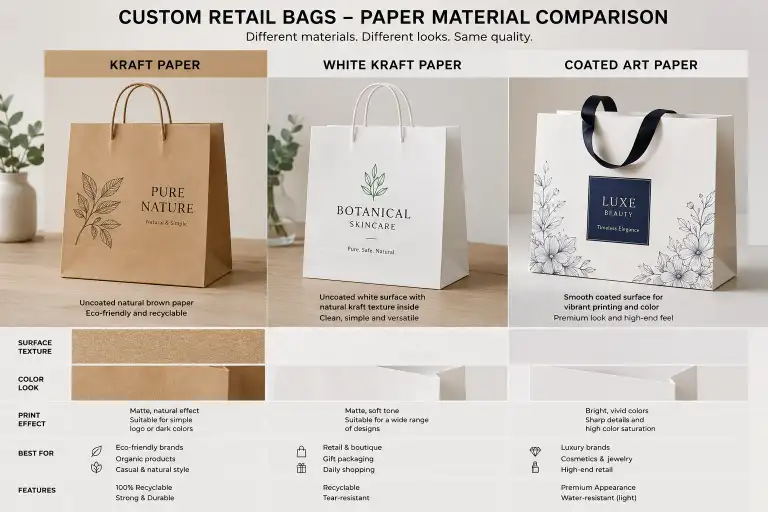
The paper type determines the bag's appearance, strength, and cost. Three main categories cover most applications.
| Paper Type | Appearance | Strength | Best For | Cost |
|---|---|---|---|---|
| Kraft Paper | Natural brown, textured | Very high | Heavy items, grocery, eco-brands | Low |
| White Kraft | Bright white, smooth | High | Apparel, cosmetics, general retail | Low–Moderate |
| Art Paper (Coated) | Smooth, glossy or matte | Moderate | Luxury retail, boutique brands | Moderate |
| Recycled Kraft | Speckled grey-brown | High | Eco-conscious brands | Low–Moderate |
| Colored Kraft | Dyed throughout | High | Brand-color matching, specialty retail | Moderate |
When to Choose Each Type
-
Kraft paper is the workhorse of the paper bag world. It is strong, inexpensive, and its natural look works well for organic food brands, coffee shops, and eco-conscious stores. The brown surface limits print contrast — dark inks work best.
-
White kraft offers the same strength as natural kraft but with a clean printing surface. Logos and full-color artwork show clearly on white. This is the most popular choice for mid-range retail brands.
-
Art paper (coated) has a smooth, coated surface that produces the sharpest print results. It is less strong than kraft and better suited for lightweight items. Luxury boutiques and high-end cosmetics brands use coated paper bags for their refined look and feel.
-
Recycled kraft has visible fiber speckles that communicate eco-friendliness. Some brands choose it specifically for its "imperfect" look, which signals sustainability authentically.
Paper Weight and GSM: What Strength Do You Need?
Paper weight is measured in grams per square meter (GSM). Higher GSM means thicker, stronger paper. The right weight depends on what customers will carry in the bag.
| GSM Range | Feeling | Max Recommended Load | Best For |
|---|---|---|---|
| 80–100 GSM | Thin, lightweight | Light items (under 1 kg) | Delicates, small items |
| 100–120 GSM | Standard retail bag | Moderate (1–3 kg) | Apparel, books, cosmetics |
| 120–150 GSM | Sturdy, premium feel | Moderate to heavy (3–5 kg) | Premium retail, heavy items |
| 150–200+ GSM | Very thick, rigid | Heavy (5–8 kg) | Luxury retail, large items |
Most retail brands order 120 GSM paper bags as their standard. It feels substantial enough for premium positioning without adding excessive weight or cost.
For lightweight boutique items (jewelry, accessories), 100 GSM is sufficient. For grocery or heavy merchandise, 150 GSM or higher is recommended to prevent tearing.
Handle Types: Twisted Paper, Flat ribbon, and Die-Cut
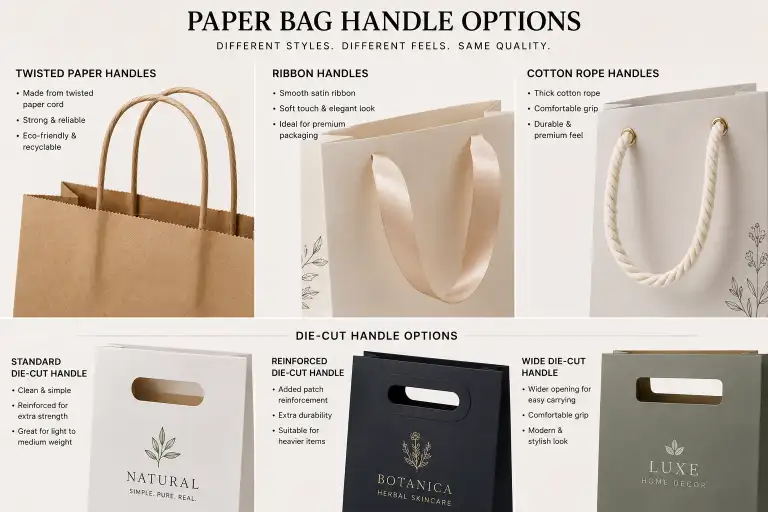
The handle affects both the bag's functionality and its aesthetic. Different handle types suit different retail contexts.
| Handle Type | Material | Strength | Best For | Cost |
|---|---|---|---|---|
| Twisted Paper | Kraft paper twisted into rope | High | Grocery, heavy items, casual retail | Low |
| Flat Paper | Flat strip of kraft paper | Moderate | Mid-range retail, light to moderate loads | Low |
| Ribbon (Satin) | Woven polyester or nylon | Moderate | Luxury retail, gifts, high-end boutiques | Higher |
| Cotton Rope | Braided cotton cord | High | Premium eco-conscious brands | Higher |
| Die-Cut Handle | Cut directly into the paper | Low (no extra material) | Small boutiques, lightweight items | Lowest |
| None (Open Top) | No handle | N/A | Take-away food, small items | Lowest |
Handle Selection Tips
- Twisted paper handles are the strongest and most cost-effective for everyday retail. They hold up to repeated use and support heavier loads.
- Ribbon handles signal luxury. A satin ribbon in a custom color adds perceived value that justifies a higher retail price point.
- Die-cut handles work for small, lightweight bags where cost is a priority. No additional material or attachment labor is needed.
- Cotton rope handles appeal to eco-conscious customers. They feel natural and reinforce a sustainability message.
Printing Methods for Custom Paper Bags
Print quality on paper bags varies by method. Choose based on your artwork complexity, order quantity, and budget.
| Printing Method | Color Capability | MOQ | Cost Per Bag | Best For |
|---|---|---|---|---|
| Flexographic | 1–4 spot colors | 500+ | Low | Simple logos, text, solid color |
| Offset | CMYK + Pantone | 1,000+ | Moderate | Detailed artwork, brand colors |
| Screen Print | 1–2 spot colors | 300+ | Moderate | Bold designs, thick ink coverage |
| Digital | Full CMYK | 50–500 | Moderate–High | Small runs, variable designs |
Printing Recommendations by Brand Tier
- Budget / high volume — Flexo printing with 1–2 colors. Works best for kraft paper with a single logo color.
- Mid-range retail — Offset printing on white kraft. Full brand color reproduction at a reasonable per-unit cost.
- Luxury boutique — Offset printing on coated art paper with foil stamping on the logo. The combination of smooth paper and metallic foil creates a premium finish.
Sizing Guide: Standard Bag Dimensions by Product Type
Ordering the right size bag reduces paper waste, keeps products secure, and looks more professional than a bag that is too large or too small.
| Bag Size (W × H × D) | Best For | Typical Load |
|---|---|---|
| 15 × 20 × 8 cm | Jewelry, small accessories | Light |
| 20 × 25 × 10 cm | Cosmetics, small gifts | 1–2 kg |
| 25 × 30 × 12 cm | Apparel, books, standard retail | 2–3 kg |
| 30 × 35 × 12 cm | Larger apparel, shoes, gift sets | 3–4 kg |
| 35 × 40 × 15 cm | Multiple items, large merchandise | 4–6 kg |
| 40 × 45 × 18 cm | Grocery, bulk items, heavy loads | 6–8 kg |
Sizing Rules
- The product should fit without force — add 2–5 cm in width and height.
- The depth should accommodate the widest product dimension plus 1–2 cm.
- A bag that is too large looks wasteful and allows products to shift.
- A bag that is too small damages easily from product pressure on the seams.
MOQ and Pricing: What Affects Paper Bag Costs
Paper bags are one of the most affordable custom packaging options, especially at scale. The cost depends on paper type, size, handle, and print complexity.
Typical Pricing
| Bag Type | 500 Units | 1,000 Units | 5,000 Units |
|---|---|---|---|
| Standard kraft, 1-color flexo | $0.50–$0.80 | $0.35–$0.55 | $0.20–$0.35 |
| White kraft, full-color offset | $0.80–$1.20 | $0.55–$0.85 | $0.35–$0.55 |
| Coated paper, ribbon handle, foil | $1.50–$2.50 | $1.00–$1.80 | $0.70–$1.20 |
Cost-Saving Tips
| Tip | How It Saves Money |
|---|---|
| Use standard sizes | Custom sizes require die changes ($50–$150 one-time) |
| Reduce print colors | Flexo with 1–2 colors is much cheaper than full CMYK |
| Choose twisted paper handles | Cheaper than ribbon or cotton, equally functional |
| Order in bulk | Highest savings at 1,000+ units |
| Combine with other packaging | Shared shipping reduces per-unit freight cost |
Finishes and Add-Ons for Premium Paper Bags
For brands that want a bag that feels as good as it looks, several finishing options are available.
| Finish | Effect | Cost Impact |
|---|---|---|
| Matte lamination | Soft, non-reflective surface, protects print | Moderate |
| Gloss lamination | Shiny surface, enhances color | Moderate |
| Soft touch coating | Velvety feel, premium tactile | Higher |
| Foil stamping | Metallic logo or text | Higher |
| Embossing | Raised logo on the bag surface | Higher |
| Spot UV | Glossy highlight on specific design elements | Higher |
| Custom gusset | Wide bottom for bulky items | Low |
Lamination adds a protective layer that prevents ink rubbing and makes the bag more durable. For white bags that will be handled frequently, lamination is worth the extra cost.
FAQ
What is the best paper type for custom retail bags?
White kraft paper (100–120 GSM) is the best all-around choice for most retail brands. It offers good strength, a clean printing surface, and moderate cost. For luxury brands, coated art paper provides the best print quality.
What is the minimum order quantity for custom paper bags?
Standard MOQ is 500–1,000 units for flexo or offset printing. Digital printing allows smaller runs of 50–200 units at a higher per-unit cost.
Which handle type is strongest?
Twisted paper handles offer the highest strength-to-cost ratio. For heavy loads, reinforced twisted paper or cotton rope handles are recommended.
Can I print full-color artwork on paper bags?
Yes. Offset printing produces full-color CMYK artwork on paper bags. For best results, use white kraft or coated paper — the colors will not show clearly on natural brown kraft.
How do I choose the right bag size?
Measure your typical product and add 2–5 cm in width and height. Standard retail bags range from 20 × 25 cm (small) to 35 × 40 cm (large). Custom sizes are available but cost more.
Are custom paper bags eco-friendly?
Yes, especially when made from recycled or FSC-certified paper. Paper bags are biodegradable, recyclable, and made from renewable resources. Avoid plastic lamination if eco-friendliness is a priority.
What is the difference between kraft and art paper bags?
Kraft paper is made from wood pulp with minimal processing — it is strong, textured, and typically brown. Art paper is coated for a smooth surface that produces sharper print results but is less strong. Kraft is better for heavy items; art paper is better for premium presentation.
Can I add a logo to both sides of the bag?
Yes. Most manufacturers print on both sides at no additional plate cost. Full printing on both sides may increase the per-unit cost slightly.
What is the production lead time for custom paper bags?
Standard lead time is 15–20 business days from artwork approval. Small digital print runs can ship in 7–10 business days.
How do I reduce the cost of custom paper bags?
Use standard sizes, limit print colors (1–2 colors with flexo), choose twisted paper handles, and order in quantities of 1,000+ units. Avoid lamination if it is not essential for your product.


