
Sustainability is no longer a nice-to-have for packaging — it is a buying signal. A growing number of consumers actively look for eco-friendly packaging before making a purchase. Brands that ignore this shift risk losing customers to competitors who take sustainability seriously.
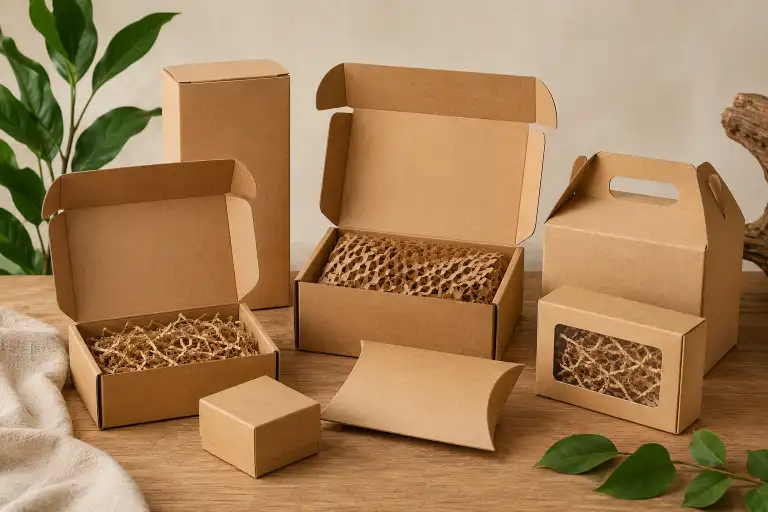
Eco-friendly packaging uses sustainable materials and processes to minimize environmental impact. For gift boxes and retail packaging, this means recycled paperboard, FSC-certified paper, kraft paper, water-based inks, and biodegradable coatings — all while maintaining the premium look your brand needs.
Whether you are sourcing custom rigid gift boxes, folding cartons, or paper bags, sustainable options exist at every price point. This guide covers the materials, certifications, printing, and cost factors you need to know to make the right eco-friendly choice for your brand.
What Is Eco-Friendly Packaging?
Eco-friendly packaging is any packaging designed to reduce environmental impact compared to conventional alternatives. This can mean:
- Using recycled or renewable materials instead of virgin resources
- Reducing material volume without sacrificing protection
- Designing for recyclability or compostability after use
- Choosing production methods that consume less energy and water
- Avoiding harmful chemicals and non-biodegradable components
For gift boxes and retail packaging, eco-friendly does not mean sacrificing quality. Modern sustainable materials and printing methods can deliver the same premium look and feel as traditional packaging — sometimes even better, as natural kraft textures and uncoated finishes have become popular design choices in their own right.
The key is understanding which eco-friendly options align with your product, budget, and brand identity.
Sustainable Materials for Custom Gift Boxes
The material you choose has the biggest impact on both sustainability and cost. Here are the most common eco-friendly materials used for custom gift boxes.
| Material | Source | Recycled Content | Best For | Premium Feel |
|---|---|---|---|---|
| Recycled greyboard | Post-consumer waste paper | 50–100% | Rigid gift boxes, magnetic boxes | High |
| FSC-certified virgin board | Responsibly managed forests | 0% (but sustainable source) | Premium retail boxes, luxury gifts | Very high |
| Kraft paperboard | Wood pulp, unbleached | 30–70% | Natural-look boxes, eco branding | Moderate |
| Recycled paperboard (CCNB) | Mixed waste paper | 80–100% | Folding cartons, budget boxes | Low–Moderate |
| Hemp paperboard | Hemp fiber | 0% (renewable crop) | Specialty eco brands | High |
| Bamboo paperboard | Bamboo fiber | 0% (fast-renewable) | Premium eco-luxury boxes | Very high |
Recycled Greyboard
Greyboard is the standard core material for rigid gift boxes. When made from recycled content (50–100%), it is one of the most sustainable options available. Greyboard is dense, strong, and provides the weight and structure that premium packaging requires.
Most rigid boxes from Asia already use recycled greyboard as standard. The key is ensuring the wrapping paper and finishes are also eco-friendly.
FSC-Certified Board
FSC (Forest Stewardship Council) certification ensures the paper fiber comes from responsibly managed forests. FSC-certified board can be either virgin or recycled. For brands that want to emphasize sustainability while maintaining a pristine white printing surface, FSC-certified virgin board with recycled content is the best option.
Kraft Paperboard
Kraft paperboard is made from unbleached wood pulp, giving it the natural brown color that has become synonymous with eco-friendly packaging. Kraft boxes work particularly well for organic food brands, artisanal products, and any brand that wants to communicate natural values.
Kraft board is available in various thicknesses suitable for both folding cartons and rigid boxes. The natural brown surface limits print contrast — dark or bold colors work best on kraft.
Emerging Materials: Hemp and Bamboo
Hemp and bamboo paperboards are newer options gaining traction in premium eco-packaging. Both grow faster than trees, require less water, and produce strong fiber. The trade-off is higher cost and limited availability. These materials are best suited for brands that want to make a strong sustainability statement and have the budget to support it.

FSC Certification: What It Means for Your Packaging
FSC certification is the most recognized standard for sustainable paper sourcing. When you see the FSC logo on packaging, it guarantees that the paper fiber used comes from a responsibly managed forest that meets strict environmental and social standards.
| FSC Label | What It Means |
|---|---|
| FSC 100% | All fiber from FSC-certified forests |
| FSC Recycled | 100% recycled fiber |
| FSC Mix | Blend of FSC-certified, recycled, and/or controlled wood |
For most brands, FSC Mix or FSC Recycled offers the best balance of sustainability and cost. FSC 100% is the gold standard but typically costs more and requires virgin fiber.
If you plan to use the FSC logo on your packaging, you must hold an FSC Chain of Custody certificate or work with a manufacturer that does. Most packaging suppliers in China offer FSC-certified materials, but always confirm before ordering.
Eco-Friendly Printing: Soy Ink, Water-Based Ink, and Finishes
Traditional printing uses petroleum-based inks and solvent-based coatings that are harmful to the environment. Eco-friendly alternatives are widely available.
| Printing Method | Eco-Friendliness | Color Quality | Suitable For |
|---|---|---|---|
| Soy-based ink | High — renewable resource, biodegradable | Excellent | Offset litho printing |
| Water-based ink | Very high — fewer VOCs, safer disposal | Very good | Flexo and digital printing |
| UV-cured ink | Moderate — no solvents but uses UV energy | Excellent | High-gloss applications |
| Conventional solvent ink | Low — petroleum-based, VOCs | Excellent | Not recommended for eco packaging |
Eco-Friendly Finishes
| Finish | Eco-Friendliness | Appearance |
|---|---|---|
| Aqueous coating | High — water-based, recyclable | Clear, matte or gloss |
| UV coating | Moderate — recyclable only without lamination | High gloss |
| Water-based lamination | Moderate — improves durability, complicates recycling | Matte or gloss |
| No coating (natural) | Highest — fully recyclable, no extra processing | Natural paper texture |
| Foil stamping (aluminum) | Low — metal foil, not recyclable | Premium metallic |
For the most eco-friendly packaging, choose aqueous coating over plastic lamination, and use soy-based or water-based inks. If you need a premium finish, spot UV on a water-based coating offers high impact with moderate environmental impact.
Eco-Friendly vs Traditional Packaging: Cost Comparison
One of the biggest questions brands have is whether eco-friendly packaging costs more. The answer is: sometimes yes, sometimes no — it depends on the material and finish choices.
| Packaging Type | Traditional | Eco-Friendly Equivalent | Cost Difference |
|---|---|---|---|
| Rigid gift box, standard | Virgin greyboard + glossy print | Recycled greyboard + aqueous coating | 0–5% more |
| Rigid gift box, premium | Virgin board + foil stamping | FSC board + water-based ink | 5–15% more |
| Folding carton | CCNB recycled board (standard) | FSC-certified board | 5–10% more |
| Kraft box | Not applicable (already eco) | Recycled kraft board | 0–5% less |
| Paper bag | Standard kraft (already eco) | FSC-certified kraft | 0–5% more |
| Custom box inserts | EVA foam (plastic-based) | Molded pulp or recycled cardboard | 10–20% less |
In many cases, the cost difference is smaller than brands expect. Recycled greyboard is often the same price as virgin greyboard. Switching from lamination to aqueous coating can save money rather than adding cost.
The areas where eco-friendly packaging does cost more are premium certifications (FSC 100%), specialty materials (hemp, bamboo), and replacing plastic components (foam inserts, plastic windows).
Recyclable Gift Boxes: What Can and Cannot Be Recycled
Not all packaging that looks eco-friendly is actually recyclable. Here is how different gift box components affect recyclability.
| Component | Recyclable? | Notes |
|---|---|---|
| Plain cardboard/paperboard box | ✅ Yes | Place in paper recycling |
| Box with aqueous coating | ✅ Yes | Recycling facilities accept coated paper |
| Box with plastic lamination | ❌ No | Lamination prevents fiber separation |
| Box with foil stamping | ❌ No (varies) | Metal particles contaminate paper recycling |
| Box with plastic window | ❌ No | Window must be removed before recycling |
| Magnetic closure | ⚠️ Sometimes | Magnets can be removed; box is then recyclable |
| Ribbon handle | ⚠️ Sometimes | Must be removed; paper recycling only accepts paper |
| Foam insert | ❌ No | Foam must go in general waste |
| Cardboard/corrugated insert | ✅ Yes | Recyclable with paper |
| Molded pulp insert | ✅ Yes | Fully recyclable, compostable |
Design for Recyclability
To make your packaging easily recyclable, follow these rules:
- Use a single material wherever possible (all-paper construction)
- Avoid plastic lamination — use aqueous coating instead
- Avoid metallic foil stamping on surfaces that go into recycling
- Make inserts from the same material as the box
- If magnets or ribbons are necessary, design them to be easily removed
How to Choose the Right Eco-Friendly Packaging for Your Brand
| If Your Brand Is... | And Your Priority Is... | Choose... |
|---|---|---|
| Luxury, premium retail | Sustainability + premium feel | FSC-certified rigid box, aqueous coating, soy-based ink |
| Organic / natural products | Authentic eco look | Kraft board rigid box or folding carton, no coating |
| Mid-range retail | Cost-effective sustainability | Recycled content folding carton, water-based ink |
| Beauty / skincare | Eco-luxury positioning | FSC Mix rigid box with molded pulp insert |
| Food / beverage | Safety + sustainability | FSC-certified carton with food-grade coating |
| Ecommerce / subscription | Low waste + low cost | Recycled corrugated mailer, minimal branding |
| Gift / corporate gifting | Maximum presentation | Recycled greyboard rigid box, magnetic closure, no lamination |

Eco-Friendly Packaging Certifications Guide
Certifications help customers trust your sustainability claims. Here are the most relevant certifications for custom gift boxes.
| Certification | What It Verifies | Where It Applies |
|---|---|---|
| FSC (Forest Stewardship Council) | Responsible forest sourcing | Paper, board, wood products |
| PEFC | Sustainable forest management | Paper, board (alternative to FSC) |
| Recycled Content Certification | Percentage of recycled material | Paper, board, plastic |
| Cradle to Cradle | Overall product sustainability | Multi-material products |
| ISO 14001 | Environmental management system | Manufacturing facility |
| EU Ecolabel | Reduced environmental impact | Various product categories |
| Green Seal | Environmental leadership | Various product categories |
For most packaging buyers, FSC certification is the most relevant and recognizable. Start there, and add additional certifications as your sustainability program matures.
If you need a packaging partner who understands these certifications, contact a sustainable packaging supplier for guidance on material selection and certification requirements.
FAQ
What is the most eco-friendly material for gift boxes?
Recycled greyboard with FSC-certified wrapping paper is the most eco-friendly option for rigid gift boxes. It uses post-consumer waste material and ensures the virgin fiber comes from responsibly managed forests.
Is eco-friendly packaging more expensive?
Not always. Recycled greyboard is comparable in cost to virgin greyboard. The main cost increases come from premium certifications (FSC 100%), specialty materials (hemp, bamboo), and replacing plastic components. Savings can come from eliminating lamination and using simpler finishes.
Can rigid boxes be eco-friendly?
Yes. Rigid boxes made from recycled greyboard with paper wrapping and aqueous coating are fully recyclable and can carry FSC certification. The key is avoiding plastic lamination and non-recyclable finishes.
What is the difference between recyclable and biodegradable packaging?
Recyclable packaging can be processed into new materials after use. Biodegradable packaging breaks down naturally in the environment. Recyclable is generally preferred because it keeps materials in use. Biodegradable only applies if the packaging ends up in conditions that support breakdown, which is not guaranteed.
Can I use the FSC logo on my packaging?
Yes, but you must hold an FSC Chain of Custody certificate or work with a manufacturer that holds one. Your packaging supplier can produce FSC-certified boxes with the logo if they have the certification.
What is kraft packaging?
Kraft packaging is made from unbleached wood pulp that retains its natural brown color. It is strong, biodegradable, and widely recyclable. Kraft is popular for eco-friendly branding but limits print color options due to the dark background.
Are magnetic gift boxes recyclable?
Partially. The paperboard box can be recycled if the magnets and any non-paper components are removed. Magnets must be separated before recycling. Some recycling programs accept boxes with small magnets still attached, but removal is recommended.
What printing method is best for eco-friendly packaging?
Offset litho with soy-based or water-based inks is the most eco-friendly printing method for high-quality packaging. Avoid solvent-based inks and plastic lamination.
Is eco-friendly packaging available for small MOQs?
Yes. Digital printing on eco-friendly materials allows small runs of 50–500 units. Recycled and FSC-certified materials are available for both digital and offset printing.
How do I verify a supplier's eco-friendly claims?
Ask for FSC certificates, recycled content documentation, and ink/coating specifications. Reliable eco-friendly packaging manufacturers will provide documentation for their materials and certifications.

