
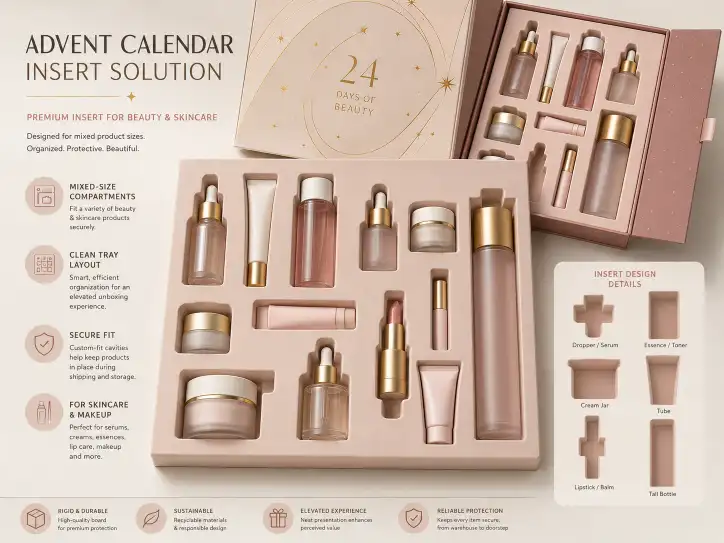
The best inserts for advent calendar boxes do more than hold products in place. They decide whether the layout looks clean, whether packing stays efficient, and whether the box still feels controlled after several doors or drawers have been opened. Once a set includes jars, bottles, tubes, and flat items in one project, the insert becomes the center of the job.
Why do mixed product sizes change the insert decision?
Start with the product list. That is where the trouble begins.
An advent calendar rarely holds one format only. One set may include a cream jar, two serum bottles, a lip product, several mini tubes, a sachet, and a few small accessories. If every item is forced into one insert depth or one repeated cavity shape, the inside starts to look awkward fast.
That is the first problem. The second problem is removal. A flat sachet is easy to lift from a shallow slot, but a short jar needs finger space, and a taller bottle needs both depth and side support. If the insert does not account for those differences, the user struggles to remove products and the presentation loses control.
This is why the best inserts for advent calendar boxes are not picked by appearance alone. They have to match product shape, product weight, opening style, and packing sequence. If the insert plan is weak, the whole calendar feels weak.
If you are still defining the outer format, start with custom advent calendar boxes before the insert is finalized. The tray should not be treated like a small add-on.
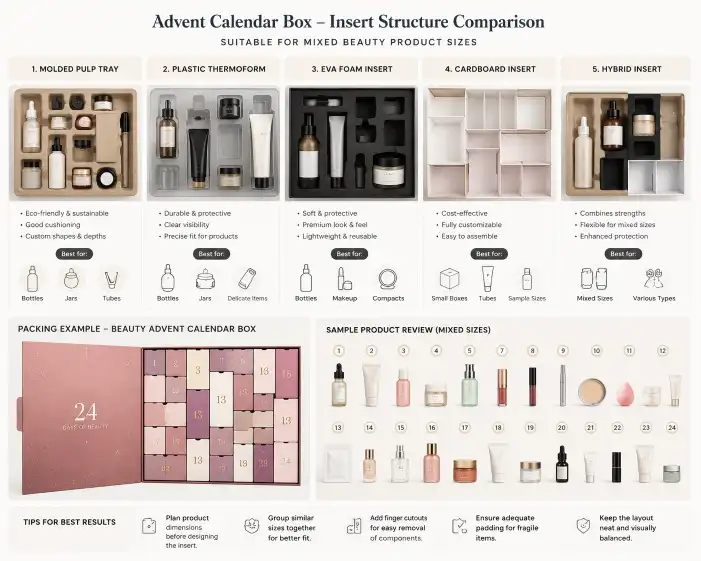
What makes an insert work well in an advent calendar box?
A good insert does three things at once. It holds the product, keeps the layout readable, and helps the box stay practical on the packing line.
That sounds simple. It is not.
In a mixed-size advent calendar box, the insert also has to solve for visual balance. If one side of the layout is filled with deep cavities for bottles and the other side only has thin slots for cards or sachets, the inside can look uneven even when the products fit well. The tray has to carry both structure and rhythm.
A useful insert should answer these questions before sampling starts:
- Does each item fit without force?
- Can the customer remove the item without tearing the box or tipping the tray?
- Can the insert handle different item heights without making the outer box too bulky?
- Does the layout still look ordered after some compartments are empty?
- Can the packing team load products in a clear sequence?
If the answer is no to any of those, the insert still needs work. Keep going.
Which insert types work best for mixed product sizes?
There is no universal answer. Different projects need different insert logic.
Paperboard fitments
Paperboard fitments are one of the most practical options when the set contains mostly lighter products. They work well for sachets, mini tubes, lip products, masks, and other low-weight items.
The strength of a paperboard fitment is speed. It keeps the insert cleaner, easier to produce, and easier to adjust during sampling. It also suits brands that want a paper-led presentation instead of foam-heavy packaging.
The weak point is heavy product support. Once glass jars or short heavy bottles enter the layout, a simple paperboard fitment may no longer hold enough control unless the design adds more structure underneath.
Vacuum-formed trays or shaped cavities
When the set includes more shaped products, cavity-style inserts become more useful. Bottles, jars, and molded beauty items need a clear pocket, not a loose paper slot.
This insert route gives better control. Each product gets its own position, and the tray can manage mixed diameters and heights more accurately.
That helps when the calendar includes premium skincare items, mini fragrance bottles, or products with decorated labels that should stay separate inside the box.
The trade-off is flexibility. A cavity tray works best when the SKU list is stable. If the product mix is still changing, this insert can become harder to adjust without changing the whole layout.
Drawer partitions
Drawer partitions work well in advent calendar boxes where each day opens as a separate drawer. This route is often used when the box needs stronger separation between products of different sizes.
It gives more control. One drawer can hold a short jar, while the next holds a slim tube or a flat mask, without forcing both into a repeated cavity grid.
This is often one of the best inserts for advent calendar boxes with mixed product sizes because it allows the layout to stay cleaner without over-complicating the outer shell. The trade-off is assembly time and board usage, which can rise quickly if the count is high.
Layered insert structures
Some projects solve mixed-size pressure by stacking products on different levels instead of forcing everything into one tray plane.
That can work well. Larger products sit in the lower level, while flat items or smaller pieces sit in an upper layer or grouped section.
This route helps when the front face must stay compact, but the product list contains a few deeper items that would otherwise push the whole box thicker. It is also useful when the campaign needs a cleaner reveal instead of showing every product depth at once.
| Insert Type | Best For | Main Strength | Watch Out For |
|---|---|---|---|
| Paperboard Fitment | lightweight mixed beauty items | clean structure and easier revision | limited support for heavier jars |
| Shaped Tray or Cavity | bottles, jars, fixed-size SKUs | better product control | less flexible when product list changes |
| Drawer Partition | drawer-style calendars with mixed items | strong separation between sizes | more assembly work |
| Layered Insert | compact calendars with varied depths | better use of internal space | sampling needs tighter planning |
How should inserts be matched to product groups?
Group first. Design second.
A mixed-size calendar becomes easier to plan when products are sorted by size, weight, and removal method. That sounds basic, but many brands skip it and jump straight into artwork or tray mockups. Then the structural work has to be redone later.
Small flat items such as masks, cards, and sachets work well in shallow slots or grouped paperboard sections. Mid-size items such as lip products, travel tubes, and balms often fit best in repeated cavities or neat partition rows. Larger items such as cream jars, serum bottles, or mini fragrance bottles need their own protected zone.
That zone matters. If larger products are scattered across the front face, the tray becomes harder to balance and the numbering can lose order. It is usually safer to cluster deeper items in one planned area, then arrange smaller products around them.
This also improves packing flow. The team can load products by section instead of jumping across the tray with items of different sizes and weights.
What works best for beauty and skincare calendars?
Beauty calendars often mix more shapes than food or simple promotional calendars. That changes the insert logic fast.
A skincare-focused set may include jars, droppers, flat masks, ampoules, and lip care items in one box. Those items vary in height, diameter, and fragility, so the insert usually needs a combination approach rather than one repeated tray format.
Paperboard fitments work well for masks, balms, and small tubes. Cavity trays work better for bottles and jars. When both appear in one project, the layout often works best when grouped by weight and depth instead of by day sequence alone.
That is where calendar projects rise or fall. A pretty front panel will not rescue a poor tray.
If your brand is also comparing premium formats outside seasonal calendars, check magnetic gift boxes separately rather than assuming the same insert logic will carry across. A magnetic box can support a short-count concept set, but a full calendar box needs more repeated opening control.
What mistakes make inserts fail in advent calendar projects?
The first mistake is approving the cavity map before the product list is locked. That leads to rework almost every time.
The second mistake is using one cavity depth for all items. It seems easier during concept design, but it wastes space, makes the box bulkier, and gives poor support to smaller products.
The third mistake is forgetting finger access. A product may technically fit, but if it cannot be removed without digging into the cavity or bending the tray edge, the customer will notice it fast.
The fourth mistake is focusing only on the opened view. A mixed-size advent calendar box also has to survive packing, transport, storage, and repeated handling. If the insert only looks good in a mockup, it is not ready.
Shipping risk should be reviewed early. If the project depends on parcel delivery or wider export movement, it helps to review ISTA packaging test guidance before sample approval, not after.
How do inserts affect packing speed and sample approval?
An insert can look clean and still slow the line. That is a real problem.
If the cavity is too tight, workers spend extra time forcing products into place. If the layout jumps between deep and shallow pockets in no clear order, the loading process becomes uneven and mistakes rise. A good insert supports both product presentation and production speed.
This is why the best inserts for advent calendar boxes are usually the ones that solve two jobs at once: they keep the inside organized for the customer and keep the packing process organized for the factory.
During sample review, do not only check print, color, and front-face artwork. Check these points too:
- does each item drop into place without force
- does the tray stay stable when some positions are empty
- can products be removed cleanly
- does the layout still look balanced after a few positions are opened
- does the loading order make sense for the packing team
That review saves time later. It also saves money.
If the project calls for paper-led material claims, confirm those before final insert choice and align them with FSC paper packaging guidance where relevant. Changing material direction after structural approval creates extra rounds of work.
How should buyers choose the best inserts for advent calendar boxes?
Do not start with a trend image. Start with the real set.
List the products. Group them by size and weight. Separate flat items from deeper items. Decide whether the box will use doors, drawers, or a book-style opening. Only after that should the insert route be chosen.
For lighter mixed sets, a paperboard fitment may be enough. For fixed-size beauty products, shaped cavities often give better control. For varied daily compartments, drawer partitions can make the layout cleaner. For tighter outer dimensions, layered inserts may solve depth without forcing the front face larger.
The best inserts for advent calendar boxes are not the fanciest ones. They are the ones that fit the real products, support the real opening style, and still work on the real packing line. Once the SKU list is fixed, the next step is clear: map the insert around actual item sizes, test the loading order, and move the project into sample review before the seasonal schedule starts closing in.


