
Every ecommerce brand ships something in a corrugated box. But the difference between a generic shipping box and a custom corrugated box is the difference between delivering a package and delivering a brand experience. Custom corrugated boxes protect your product, carry your logo, and arrive in good condition — three things a plain brown box cannot guarantee.
Whether you ship skincare sets, subscription boxes, or fragile electronics, the right corrugated packaging reduces damage rates, lowers shipping costs, and turns every delivery into a branding touchpoint.
This guide covers everything ecommerce brands need to know about custom corrugated boxes — flute types, board grades, printing options, sizing, and cost optimization.
Why Ecommerce Brands Need Custom Corrugated Boxes
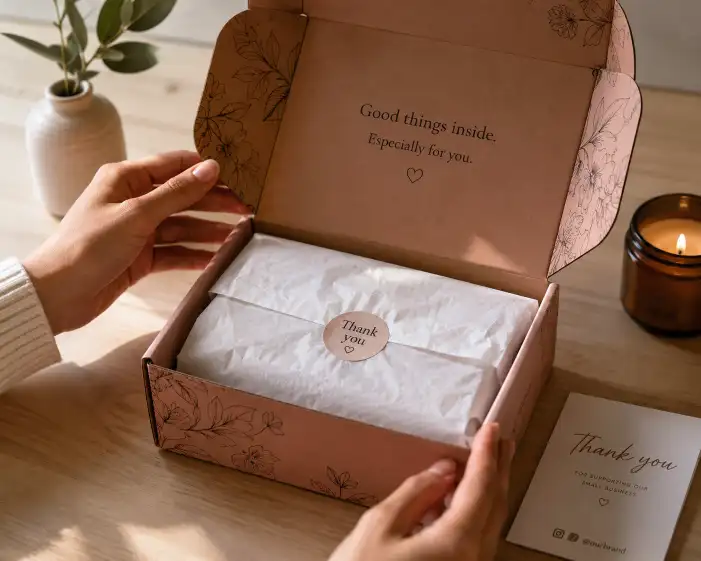
Standard shipping boxes serve one purpose: getting a product from point A to point B. Custom corrugated boxes serve three:
| Benefit | What It Means for Your Brand |
|---|---|
| Brand visibility | Your logo, colors, and design appear on every package that arrives at a customer's door |
| Right fit | Box dimensions matched to your product eliminates wasted space and reduces shipping volume |
| Consistent quality | You control the board grade, flute type, and print quality — not whatever the carrier has in stock |
Ecommerce brands that switch from generic boxes to custom corrugated packaging typically see higher social media mentions (unboxing posts), lower damage rates (proper flute selection), and reduced dimensional weight charges (right-size boxes).
Corrugated Box Flute Types: B, E, F, and Double Wall Explained
The flute is the wavy layer between two flat linerboards. It provides the cushioning and stacking strength of the box. Different flute sizes suit different applications.
| Flute Type | Thickness | Best For | Print Quality |
|---|---|---|---|
| A Flute | ~5.0 mm | Heavy items, fragile goods | Poor — too thick for detail |
| B Flute | ~3.2 mm | Cans, bottles, standard shipping | Good for basic graphics |
| C Flute | ~4.0 mm | General shipping, most ecommerce | Good |
| E Flute | ~1.6 mm | Retail displays, lightweight ecommerce | Very good — accepts detailed print |
| F Flute | ~0.8 mm | Small consumer goods, cosmetics | Excellent — near folding carton quality |
| BC Double Wall | ~6.0 mm | Heavy items, pallet shipping, export | Limited |
| EB Double Wall | ~4.8 mm | Heavy items with better print | Moderate |
For most ecommerce brands, E flute is the best balance of strength, weight, and print quality. It is rigid enough to protect most products, thin enough to keep shipping costs low, and smooth enough to accept custom printing with fine detail.
For lightweight products like cosmetics, skincare, and small electronics, F flute offers near-folding-carton print quality with corrugated strength.
For heavy or fragile items, BC double wall provides maximum protection but adds weight and cost.
Board Grades: Single Wall, Double Wall, and Heavy-Duty Options
The board grade determines the box's burst strength and stacking resistance.
| Grade | Layers | Typical Weight Limit | Best For |
|---|---|---|---|
| Single wall (standard) | 1 fluted layer + 2 liners | Up to 15 kg | Most ecommerce orders |
| Single wall (heavy) | 1 fluted layer, heavier paper | Up to 25 kg | Books, tools, heavier items |
| Double wall | 2 fluted layers + 3 liners | Up to 40 kg | Fragile electronics, export |
| Triple wall | 3 fluted layers + 4 liners | Over 40 kg | Industrial, pallet shipping |
The edge crush test (ECT) rating measures the box's stacking strength. For ecommerce:
- 32 ECT — Standard for most ecommerce orders
- 44 ECT — For heavier items or stacking in storage
- 48+ ECT — For export or palletized shipping
A higher ECT rating does not mean better quality — it means the right strength for the application. Over-specifying board grade adds cost and weight without benefit.
Printing on Corrugated Boxes: Flexo, Digital, and Litho Label

Printing on corrugated boxes requires different methods than printing on rigid boxes or folding cartons because the board surface is not perfectly flat.
| Printing Method | Color Quality | MOQ | Cost Per Box | Best For |
|---|---|---|---|---|
| Flexographic (Flexo) | Good, single or spot color | 500+ units | Low | Simple logos, text, 1–2 colors |
| Digital Direct Print | Very good, CMYK | 50–500 units | Moderate | Small runs, detailed graphics, variable data |
| Litho Label (Litho Laminate) | Excellent, CMYK + Pantone | 1,000+ units | Higher | Premium branding, retail display boxes |
| Screen Print | Good, single color | 300+ units | Moderate | Simple bold designs, white ink on kraft |
Which Printing Method Should You Choose?
- Budget-friendly branding — Flexo printing with 1–2 spot colors on kraft board. Keep it simple. A logo on a brown box is more memorable than a blank box.
- Small batches / startups — Digital direct print. No plate costs, low minimums, full color. Ideal for runs of 50–500 boxes.
- Premium retail + ecommerce — Litho laminate. A full-color printed label is laminated onto the corrugated board, giving you retail-shelf print quality with corrugated strength.
For brands looking for both a shipping box and a retail display, a litho-laminated corrugated box serves both purposes without needing two separate packaging orders.
Box Styles for Ecommerce: RSC, Mailer, and Custom Shapes
| Box Style | Description | Best For |
|---|---|---|
| RSC (Regular Slotted Container) | Standard rectangular box, flaps meet at center | General ecommerce shipping |
| Half-Slotted Container (HSC) | RSC without top flaps | Lid-style boxes, easy-packing |
| Full Overlap Container (FOL) | Flaps fully overlap for extra strength | Heavy items |
| Die-Cut Mailer | Self-locking, no tape needed | Subscription boxes, apparel, single items |
| One-Piece Folder | Flat fold, wraps around product | Books, documents, flat items |
| Custom Die-Cut Shape | Brand-specific shape, scored and cut | Premium gifts, special products |
The RSC is the most common and most cost-effective box style for ecommerce. It ships flat, assembles quickly, and works with most automated packing systems.
For brands that want a premium unboxing experience without the cost of a custom rigid box, a die-cut mailer with custom printing offers a strong middle ground — protective, brandable, and relatively low cost per unit.
Sizing Guide: How to Choose the Right Box Dimensions
Box size directly affects shipping costs. Carriers use dimensional weight (DIM weight) pricing, which means a larger box costs more to ship even if it is lightweight.
The Cost of Oversized Boxes
| Product Size | Box Used | DIM Weight | Shipping Cost Impact |
|---|---|---|---|
| 15 × 10 × 5 cm | 16 × 11 × 6 cm | 0.2 kg | Baseline |
| 15 × 10 × 5 cm | 20 × 15 × 10 cm | 0.5 kg | +150% |
| 15 × 10 × 5 cm | 25 × 20 × 15 cm | 1.1 kg | +450% |
Sizing Rules for Custom Corrugated Boxes
- Add 3–6 mm per dimension for product fit — just enough to insert and remove the product without force.
- No empty space — Fill void areas with tissue paper, kraft paper, or corrugated dividers. Empty space causes product movement and damage.
- Test multiple sizes — Order samples in 2–3 size variations. The smallest box that safely fits your product is the most cost-effective.
- Consider stacking — If boxes will be stacked in storage, the box must support the weight of boxes above it without crushing.
MOQ and Pricing for Custom Corrugated Boxes
Corrugated boxes are more affordable than rigid boxes at scale because the production process is highly automated.
Typical Pricing Table
| Order Quantity | Cost Per Box (Standard Size) | Notes |
|---|---|---|
| 100–250 units | $0.80–$1.50 | Digital print, no plate costs |
| 500–1,000 units | $0.50–$0.90 | Flexo or digital, plate costs apply |
| 1,000–5,000 units | $0.30–$0.60 | Best value range for most brands |
| 5,000+ units | $0.20–$0.45 | Bulk pricing, custom flute available |
What Affects the Price
| Factor | Impact on Price |
|---|---|
| Box size | Larger boxes use more material |
| Board grade | Double wall costs 30–50% more than single wall |
| Print coverage | Full-color litho label costs more than 1-color flexo |
| Quantity | Higher quantity = lower cost per unit |
| Die-cut shape | Custom shapes require a die ($50–$150 one-time) |
For pricing on standard custom corrugated boxes, contact a corrugated box packaging manufacturer with your dimensions and quantity for an accurate quote.
Sustainability: Recycled Content and Eco-Friendly Options
Corrugated boxes are already one of the most sustainable packaging options because the material is widely recycled. Custom corrugated boxes can be even more eco-friendly.
Sustainable Options
| Option | How It Works | Best For |
|---|---|---|
| Recycled content board | Up to 100% post-consumer recycled fiber | Brands with sustainability goals |
| FSC-certified board | Fiber from responsibly managed forests | Certifiable eco-claims |
| Water-based inks | Flexo or digital inks without solvents | Food-safe, compostable packaging |
| Minimal design | Less ink coverage, smaller box size | Reducing material and chemical use |
| Tape-free closure | Self-locking die-cut design | Plastic-free shipping |
Corrugated board with recycled content is widely available and performs similarly to virgin board for most ecommerce applications. Specify recycled content to your manufacturer and request the recycled percentage in writing.
For brands looking for a complete eco-friendly packaging strategy, see eco-friendly packaging options.
FAQ
What is the best flute type for ecommerce shipping?
E flute is the most versatile for ecommerce. It provides good protection, lightweight shipping, and accepts detailed print. For small or lightweight products, F flute offers even better print quality.
What is the difference between custom corrugated boxes and rigid boxes?
Corrugated boxes have a fluted layer between liners, making them lightweight and collapsible for flat storage. Rigid boxes are made from thick board, are not collapsible, and offer a more premium feel. Corrugated boxes are better for shipping; rigid boxes are better for retail and gifting.
Can I print my logo on corrugated boxes?
Yes. Flexo printing is the most economical for 1–2 color logo printing. Digital printing works for full-color small runs. Litho laminate offers the highest print quality for full-coverage branding.
What is the MOQ for custom corrugated boxes?
Digital print MOQ starts at 50–100 units. Flexo print MOQ starts at 500 units. Litho laminate MOQ starts at 1,000 units.
How do I reduce shipping costs with custom corrugated boxes?
Reduce dimensional weight by right-sizing the box to your product. Use single wall board where possible. Eliminate void fill by matching box size to product dimensions.
Are custom corrugated boxes eco-friendly?
Yes. Corrugated boxes are made from paper fiber, which is renewable and widely recycled. Most custom corrugated boxes contain 30–100% recycled content and are fully recyclable after use.
What box style is best for subscription boxes?
Die-cut mailer boxes with self-locking closures are the most popular for subscription boxes. They are easy to pack, require no tape, and arrive cleanly at the customer's door.
How long does it take to produce custom corrugated boxes?
Standard production lead time is 10–20 business days from artwork approval. Digital print runs can ship in 5–10 business days.
Can corrugated boxes be used for retail display?
Yes. Litho-laminated corrugated boxes have print quality comparable to folding cartons and can be designed for both shipping and retail display. This dual-use reduces total packaging cost.
What is a die-cut corrugated box?
A die-cut box is cut from a flat sheet using a steel rule die, creating a custom shape with fold lines, slots, and locking tabs. Die-cut boxes ship flat and assemble without glue or tape.

