
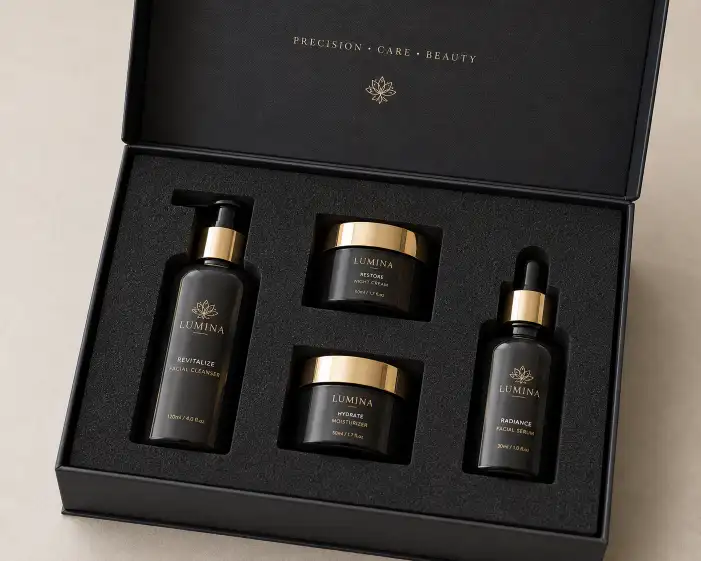
The inside of a box matters as much as the outside. A beautiful rigid box with a loose, shifting product inside feels cheap. A well-designed insert holds the product securely, protects it during shipping, and makes the unboxing experience feel intentional.
Custom box inserts serve two purposes: physical protection and visual presentation. The right insert keeps your product from moving inside the box, and it presents the product at the right angle and height for that first impression when the lid opens.
This guide covers the most common insert materials, how to choose between them, and design considerations for getting the fit right.
Why Box Inserts Matter for Your Packaging
A box insert does more than fill empty space. It performs three critical functions:
| Function | What It Does | Why It Matters |
|---|---|---|
| Protection | Prevents product movement during shipping | Reduces damage rates and return costs |
| Presentation | Positions the product at the right height and angle | Creates a professional unboxing experience |
| Branding | Adds a layer of intentional design inside the box | Signals that every detail of the packaging was considered |
Products without inserts arrive damaged more often, feel loose when handled, and leave a weaker impression when the box is opened. For premium brands, the insert is not optional — it is part of the product experience.
Foam Inserts: Protection for Fragile Items
Foam is the most commonly used insert material for fragile products. It compresses slightly around the product, holding it firmly in place while absorbing shock.
Types of Foam Used in Packaging
| Foam Type | Density | Best For | Cost Indicator |
|---|---|---|---|
| Polyurethane (PU) Foam | Soft to medium | Glass bottles, electronics | Moderate |
| Polyethylene (PE) Foam | Medium to firm | Cosmetics, jewelry, tools | Moderate |
| EPE (Expanded Polyethylene) | Soft, flexible | Lightweight items, surface protection | Lower |
| Egg Crate Foam | Medium, contoured | Multiple items in one layer | Moderate |
| Anti-Static Foam | Medium, conductive | Electronics, circuit boards | Higher |
Cutting Methods
| Cutting Method | Precision | Minimum Quantity | Best For |
|---|---|---|---|
| CNC Routing | Very high | 1 unit | Prototypes, small batches, complex shapes |
| Die-Cutting | High | 500+ units | Production runs, uniform shapes |
| Water Jet | Very high | 1 unit | Large or thick foam pieces |
| Hot Wire | Moderate | 1 unit | Simple shapes, blocks |
For most custom box insert applications, CNC routing is the best choice for small to medium runs. The precision is excellent and there are no tooling costs. For large production runs, die-cutting lowers the per-unit cost significantly.
Recommended Applications
- Glass perfume bottles — PU foam with CNC-cut cavity, wrapped in velvet for presentation
- Electronics — Anti-static foam with precision cutouts for each component
- Wine and liquor — PE foam base with cutout for bottle neck, egg crate top layer
- Skincare sets — PU foam with custom cavities for each bottle and jar
EVA Tray Inserts: Premium Feel for Cosmetics and Jewelry
EVA (ethylene-vinyl acetate) foam is denser and firmer than PU foam. It holds its shape better and accepts fabric wrapping well, making it a popular choice for premium packaging.
EVA Insert Benefits
| Advantage | Why It Works |
|---|---|
| Rigid structure | Holds shape without collapsing, even with heavy items |
| Fabric wrapping | Accepts velvet, leatherette, or suede wrapping for a luxury finish |
| Multiple cavities | One EVA sheet can hold 6–12 items in a single layer |
| Reusability | Customers often keep EVA trays for storage after the product is used |
Best Uses for EVA Inserts
- Jewelry sets — EVA tray wrapped in velvet or leatherette, with custom cutouts for each piece
- Cosmetic gift sets — Multiple product cavities in a single tray, fabric-wrapped for premium presentation
- Perfume sets — Firm EVA holds tall bottles securely without tipping
- Corporate gifts — EVA tray with custom-shaped cavities for branded item sets
EVA inserts cost more than plain foam but less than full fabric-wrapped options. For brands positioning in the mid-to-premium range, EVA wrapped in fabric offers the best balance of cost and luxury feel.
Cardboard Inserts: Cost-Effective and Eco-Friendly
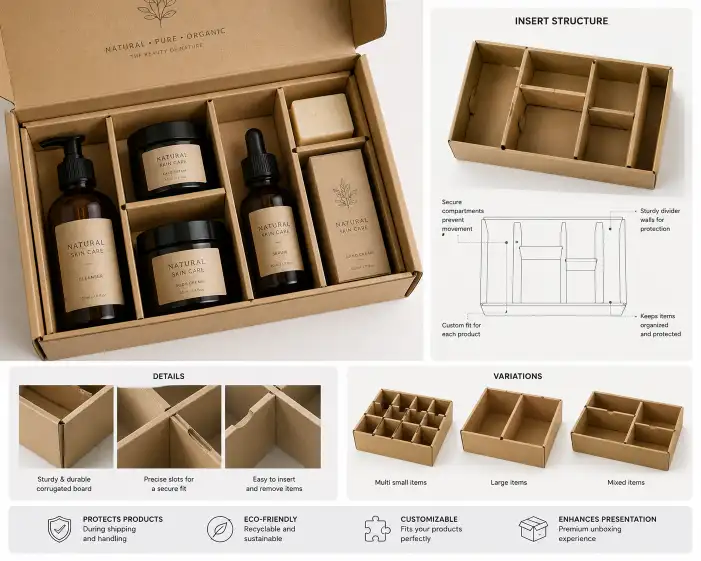
Cardboard inserts (also called paperboard inserts or cardboard dividers) are made from die-cut grey board or paperboard. They are lightweight, recyclable, and the most cost-effective insert option.
Types of Cardboard Inserts
| Type | Construction | Best For |
|---|---|---|
| Flat divider | Single sheet with cutouts | One-layer product display |
| Folded structure | Scored and folded board | Multi-level product display |
| Grid divider | Cross-slotted sheets | Multiple identical items (bottles, jars) |
| Platform riser | Folded board with raised center | Lifting a product to a higher viewing level |
Advantages and Limitations
| Pros | Cons |
|---|---|
| Lowest cost insert option | Less shock absorption than foam |
| 100% recyclable | Visible board edge may look less premium |
| Ships flat, reduces storage space | Limited to lighter products (under 500 g) |
| Fast production, low MOQ | Not suitable for heavy or sharp-edged items |
Cardboard inserts are the right choice for brands that prioritize eco-friendly packaging and cost efficiency over luxury presentation. They work well for chocolate boxes, tea sets, and consumer goods where the product does not require heavy shock protection.
Molded Pulp Inserts: Sustainable Alternative to Plastic and Foam
Molded pulp (also called molded fiber) is made from recycled paper pulp pressed into shape. It is biodegradable, compostable, and increasingly popular for eco-conscious brands.
Molded Pulp Characteristics
| Factor | Details |
|---|---|
| Material | Recycled paper, cardboard, or agricultural fiber |
| Production | Pulp is mixed with water and pressed into a mold |
| Finish | Textured surface, can be dyed or left natural |
| End of life | Biodegradable, compostable, recyclable |
| Cost per unit | Moderate (tooling cost + per-unit cost) |
Best Uses
- Eco-friendly brand packaging — Aligns with sustainability messaging
- Electronics accessories — Headphones, chargers, small devices
- Cosmetic sets — Natural finish complements organic skincare brands
- Subscription boxes — Lightweight, protective, and compostable
One limitation: molded pulp has a textured surface that does not accept fine print detail. If your insert needs brand printing or a smooth finish, foam or cardboard is a better choice.
Velvet and Fabric-Lined Inserts: Luxury Presentation
For the highest-end packaging, inserts are wrapped in fabric. The fabric adds visual warmth and a tactile premium feel that foam or cardboard alone cannot achieve.
Fabric Options for Insert Wrapping
| Fabric | Look and Feel | Cost | Best For |
|---|---|---|---|
| Velvet | Soft, rich color, matte sheen | Higher | Jewelry, watches, premium cosmetics |
| Leatherette | Smooth, leather-like | Higher | High-end gift sets, corporate gifts |
| Satin | Shiny, smooth surface | Higher | Perfume, ribbon boxes |
| Suede | Soft, matte, non-reflective | Highest | Ultra-premium packaging |
Fabric-wrapped inserts are typically made by wrapping the chosen fabric around a foam or EVA core. The core provides structure, and the fabric provides the visible surface.
When to Upgrade to Fabric-Lined Inserts
- Your product retails above $100
- Your brand identity centers on luxury and craftsmanship
- The insert is visible as part of the unboxing experience
- Customers keep the box for storage after purchase
Insert Material Comparison Table
| Material | Protection Level | Perceived Quality | Cost | Eco-Friendly | Best Quantity Range |
|---|---|---|---|---|---|
| PU Foam | Very high | Moderate | $$ | Low (not recyclable) | 1–10,000+ |
| EVA Foam | High | High | $$$ | Low (not recyclable) | 500–10,000+ |
| Cardboard | Low–Moderate | Low–Moderate | $ | High (recyclable) | 100–50,000+ |
| Molded Pulp | Moderate | Moderate | $$ | Very high (compostable) | 1,000–100,000+ |
| Fabric-Wrapped EVA | High | Very high | $$$$ | Low | 500–5,000+ |
How to Choose the Right Insert for Your Product
Use this decision framework to narrow down your insert options:
Step 1: Assess Product Fragility
| Product Type | Recommended Insert |
|---|---|
| Glass bottles, fragile electronics | PU foam or EVA foam |
| Solid products (chocolate, soap) | Cardboard divider or EVA |
| Heavy items (wine, large jars) | PE foam or EVA |
| Flat items (documents, cards) | Cardboard folder or none |
Step 2: Define Your Brand Tier
| Brand Positioning | Recommended Insert |
|---|---|
| Mass market | Cardboard divider or plain foam |
| Premium | EVA tray or PU foam |
| Luxury | Fabric-wrapped EVA or velvet foam |
Step 3: Consider Eco-Impact
If sustainability is a priority, choose molded pulp or cardboard inserts. Avoid foam if your brand emphasizes environmental responsibility. For a middle ground, use cardboard with recycled content.
Step 4: Match Insert to Box Type
Different box styles work best with different insert types. For a complete solution with your rigid box order, browse the box inserts collection and discuss options with your manufacturer.
FAQ
What is the best box insert material for fragile products?
PU foam is the best choice for fragile products. It compresses around the product, holding it securely and absorbing shock during shipping. For extra protection, choose a higher-density foam.
Can I get custom-shaped cavities in my inserts?
Yes. CNC routing and die-cutting both produce custom-shaped cavities. CNC routing is better for complex shapes and small runs. Die-cutting is more cost-effective for large production runs.
What is the difference between foam and EVA inserts?
Foam (PU or PE) is softer and more compressible, making it better for shock absorption. EVA is firmer and holds its shape better, making it better for presentation and fabric wrapping.
Are cardboard inserts strong enough for heavy products?
Cardboard inserts are best for lightweight products (under 500 g). For heavier items, use foam or EVA inserts that provide better structural support and shock absorption.
What is the MOQ for custom box inserts?
MOQ depends on the material and cutting method:
- CNC-cut foam: 50–100 units
- Die-cut foam or cardboard: 500+ units
- Molded pulp: 1,000+ units
- Fabric-wrapped: 300–500 units
Are foam inserts recyclable?
Most foam inserts (PU, PE, EPE) are not widely recyclable. For eco-friendly alternatives, choose cardboard, molded pulp, or recycled-content inserts.
How do I measure my product for a custom insert?
Measure the product at its widest point in all three dimensions. Add 2–3 mm tolerance around each dimension for a snug but removable fit. For multi-item sets, measure each item and calculate the combined layout.
Can inserts be made from recycled materials?
Yes. Cardboard inserts can use 100% recycled board. Molded pulp inserts are made from recycled paper. Some foam suppliers offer recycled-content foam, though availability is limited.
What is a fabric-wrapped insert?
A foam or EVA core covered with a fabric layer (velvet, leatherette, satin, or suede). The core provides structure and protection; the fabric provides a premium visual and tactile finish.
How do I choose between foam and molded pulp?
Choose foam if protection and precision fit are the top priorities. Choose molded pulp if sustainability and compostability are more important. For products that need both, consider combining a pulp base with a foam top layer.


