
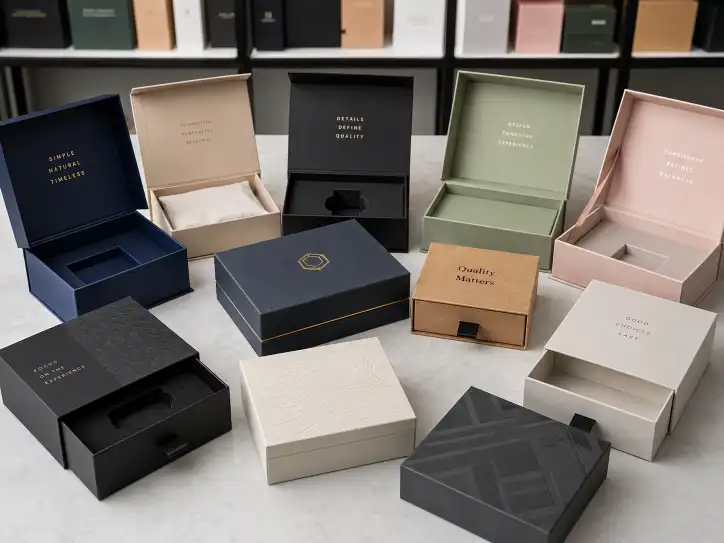
Choosing the right rigid box manufacturer is one of the most important decisions you will make for your packaging project. A good manufacturer delivers consistent quality, meets your deadlines, and helps you optimize your design for production. A poor choice leads to delays, quality issues, and unexpected costs.
The challenge is that most manufacturers look similar on paper. They all list the same services, the same certifications, and the same capabilities. The real differences only become clear when you know what to ask and what to look for during evaluation.
This guide provides a structured checklist for evaluating and selecting a custom rigid box manufacturer. Use it to compare suppliers objectively and find the right partner for your project.

Step 1: Define Your Requirements Before You Start Looking
Before contacting any manufacturer, write down your project specifications. This helps you filter out suppliers who are not a good fit before you invest time in detailed discussions.
Project Specification Template
| Requirement | Your Answer | Why It Matters |
|---|---|---|
| Box style | Magnet, top-bottom, drawer, hinged, ribbon | Determines which manufacturers have experience with your style |
| Box dimensions | Length × width × height (internal) | Affects die-making requirements and material consumption |
| Product type | Cosmetics, jewelry, food, electronics | Some manufacturers specialize by industry |
| Order quantity | First order + projected annual volume | Separates manufacturers by MOQ compatibility |
| Target cost per box | $X.XX | Prunes suppliers outside your budget range |
| Timeline | Target launch date | Confirms production capacity availability |
| Materials | Board grade, paper type, finishes | Determines if the manufacturer stocks what you need |
| Certifications required | FSC, ISO, FDA, BSCI | Narrows the list to compliant suppliers |
Having this document ready before you start outreach saves time and helps you compare quotes on an equal basis.
Step 2: Evaluate Manufacturing Capabilities
Not all custom rigid box manufacturers have the same equipment or production capacity. Ask specific questions about their capabilities.
Key Capability Questions
- What types of rigid boxes do you produce? — Confirm they regularly make your box style, not just list it on their website.
- What is your maximum and minimum box size? — Some manufacturers cannot produce very large or very small boxes.
- What printing methods do you offer? — Offset, digital, screen, and foil stamping each require different equipment.
- What finishing options are done in-house vs outsourced? — In-house finishing is faster and easier to control.
- What is your monthly production capacity? — Ensures they can handle your order volume and any future scale-up.
- Do you offer insert production in-house? — Boxes and inserts from the same manufacturer fit better and simplify logistics.
Production Capacity Table
| Factory Size | Monthly Rigid Box Output | Typical Minimum Order | Best For |
|---|---|---|---|
| Small workshop | 10,000–50,000 units | 200–500 units | Startups, small batches, test runs |
| Medium factory | 50,000–200,000 units | 500–1,000 units | Growing brands, regular orders |
| Large factory | 200,000–1,000,000+ units | 1,000–3,000 units | High-volume brands, retail chains |
| Very large manufacturer | 1,000,000+ units | 3,000–5,000+ units | Mass retail, enterprise accounts |
Step 3: Assess Quality Control Processes
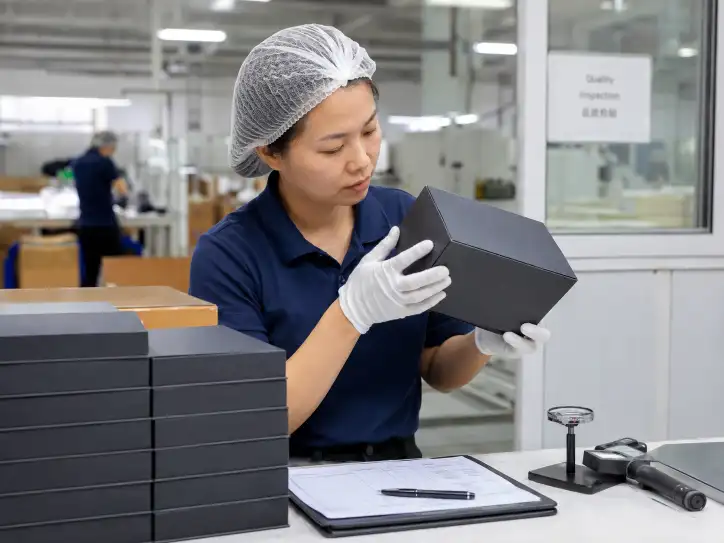
Quality control is where good manufacturers separate from average ones. Ask about their QC process at every stage.
QC Checkpoints to Ask About
| Stage | What Should Be Checked | Why It Matters |
|---|---|---|
| Incoming materials | Board density, paper color, adhesive quality | Bad materials produce bad boxes regardless of assembly skill |
| During production | Die-cut accuracy, print registration, glue application | Catching issues mid-run prevents total batch failure |
| Finished boxes | Corner quality, closure fit, surface finish, dimensional accuracy | The final check before your boxes ship |
| Packaging | Outer carton strength, box-to-box protection, pallet stability | Prevents damage during freight |
Ask the manufacturer for their QC checklist or quality standard document. If they cannot provide one, that is a red flag.
Sampling Process
A reliable manufacturer will offer a structured sampling process:
- Structural drawing — 2D CAD drawing showing dimensions and construction details.
- Pre-production sample (PPS) — A physical sample using the actual materials and finishes specified.
- Proof approval — Digital or physical proof confirming artwork and color.
- Production sample — A sample pulled from the first production run to confirm consistency.
Sample production typically takes 5–10 business days. A small fee applies and is usually deducted from the production order.
Step 4: Compare Samples and Portfolios
Request samples from at least three manufacturers before making a decision. Comparing samples side by side reveals quality differences that are not obvious from photos or quotes.
What to Evaluate on a Sample
| Quality Factor | What to Look For |
|---|---|
| Corner finish | Are the paper corners cleanly folded or are there wrinkles and gaps? |
| Board density | Does the box feel solid or does it flex under pressure? |
| Closure fit | Does the lid close smoothly and stay closed? Is the magnet alignment correct? |
| Print quality | Is the print sharp and color-accurate? Are there registration issues? |
| Paper wrap | Is the paper evenly wrapped with no bubbles, lifting, or visible seams? |
| Edge finishing | Are exposed edges clean or rough? |
If a manufacturer's sample quality does not meet your expectations, the production run will not be better. Samples are the best effort a factory can produce — production quality is almost always slightly lower.
Step 5: Understand MOQ and Pricing Terms
Pricing and minimum order quantities vary significantly between manufacturers. Understanding the cost structure helps you compare quotes accurately.
What Should Be Included in a Quote
A complete quote should include:
- Unit price at your target quantity and at higher quantities for comparison
- Tooling / die cost — One-time setup fees for custom dies and plates
- Sample cost — Fee per sample unit, and whether it is refundable against production
- Packaging cost — Inner packaging and outer carton costs
- Shipping cost — FOB (factory) or CIF (delivered to port) pricing
- Payment terms — Typical terms are 30%–50% deposit with balance before shipment
Typical Pricing Structure for Rigid Boxes
| Cost Component | Typical Range | Notes |
|---|---|---|
| Unit price (500–1,000 units) | $1.50–$5.00 per box | Depends on size, materials, and complexity |
| Die / tooling | $80–$200 per die | One-time cost, reusable for reorders |
| Printing plates | $50–$150 per plate | One-time cost per color |
| Sample fee | $50–$200 per sample | Usually deducted from production order |
| Outer carton | Included or $0.10–$0.30 per box | Ask if it is included in the unit price |
For a detailed breakdown of rigid box pricing, refer to the custom luxury rigid box pricing guide.
MOQ Considerations
Standard MOQ for custom rigid boxes is 500–1,000 units per design. If your order is smaller, ask about:
- Semi-custom programs with pre-configured sizes
- Setup surcharge options for smaller runs
- Combined SKU production to share the MOQ across designs
See the rigid box MOQ guide for more details on minimum order quantities and how to negotiate lower MOQs.
Step 6: Evaluate Communication and Responsiveness
Communication quality during the quoting and sampling phase is a reliable predictor of how the manufacturer will behave during production.
Communication Checklist
| Factor | What to Assess |
|---|---|
| Response time | How long does it take to reply to your initial inquiry? (1–2 business days is reasonable) |
| Question quality | Do they ask clarifying questions or send a generic quote? |
| English proficiency | Can they communicate technical details clearly? |
| Proactiveness | Do they suggest improvements or alternatives, or just take orders? |
| Follow-through | Do they deliver what they promise when they say they will? |
A manufacturer who answers slowly or vaguely during the sales process will not become faster during production. Responsiveness during evaluation is the best indicator of what working with them will be like long term.
Step 7: Check Certifications and Compliance
Certifications confirm that a manufacturer meets industry standards. Depending on your target market and product type, some certifications may be required.
Common Packaging Certifications
| Certification | What It Means | Required For |
|---|---|---|
| ISO 9001 | Quality management system standard | Most B2B buyers require this |
| ISO 14001 | Environmental management system | Brands with sustainability commitments |
| FSC (Forest Stewardship Council) | Paper sourced from responsibly managed forests | Eco-friendly packaging claims |
| BSCI / SMETA | Social compliance audit | Retailers in Europe and North America |
| FDA | Food-grade material compliance | Food and cosmetic packaging |
| Reach / RoHS | Chemical and material safety compliance | European market requirements |
Ask for current certification documents, not just logos on the website. Certifications must be renewed periodically, and expired certifications mean the manufacturer is not actively audited.
Red Flags to Watch For
| Red Flag | Why It Is a Problem |
|---|---|
| No physical samples available | If they cannot produce a sample, they cannot produce your order |
| Vague pricing (no unit cost breakdown) | Hidden costs will appear later |
| MOQ drops significantly after negotiation | If 1,000 becomes 300 with no design change, the first number was artificial |
| Poor English in technical communication | Misunderstandings during production lead to errors and delays |
| No QC documentation | Quality control is not systematic and errors will be missed |
| Extremely low pricing compared to others | Materials or labor quality is being cut somewhere |
Trust your judgment. If something feels off during the evaluation phase, it will likely become a bigger problem during production.
Comparison Table: China vs Domestic Manufacturers
One of the key decisions when selecting a rigid box packaging manufacturer is whether to source from China or a domestic supplier in your own country.
| Factor | China Manufacturer | Domestic Manufacturer |
|---|---|---|
| Typical MOQ | 500–1,000 units | 1,000–2,000 units |
| Per-unit cost | Lower (30–50% less than domestic) | Higher |
| Setup/tooling costs | Moderate ($80–$200 per die) | Higher ($150–$350 per die) |
| Lead time | 15–25 business days + shipping | 10–20 business days |
| Shipping cost | $200–$800 per cubic meter | Lower or included |
| Communication | English varies, time zone difference | Native language, same time zone |
| Sample turnaround | 5–10 business days | 3–7 business days |
| Quality consistency | Good if QC is verified | Generally more consistent |
| Minimum reorder MOQ | 300–500 units | 500–1,000 units |
Cost Comparison Example: 1,000 Rigid Boxes
| Cost Item | China Manufacturer | Domestic Manufacturer |
|---|---|---|
| Unit price (1,000 boxes) | $2.50 each | $4.50 each |
| Subtotal | $2,500 | $4,500 |
| Shipping | $350 | $100 |
| Duties | $75 | $0 |
| Total cost | $2,925 | $4,600 |
| Cost per box delivered | $2.93 | $4.60 |
The savings from China manufacturing are significant, especially for larger orders. For small orders (under 500 units), the shipping cost proportion makes domestic suppliers more competitive.
FAQ
What should I look for in a rigid box manufacturer?
Look for relevant experience with your box style, good sample quality, clear communication, transparent pricing, and relevant certifications. Always request samples before committing.
How do I verify a rigid box manufacturer's quality?
Request physical samples and compare them against your quality checklist. Ask for their QC documentation. If possible, arrange a factory visit or third-party inspection before production.
What is a reasonable response time from a packaging manufacturer?
1–2 business days for initial responses is reasonable. Faster responses during evaluation usually indicate better communication during production.
Should I choose a China manufacturer or a domestic supplier?
China manufacturers offer lower per-unit costs (30–50% less) and lower MOQs. Domestic suppliers offer faster shipping, easier communication, and no import duties. The right choice depends on your order volume, timeline, and budget.
What certifications should a rigid box manufacturer have?
ISO 9001 is the basic quality certification. FSC is important for eco-friendly packaging claims. BSCI or SMETA is often required by retailers in Europe and North America. FDA compliance is needed for food and cosmetic packaging.
How many samples should I request before placing an order?
Request samples from at least 2–3 manufacturers. Compare them side by side on corner quality, closure fit, print accuracy, and material feel.
What is the typical payment terms for custom rigid box orders?
Standard terms are 30–50% deposit with the order, balance before shipment or against shipping documents. Custom terms may be available for repeat orders.
How do I know if a manufacturer is being honest about their MOQ?
Compare their MOQ to industry standards. If a factory claims 100-unit MOQ for fully custom rigid boxes, ask for clarification — there is usually a setup surcharge or limited customization involved.
What questions should I ask before placing a reorder?
Ask if the dies and plates are still available (most manufacturers keep them for 12–24 months). Confirm the current material prices, as paper and board costs fluctuate. Ask about lead time for the reorder quantity.
Can the same manufacturer produce both boxes and inserts?
Many manufacturers offer both. Producing boxes and inserts from the same manufacturer ensures dimensional compatibility and simplifies logistics. Always confirm this capability during evaluation.


