
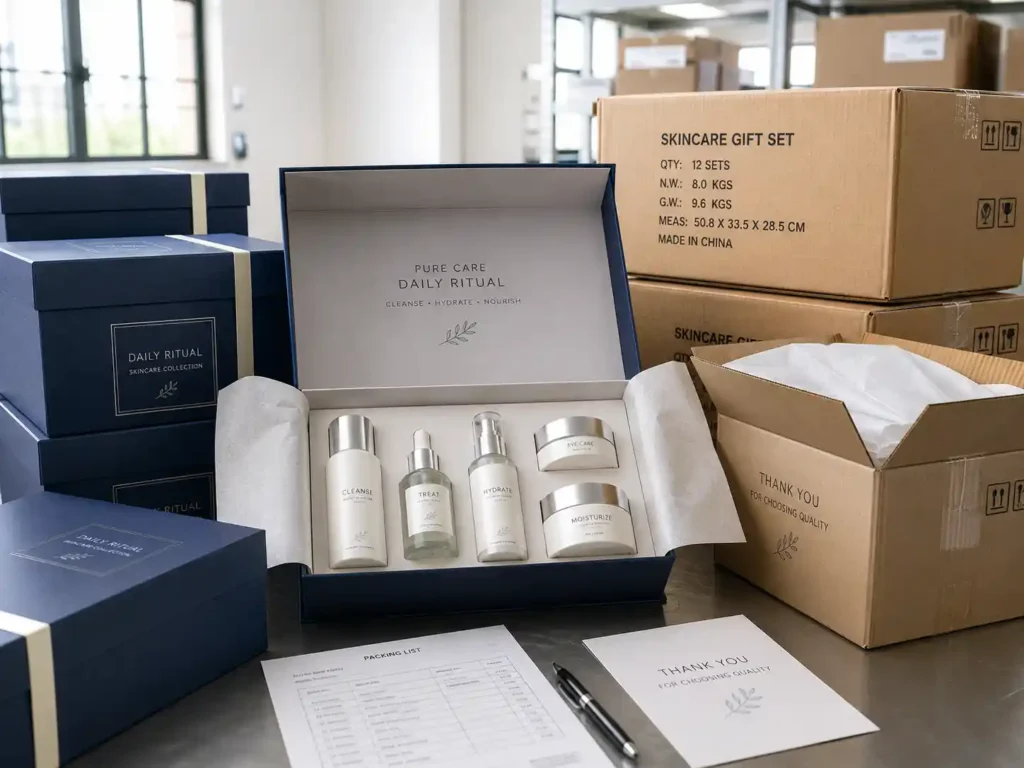
A skincare gift box must protect bottles, jars, droppers, tubes, and refill products without making the set look crowded. The box style, insert structure, paper material, and packing method all affect how the product feels when opened and how well it survives shipping.
For skincare sets, the main decision is not only “which box looks premium.” It is whether the box can hold different product weights, keep glass containers stable, support printing and finishing, and remain practical for bulk production.
Why skincare gift box structure matters for bottles and jars
Skincare products create packaging challenges because they often combine different shapes in one set. A serum bottle may be tall and narrow. A cream jar may be short and heavy. A toner bottle may need deeper support. A spatula, card, or refill pouch may need a separate cavity.
This is where a custom structure helps. In our experience, many packaging projects run into issues when the outer box is approved before the insert is tested. The box may look fine in a rendering, but the product can tilt, rattle, or press against the lid during transport.
A good skincare gift box should answer four practical questions:
- Does each product sit in the correct position?
- Can the insert support product weight during handling?
- Does the lid close smoothly after products are loaded?
- Can the full set be packed into export cartons without crushing corners?
Small details matter. If the jar cavity is too loose, the product moves. If the bottle cavity is too tight, workers may damage the insert during hand assembly. If the box depth is wrong, the product can touch the lid and leave pressure marks.

Best skincare gift box styles for different set types
Different skincare sets need different box structures. A premium serum kit, a retail trial set, and a holiday skincare collection should not use the same packaging by default.
Magnetic skincare gift box for premium sets
A magnetic box is often used for premium skincare sets because it creates a clean opening experience and allows a rigid structure. It works well for glass bottles, jars, and multi-piece product arrangements.
For bottle and jar sets, magnetic gift boxes are useful when the set needs a stronger presentation box with paper wrap, printed artwork, foil stamping, embossing, or a textured surface. The rigid board gives the box a stable shape, while the magnetic flap makes the opening feel controlled.
This style is suitable for:
- Serum and cream gift sets
- Holiday skincare boxes
- Influencer mailer-style gift packs
- Retail display gift sets
- Premium product launch packaging
The main production point is insert depth. A magnetic closure box looks polished from the outside, but the inside must be planned around the tallest bottle and the heaviest jar. For glass containers, paperboard inserts may need thicker board, layered support, or a wrapped EVA insert depending on the product weight and shipping route.
Drawer box for layered skincare presentation
A drawer box works well when the skincare set benefits from a sliding reveal. It can hold bottles, jars, masks, or small accessories in a structured tray. Compared with a magnetic box, a drawer box can feel more compact and organized.
Drawer boxes are useful for:
- Two-piece skincare sets
- Travel-size bottle and jar combinations
- Spa gift sets
- Sample kits with small compartments
- Retail gift packs that need a clean shelf shape
The biggest detail is sliding tolerance. If the drawer is too tight, it feels hard to open. If it is too loose, the inner tray may move during shipping. During sampling, we normally check the paper wrap thickness, greyboard thickness, drawer gap, and product loading weight together.
A drawer structure can also be compared with a magnetic structure when the buyer is choosing between a sliding opening and a lid-opening experience. For a related structure comparison, the drawer box vs magnetic box guide is useful because many of the same box-selection points apply to skincare, cosmetics, jewelry, and gift sets.
Lid and base box for simple retail gift sets
A lid and base box is a practical option when the set needs a classic gift-box shape. It can be made with rigid board for a premium finish or with paperboard for lighter retail packaging.
This style works well when the products have similar heights. For example, three cream jars can sit in a flat insert and be covered by a separate lid. The structure is simple, but the insert still needs accuracy. If the lid height is not calculated well, the top of the bottle cap or jar lid may press against the inside of the lid.
Lid and base boxes can be easier to hand pack than some complex structures. They also allow a clear separation between outer presentation and inner product arrangement. For many packaging projects, this makes sampling faster and bulk assembly smoother.
Folding carton for lighter skincare items
A folding carton is not always the first choice for heavy glass bottles, but it can work well for lightweight skincare products, masks, tubes, sachets, and retail refill packs. It is usually flatter during shipping before assembly, which can help reduce storage space.
For light retail packaging, folding boxes can support printed branding, product information, and shelf-ready presentation. The trade-off is strength. If the product is heavy or fragile, a folding carton may need an inner tray, divider, or secondary protection.
This style is suitable when the buyer wants a clean retail paper box rather than a rigid gift box. It can also work as a sleeve around a tray or as an outer carton for a smaller skincare gift set.
Mailer box for eCommerce skincare kits
A mailer box is useful when the gift set needs to ship directly to customers. It can combine branding, structure, and shipping protection in one box. For skincare, this is useful for subscription sets, starter kits, sample programs, and online product launches.
mailer boxes can be designed with corrugated board, printed liners, paper inserts, or protective cavities. For shipping-oriented projects, buyers can also review products for mailer boxes to match product type with mailer structure.
The key point is transit protection. A skincare mailer must control movement. If the product touches the box wall, the risk of corner impact or bottle damage increases. For fragile products, a shipper box around the gift box may still be needed.
How to choose inserts for a skincare gift box
The insert is often more important than the outer box. It controls product position, opening neatness, and shipping stability.
For skincare bottles and jars, custom box inserts can be made from paperboard, corrugated board, EVA foam, molded pulp, or wrapped greyboard. Each option affects cost, appearance, protection, and assembly time.
Paperboard inserts
Paperboard inserts are common for medium-weight skincare sets. They are suitable for bottles, jars, tubes, and small accessories when the product is not too heavy. They can be printed, folded, and designed with cavities or raised supports.
Paperboard is a strong choice when the project needs a clean paper-based look. It can also support flat-pack efficiency in some structures. The limitation is load-bearing strength. A heavy glass jar may need extra support below the cavity.
EVA inserts
EVA inserts are often used when the product is fragile, heavy, or needs a snug fit. EVA can hold glass bottles tightly and create a neat product layout. It is common for premium skincare, perfume, beauty tools, and delicate gift sets.
The trade-off is material feel and sustainability concerns. Some buyers prefer paper-based inserts for brand positioning or recycling goals. Others choose EVA because protection is the priority.
Molded pulp and paper-based support
Molded pulp can work for brands seeking a paper-based protection system. It may suit certain jar and bottle shapes, especially when the design allows rounded cavities and enough wall thickness.
The production point is mold cost and tolerance. Molded pulp may need more setup than a folded paperboard insert. It also has a different surface texture, so the visual style should match the product positioning.

Comparison table: skincare box styles and buying factors
| Box style | Best use case | Main strength | Production detail to check |
|---|---|---|---|
| Magnetic box | Premium skincare sets, glass bottles, product launches | Strong presentation and smooth opening | Magnet position, flap closure, insert height, board thickness |
| Drawer box | Compact bottle and jar sets, sample kits | Controlled sliding reveal | Drawer tolerance, pull ribbon, tray fit, paper wrap thickness |
| Lid and base box | Classic retail gift sets | Simple structure and easy packing | Lid depth, product height, insert clearance |
| Folding carton | Light tubes, masks, sachets, refill packs | Efficient retail paper packaging | Board grade, crease lines, locking structure |
| Mailer box | eCommerce skincare kits | Shipping-friendly structure | Corrugated grade, insert support, outer carton plan |
| Advent calendar box | Seasonal skincare sampling, multi-day gifting | Multi-compartment presentation | Door count, cavity size, product loading order |
Seasonal skincare sets sometimes use advent calendar boxes when each product needs a separate compartment. This can work well for mini serums, ampoules, creams, sachets, and promotional trial sizes. The production challenge is cavity planning. A 12-day or 24-day layout needs accurate product measurements before the dieline is finalized.
Material and finishing choices that affect the final result
A skincare gift box often needs to look clean, refined, and stable. The material choice has to support that goal without creating production issues.
Board thickness
Rigid skincare boxes often use greyboard inside the paper wrap. The thickness depends on the box size and product weight. A small serum set may not need the same board thickness as a large holiday collection with several glass jars.
Thicker board can improve strength, but it also affects folding edges, box weight, and shipping cost. During sampling, it is better to test the real product weight rather than judge by box size alone.
Paper wrap
Paper wrap changes the box’s surface feel. Coated paper, specialty paper, textured paper, and printed art paper all create different results. Some papers handle foil stamping better. Some papers show fingerprints more easily. Some textured papers may reduce the sharpness of small printed details.
For skincare packaging, many buyers choose soft neutral colors, metallic details, or clean printed patterns. The artwork should be checked on the selected paper, not only on screen.
Printing and finishing
Common finishing options include:
- Matte lamination
- Gloss lamination
- Spot UV
- Hot foil stamping
- Embossing
- Debossing
- Metallic ink
- Soft-touch surface treatment
Foil and embossing can make a skincare gift box feel more premium, but they need enough artwork spacing. Thin lines, small letters, and complex logo details may not stamp cleanly. A factory sample helps confirm whether the finish matches the design intent.
Responsible sourcing and process control
If responsible paper sourcing is important, buyers can review FSC chain of custody certification, which explains how forest-based materials are traced through the supply chain. ([森林管理委员会][1]) For quality-management expectations, ISO 9001 is a recognized quality management system standard used to support repeatable processes and consistent output. ([ISO][2])
These references do not replace project-level checks. They help frame the conversation around material control, supplier documentation, and production consistency.
Sampling checks before bulk production
A sample is not only a visual approval. It is a structure test.
For skincare bottles and jars, the sample should be checked with real filled products if possible. Empty bottles do not show the same weight. A cream jar filled with product may stress the insert in a different way.
During sample review, check:
- Product fit inside each cavity
- Lid closure after loading
- Insert lifting or bending
- Drawer sliding feel
- Magnet strength
- Paper wrap alignment
- Corner finish
- Print color under normal light
- Foil or embossing detail
- Carton packing direction
This step can prevent expensive corrections later. Once bulk printing begins, changes to structure, size, artwork, or insert layout can create waste and delay delivery.
Export packing and shipping protection
A beautiful gift box can still fail if the export packing is weak. For skincare packaging, shipping protection should be considered early, especially when glass bottles or jars are involved.
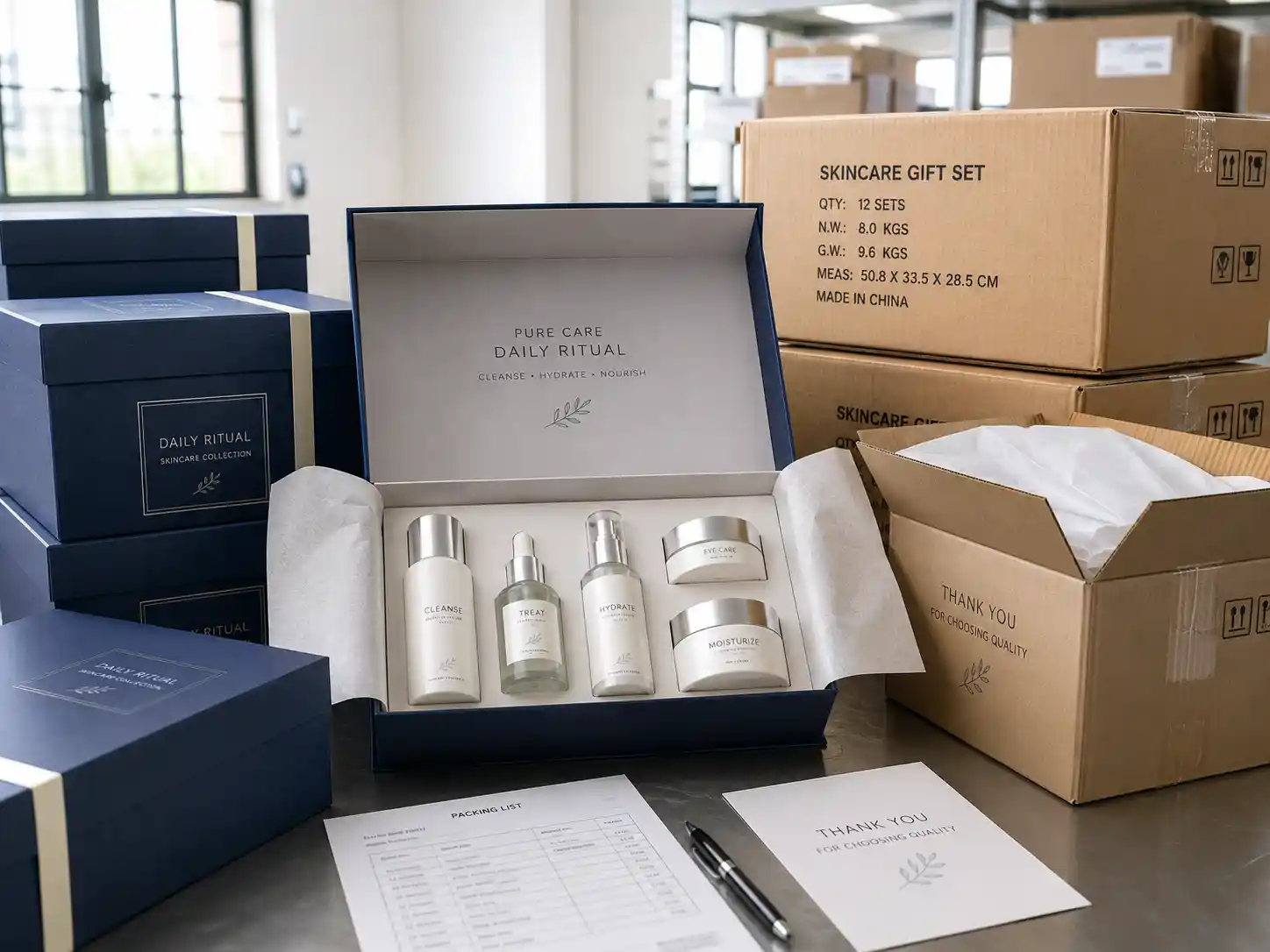
A typical export packing plan may include inner polybag protection, paper tissue, corner protection, corrugated master cartons, carton labels, and pallet instructions. The packing method depends on whether the boxes are shipped empty, pre-assembled, flat-packed, or loaded with product.
For shipment validation, the International Safe Transit Association test procedures provide packaging test methods ranging from early screening tests to broader transport simulations. ([国际安全运输协会][3]) Even when a project does not require formal testing, the same thinking helps buyers ask better questions about drop risk, vibration, compression, and carton stacking.
Common mistakes when developing skincare gift packaging
Buyers often run into the same issues during box development. Most of them can be avoided with better information at the inquiry stage.
Choosing the box style before measuring products
The outer structure should follow product dimensions. Send bottle diameter, bottle height, cap shape, jar diameter, jar height, and product weight before the dieline is created. Photos help, but measurements drive the structure.
Ignoring insert assembly time
A complex insert may look impressive, but it can slow down packing. If a project has a large quantity or tight delivery time, assembly efficiency matters. A cleaner insert may produce a better result than an over-complicated one.
Designing artwork before confirming material
Colors shift across coated paper, specialty paper, kraft paper, and textured paper. Metallic finishes also change under different lighting. Artwork should be checked against the selected paper and finish.
Forgetting the shipping carton
The outer gift box is not the final protection layer. Export cartons need the correct size, strength, and packing direction. For heavy skincare sets, carton compression and pallet stacking should be reviewed before production.
Turn the skincare gift box idea into a production-ready project
A skincare gift box becomes easier to develop when the project starts with practical information. Share the product size, product weight, quantity, target box style, preferred insert type, artwork file, reference structure, packing method, and expected delivery time. With these details, the factory can suggest a structure that fits both presentation and production.
For premium skincare sets, magnetic boxes, drawer boxes, and lid and base boxes are often strong options. For lighter retail products, folding cartons may work better. For online sales, mailer boxes and protective inserts deserve attention. For seasonal kits, multi-compartment structures can create a stronger gifting experience.
Gifts Pack supports custom gift box and paper packaging projects from structure planning to sampling, insert development, printing, finishing, hand assembly, export packing, and production follow-up. The next step is simple: turn the bottle and jar dimensions into a box structure that can be sampled, checked, and prepared for bulk production through Gifts Pack factory support.

