
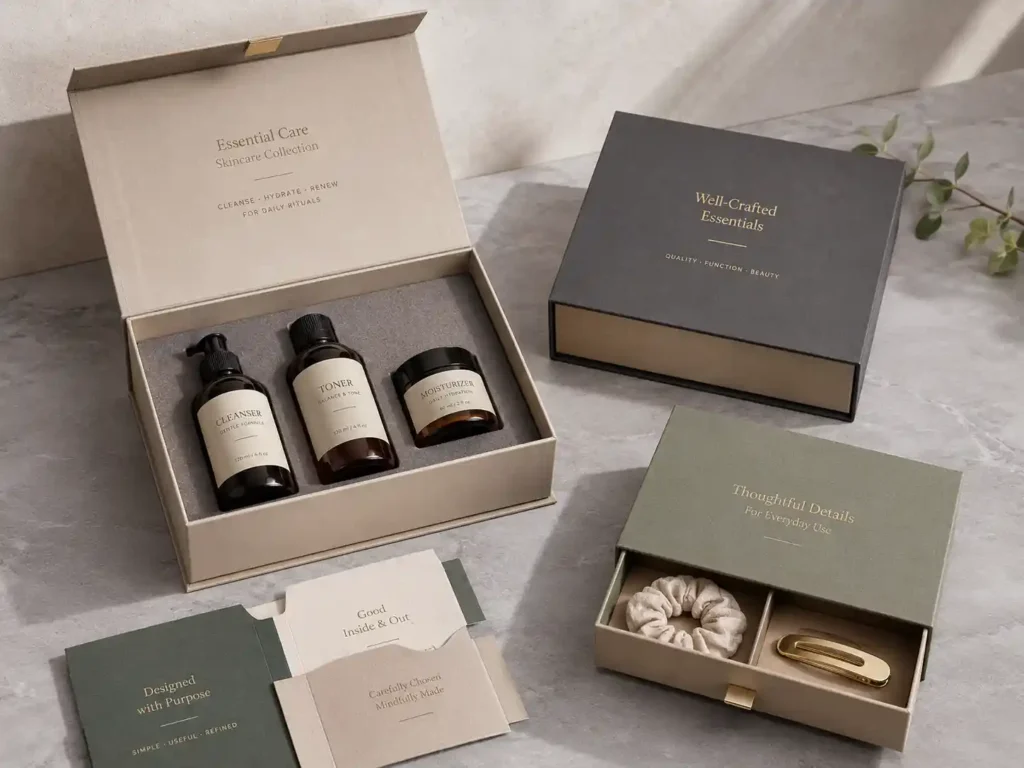
Choosing a custom paper box structure is not only a style decision. It affects product protection, shelf presentation, insert fit, packing speed, shipping cost, and how smoothly the project moves from sampling to bulk production.
For many packaging projects, buyers start with a reference photo and ask for a similar look. That helps, but the better starting point is the product itself: size, weight, fragility, retail channel, unboxing goal, and delivery method. The right box structure should protect the product, support the brand message, and remain practical for factory production.
Why Custom Paper Box Structure Matters Before Design Starts
A beautiful artwork file cannot fix the wrong structure. If the board is too thin, the lid may feel loose. If the insert is not planned early, the product may shift during shipping. If the box is too complex for hand assembly, labor cost and lead time can rise.
In our experience, the structure decision should happen before final artwork. First check the product dimensions, product weight, display method, packing method, and expected order quantity. Then decide whether the project needs a rigid gift box, folding carton, mailer box, drawer box, shoulder box, or multi-compartment box.
Small change. Big result.
A 2 mm adjustment in cavity size can improve insert fit. A stronger greyboard can help a premium gift set feel more stable. A foldable rigid structure can reduce shipping volume for larger gift packaging projects. These details matter because the box is not only printed paper. It is a production object.

Matching a Custom Paper Box to Industry Needs
Different industries use gift packaging in different ways. Cosmetics often need premium presentation and insert control. Food gifts need clean compartment planning and material compatibility. Jewelry packaging may need a compact rigid structure with a soft insert. eCommerce products need shipping-friendly strength.
Beauty, Skincare, and Fragrance
Beauty packaging often needs a premium first impression, but the structure must also protect bottles, jars, tubes, and sets with different heights. A magnetic rigid box works well when the product needs a clean opening experience and stronger presentation. For premium launch kits, magnetic gift boxes can support paperboard inserts, EVA inserts, foam inserts, or molded trays depending on the product weight and surface finish.
The common issue is not the outside box. It is the inside fit.
A serum bottle, cream jar, and small card may need different cavity depths. If the insert is too loose, the set looks unfinished. If it is too tight, the product may be hard to remove. For skincare and fragrance sets, insert testing during sampling should include product placement, removal feel, lid closing, and carton packing.
Foil stamping, embossing, debossing, and soft-touch lamination can work well for beauty boxes, but they should be checked against the paper wrap. Some dark papers show fingerprints. Some foil colors need more testing on textured paper. A sample is not decoration. It is a production test.
Jewelry, Watches, and Small Gift Items
Jewelry and small gift items often need a compact structure with a strong perceived value. Drawer boxes, shoulder boxes, and magnetic boxes are common choices. A drawer box creates a slow reveal, while a magnetic box feels direct and clean. The best choice depends on product size, insert type, and how the product should be presented when opened.
For structure selection, the comparison between a drawer box and magnetic box is useful because both can look premium but perform differently. This drawer box vs magnetic box guide is especially relevant when the product is small, high-value, and presentation-led.
Jewelry packaging also needs careful insert material selection. Velvet-covered foam, paperboard inserts, EVA, and molded pulp can all work, but each gives a different look and cost level. If the product has a chain, charm, or small accessory, the insert must prevent tangling and movement.
Candles, Home Fragrance, and Fragile Gifts
Candles and glass products need structure and cushioning. A lid and base box can work for retail gifting, while a magnetic box can support premium candle sets. The insert should hold the jar from the base or shoulder area, not only from the lid. This reduces movement.
For candle projects, board thickness, insert height, and outer carton packing need to be reviewed together. Glass weight changes the box performance. A candle box that looks fine on a desk may fail in export cartons if the internal support is weak.
A practical candle gift box guide can help buyers think through jar size, insert support, finish choice, and retail presentation before sampling.
Comparing Common Box Structures by Use Case
The table below gives a practical starting point. Final structure should still be checked with product samples, artwork, shipping method, and packing quantity.
| Box structure | Best-fit products | Main advantage | Watch-out point | Common insert option |
|---|---|---|---|---|
| Magnetic rigid box | Beauty sets, launch kits, premium gifts | Strong presentation and clean opening | Higher material and assembly cost | Paperboard, EVA, foam, molded tray |
| Drawer box | Jewelry, small gifts, accessories | Smooth reveal and compact display | Sleeve and drawer fit must be tested | Paperboard, velvet foam, EVA |
| Lid and base box | Candles, apparel gifts, retail sets | Simple structure with premium feel | Lid tolerance affects opening feel | Paperboard or foam insert |
| Shoulder box | Jewelry, fragrance, small luxury sets | Layered look and stable structure | More components to assemble | Foam, card insert, covered insert |
| Mailer box | eCommerce sets, samples, subscription gifts | Shipping-friendly and flat-packed | Print cracking on folds needs checking | Corrugated insert or paperboard insert |
| Folding carton | Lightweight retail products | Cost-efficient and space-saving | Less premium than rigid structures | Paperboard tray or locking structure |
| Advent calendar box | Seasonal gifts, beauty, food, promotions | Multi-compartment storytelling | Drawer/window fit needs detailed planning | Paperboard dividers, trays, cavities |
When Mailer Boxes and Folding Cartons Make More Sense
Not every project needs a rigid gift box. For eCommerce, sample kits, lightweight retail products, and direct shipping, a mailer box or folding carton may be more practical.
Mailer boxes are useful when the box needs to ship, open cleanly, and carry branded artwork. They can be made with corrugated board and printed inside and outside. The structure can include dust flaps, locking tabs, and inner supports.
For product matching, this guide on products for mailer boxes helps explain when a mailer structure is suitable for small sets, subscription items, samples, and promotional kits.
Folding boxes are better when flat packing, lower unit cost, and retail shelf use matter more than a rigid unboxing feel. Folding cartons can work for small cosmetics, accessories, food sleeves, and lightweight product packaging. They are efficient, but they need strong dieline control. Fold lines, locking tabs, glue areas, and paper grain direction all affect the final shape.
Custom Paper Box Inserts: The Hidden Structure Buyers Notice
A box insert is not an accessory. It is part of the structure.
For many gift box projects, the buyer focuses on the outer box first. Then, during sampling, the team realizes that the product moves, the lid does not close smoothly, or the bottle neck sits too high. This is why insert planning should start early.
Custom box inserts can include paperboard inserts, corrugated inserts, EVA, foam, molded pulp, and covered insert trays. The right choice depends on product weight, surface sensitivity, sustainability goals, and target presentation.
Insert Fit Checks During Sampling
A good sample should answer practical questions:
- Does each product sit flat and centered?
- Can the product be removed without tearing the insert?
- Does the lid close without pressure?
- Does the insert shift inside the box?
- Does the product stay stable when the box is tilted?
- Does the packed box survive normal carton handling?
For paperboard inserts, folding accuracy and locking tabs matter. For EVA or foam, cavity cutting must match the product shape. For molded trays, tooling and tolerance need early review. The insert should be tested with real products, not only product drawings.

Seasonal and Multi-Compartment Packaging
Seasonal packaging creates another challenge: many small products in one structure. Advent calendar boxes, promotional kits, and holiday gift sets often need drawers, doors, trays, dividers, or numbered windows.
Advent calendar boxes need detailed structure planning because each compartment must match the product size. A beauty advent calendar may include bottles, tubes, sachets, jars, and accessories in one box. If every cavity uses the same size, the packaging may waste space. If every cavity is different, production becomes more complex.
The best approach is to group similar products and create a structure that balances fit, assembly, and cost. For example, small items can share one tray layer, taller bottles can use deeper cavities, and lightweight samples can use folded paperboard dividers.
Number printing, window cutting, drawer pulling, and insert assembly should be checked before bulk production. A calendar box is not one box. It is many small packaging decisions in one project.
Materials, Printing, and Finish Choices
Material choice should support structure first, then decoration. Greyboard thickness affects rigid box strength. Corrugated flute affects mailer protection. Coated paper, specialty paper, kraft paper, and art paper all behave differently during printing, wrapping, folding, and finishing.
Responsible sourcing can also be part of the material discussion. FSC explains that chain-of-custody certification supports claims for FSC-certified materials in paper and packaging supply chains through controlled management systems. FSC chain-of-custody certification is worth discussing when a project requires certified paper claims.
For print control, buyers should check:
- CMYK color tolerance on the selected paper
- Pantone color matching when brand color is strict
- Lamination choice for scuff resistance
- Foil stamping area and edge sharpness
- Embossing depth and paper wrap behavior
- Spot UV registration on printed graphics
Quality management also matters when artwork, sampling, material purchasing, printing, assembly, and packing must repeat across bulk production. ISO describes ISO 9001 as a quality management standard that helps organizations build processes for consistent products and services. ISO 9001 is a useful reference when buyers discuss process control with packaging suppliers.
Production Checks That Reduce Risk
A custom paper box project should move through controlled steps. Rushing from artwork to mass production can create avoidable problems.
A practical production flow often includes:
- Confirm product size, weight, and packing method.
- Choose the box structure and insert material.
- Create dieline and structure sample.
- Test product fit and lid closing.
- Confirm paper, board, printing, and finish.
- Produce pre-production sample when needed.
- Check bulk printing, mounting, die-cutting, wrapping, and assembly.
- Inspect finished boxes before export packing.
Export packing should not be treated as the last detail. Master carton strength, carton size, box orientation, moisture protection, and pallet method can affect arrival condition. ISTA provides packaging test procedures that range from screening tests to simulations of shipping hazards, which can help teams think more clearly about transit risk. ISTA test procedures are relevant when a project needs formal shipping validation or stronger transport confidence.

How to Choose the Right Custom Paper Box Structure
Start with the product, not the decoration. A strong inquiry usually includes product dimensions, product weight, quantity, preferred box style, insert needs, artwork plan, shipping method, and expected delivery time. A reference photo also helps, but it should not replace structural review.
For premium gift sets, magnetic rigid boxes, drawer boxes, shoulder boxes, and lid and base boxes often work well. For shipping-oriented packaging, mailer boxes and corrugated structures may be stronger choices. For lightweight retail packaging, folding cartons can reduce cost and storage space. For seasonal campaigns, multi-compartment structures need more sampling time.
A custom paper box becomes easier to produce when the structure, insert, material, finish, and export packing are planned together. Share the product details early, ask for a structure recommendation, and use the sample stage to test fit, finish, and packing before bulk production begins. Gifts Pack factory support can help turn those project details into a workable packaging direction.

