
Feeling lost in the world of box names? Using the wrong term can cause costly errors. I'll explain the right names so you always get what you need.
A "cardboard box" is most accurately called a "corrugated fiberboard box." This name describes its structure: fluted paper sandwiched between flat linerboards. People also call it a shipper, master carton, or simply a corrugated box.

Understanding the main name is just the beginning. The packaging world uses many terms, and knowing them helps you communicate clearly with suppliers and clients. Over my 16 years in this industry, I've seen how a small mix-up in terminology can create big problems. Getting the basics right is crucial for any designer, like my friend Peter, who needs precision in his work. These boxes are the "infrastructure" of the packaging world. They are not the most visible, but they are absolutely essential for getting products safely from one place to another. So, let's dive deeper into what these boxes are really called.
What is a cardboard box called?
Do you worry about using the correct industry term for a box? This uncertainty can lead to confusion. I'll give you the precise names professionals use every day.
Professionals call it a corrugated box or shipper. The term "cardboard box" is common but less precise. Other names include Regular Slotted Container (RSC), which describes its common style, or master carton, when it holds smaller, individual product boxes.
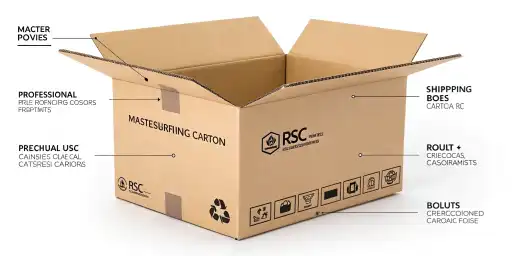
The name "corrugated box" is key because it points to the box's structure. It is not just a single layer of thick paper. It is an engineered material designed for strength. I always tell new designers to think of it as the unseen foundation of logistics. These boxes are all about protection and transport efficiency, not brand flashiness. Their job is to get products from A to B safely and at a low cost. They are the most indispensable product in all of paper packaging.
Key Terminology Explained
It’s important to distinguish between technical and common names. While your customer might say "cardboard box," as a designer, you need more precision to get the job done right.
| Term | When to Use It | My Insight |
|---|---|---|
| Corrugated Box | The most accurate, professional term. | This shows you understand the material's structure. |
| Shipper / Shipping Carton | When discussing logistics and transport. | This highlights its primary function: moving goods. |
| RSC (Regular Slotted Container) | To specify the most common box style. | This is a technical term for getting production quotes. |
| Master Carton | When it contains multiple smaller units. | This describes its role in the packaging hierarchy. |
Using the right term shows your expertise and ensures clarity in your projects. It is the difference between a general idea and a specific, manufacturable design.
What are the three types of boxes?
Do you think all paper boxes are alike? This thinking limits your creativity and can result in poor packaging choices. I’ll show you the three main types of boxes.
The three main types of paper-based boxes are: 1. Corrugated Boxes for shipping, 2. Paperboard Boxes (or folding cartons) for retail products, and 3. Rigid Boxes (or set-up boxes) for luxury items. Each has a very different purpose and construction.
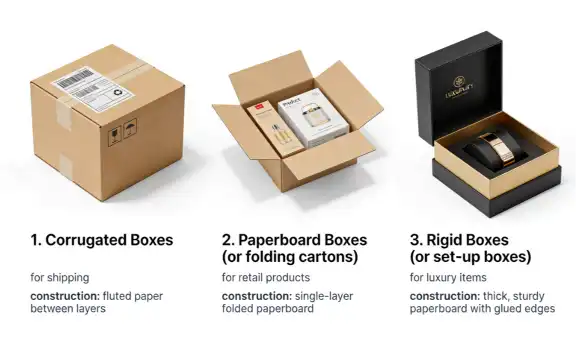
Understanding these three categories is fundamental for any packaging designer. I have spent years working with all three, and they serve completely different purposes. One is for pure strength, one is for retail shelves, and one is for creating a premium experience. Choosing the wrong one is like using a hammer to turn a screw; it just will not work effectively. Each type solves a different problem for the brand and the customer.
1. Corrugated Boxes
These are the workhorses. Made with that wavy inner layer, which we call the "flute," their entire purpose is strength and protection during shipping. They are the "infrastructure" product I mentioned—essential, low-cost, but not glamorous. Their value is in performance, not looks.
2. Paperboard Boxes (Folding Cartons)
Think of a cereal box or a toothpaste box. This is paperboard. It is a single layer of paper pulp that is pressed and dried. It is lightweight, prints beautifully, and is designed to grab attention on a shelf and inform the customer. Branding is its primary job.
3. Rigid Boxes
These are the premium players, like the box for a new iPhone or a luxury watch. They are made from thick chipboard wrapped in paper or other fine materials. They do not fold flat and are all about creating a high-end unboxing experience. They communicate quality and value, not just transport efficiency.
What is a big cardboard box called?
Struggling to name a very large box for your project? Calling it just a "big box" can cause confusion and quoting errors. I'll give you the professional terms.
A big cardboard box is often called a Gaylord box, pallet box, or bulk cargo container. These terms describe large, heavy-duty corrugated containers designed to hold bulk quantities and fit perfectly on a standard shipping pallet.
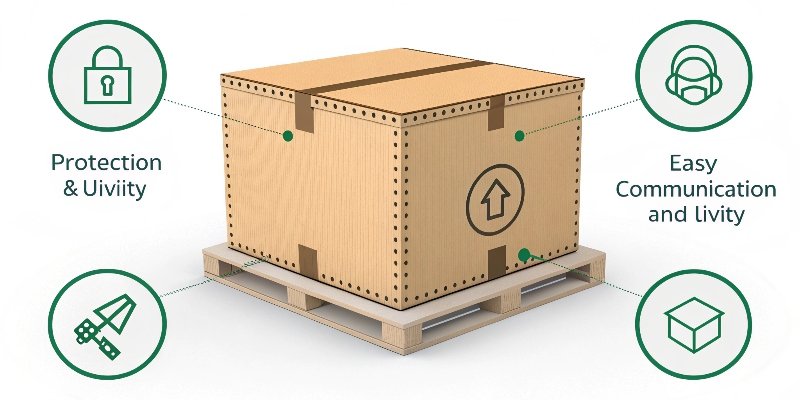
When you move from shipping individual master cartons to shipping goods in bulk, the terminology changes. These are not just scaled-up versions of a small box. They are engineered systems for logistics. After more than a decade in packaging, I have seen these containers handle everything from plastic resins to agricultural produce. Their design is all about maximizing space on a truck or in a warehouse and minimizing handling costs. They are a perfect example of how packaging is critical to the supply chain.
Common Names for Large Boxes
- Gaylord Box: This is a very common trade name that has become a generic term in the industry. It refers to a pallet-sized corrugated box. It is usually multi-walled, often with two or three layers of corrugated board, for extra strength to handle immense weight.
- Pallet Box / Bin: This is a more descriptive name. It simply means a box designed to fit the dimensions of a pallet, such as 48x40 inches in the US. It makes moving hundreds of kilograms of product with a forklift incredibly simple.
- Bulk Cargo Container: This is a broader, more formal term. It covers any large container for shipping bulk materials, with Gaylord boxes being a prime example in the corrugated world.
The key here is efficiency at scale. These boxes reduce handling time and protect large volumes of product during transit.
What do Americans call cardboard?
Do you work with American clients? A small difference in vocabulary can create big misunderstandings in your packaging designs. I'll clarify what "cardboard" means in the US market.
In the United States, "cardboard" is a casual, generic term used for almost any stiff paper-based material. This includes corrugated fiberboard (for shipping boxes) and paperboard (for cereal boxes). For professional clarity, it is always better to specify "corrugated" or "paperboard."

Navigating international business means understanding these small but important language differences. I remember a project early in my career where a US client kept saying "cardboard," and my team in Asia was thinking of simple, thin paperboard. This led to a lot of back-and-forth to clarify the material's strength requirements. It was a simple lesson: never assume, always clarify. As a designer like Peter, who works with global clients, being precise is your best tool. The term "cardboard" in American English is a catch-all. It's what the general public says, not what a professional should rely on.
American English vs. Professional Terms
Here is a simple way to think about it to avoid confusion:
| Common American Term | What It Can Mean | The Professional Term to Use |
|---|---|---|
| "Cardboard" | A brown shipping box. | Corrugated Box |
| "Cardboard" | A cereal box or retail carton. | Paperboard / Folding Carton |
| "Cardboard" | The thick back of a notepad. | Chipboard |
When you are in a design meeting with an American partner, if they say "cardboard," your next question should always be, "Do you mean corrugated for shipping, or paperboard for a retail carton?" This simple question saves an incredible amount of time and prevents costly errors down the line.
Conclusion
In packaging, knowing the right name for a box is crucial. Using precise terms like "corrugated" or "RSC" ensures clarity, avoids costly mistakes, and shows your professional expertise.


